Yes the placebo was shit but I think other trials found similar results and it’s confirmed by Mendelian randomization and association studies. Also seen in animal models. That’s why I’m more confident regarding EPA.
2 Likes
Results: The overall mean (SD) for the Omega-3 Index in these 10 cohort studies was 6.1% (2.1%), and the HR for a 1-SD increase was 0.85 (95% confidence interval, 0.80-0.91). Median quintile 1 and 5 levels were 4.2% vs. 8.3%, respectively. Based on these values, we estimate that risk for fatal CHD would have been reduced by about 30% moving from an Omega-3 Index of 4%-8%.
Conclusions: These findings support the use of <4% and >8% as reasonable therapeutic targets for the Omega-3 Index.
I find the convincing research against DHA use hard to reconcile with Omega 3 index research. I could not find MRs or RCTs that target omega 3 index specifically. Though I suppose the MRs on omega 3 work as a proxy to blood levels anyways?
Perhaps one should target 8%+ omega index using EPA-only supplementation if needed. Another possibility is that 8%+ omega index only matters as a proxy for sufficient fatty fish intake, and the omega index itself is not actually the risk factor (so supplementing to achieve 8%+ does not help)
3 Likes
The omega index is the sum of EPA + DHA in the red blood cells. Maybe all what matters is DHA in the brain and serum EPA and therefore the omega 3 index is just a poor proxy? (I don’t know, I might be making things up)
But didn’t PREVENTE4 find that DHA indeed accumulated in the brain but had no effect there?
1 Like
This phenotype would basically be high RBC EPA and low RBC DHA. I don’t know if such a study exists comparing it with other ratios.
In these omega 3 index study, did they adjust for income and educational attainment? If not, maybe the omega 3 index is just a proxy for fish consumption which itself is probably associated with higher income and education? It could also be that something else than EPA + DHA is beneficial in fish (starting with: when you eat fish you don’t eat red meat).
There maybe also be subgroups that don’t benefit from supplementation because of some poor processing.
I’d like to see association studies (adjusted for income, education, race, smoking status, alcohol, BMI, physical exercise and comorbidities) looking at serum EPA, DHA, and DPA (separately) and RBC EPA, DHA, and DPA. But from what I remember even the UK Biobank didn’t have that kind of granularity. Maybe the ratios matter as well?
2 Likes
This 2024 study adjusted for income, education, and physical activity and, surprise, they found a U-shape curve for DHA with higher CVD and IHD mortality at high levels: How much omega-3 do you need? - #53 by adssx
Unfortunately, DHA is the only specific omega-3 fatty acid level available in the UK biobank. But we could look at “Non-DHA omega 3 PUFA”. Omega 3 PUFAs = 50% DHA + 25% DPA + 20% EPA + 5% others (mostly ALA). So, “Non-DHA omega 3 PUFAs” would be a good proxy for “DPA + EPA”.
4 Likes
EPA seems much more important for mental effects than DHA, though people think that because brain has more DHA in it then supplemental DHA is more important. However pretty much all studies using omega 3 that have found positive benefits in things like depression, cognition or ADHD use mainly EPA at higher ratio or only EPA altogether
4 Likes
Yes, we have a thread about this, and now the mechanism of action might be known: Omega 3 makes me depressed: why? - #124 by adssx
1 Like
The tide is slowly turning on DHA:
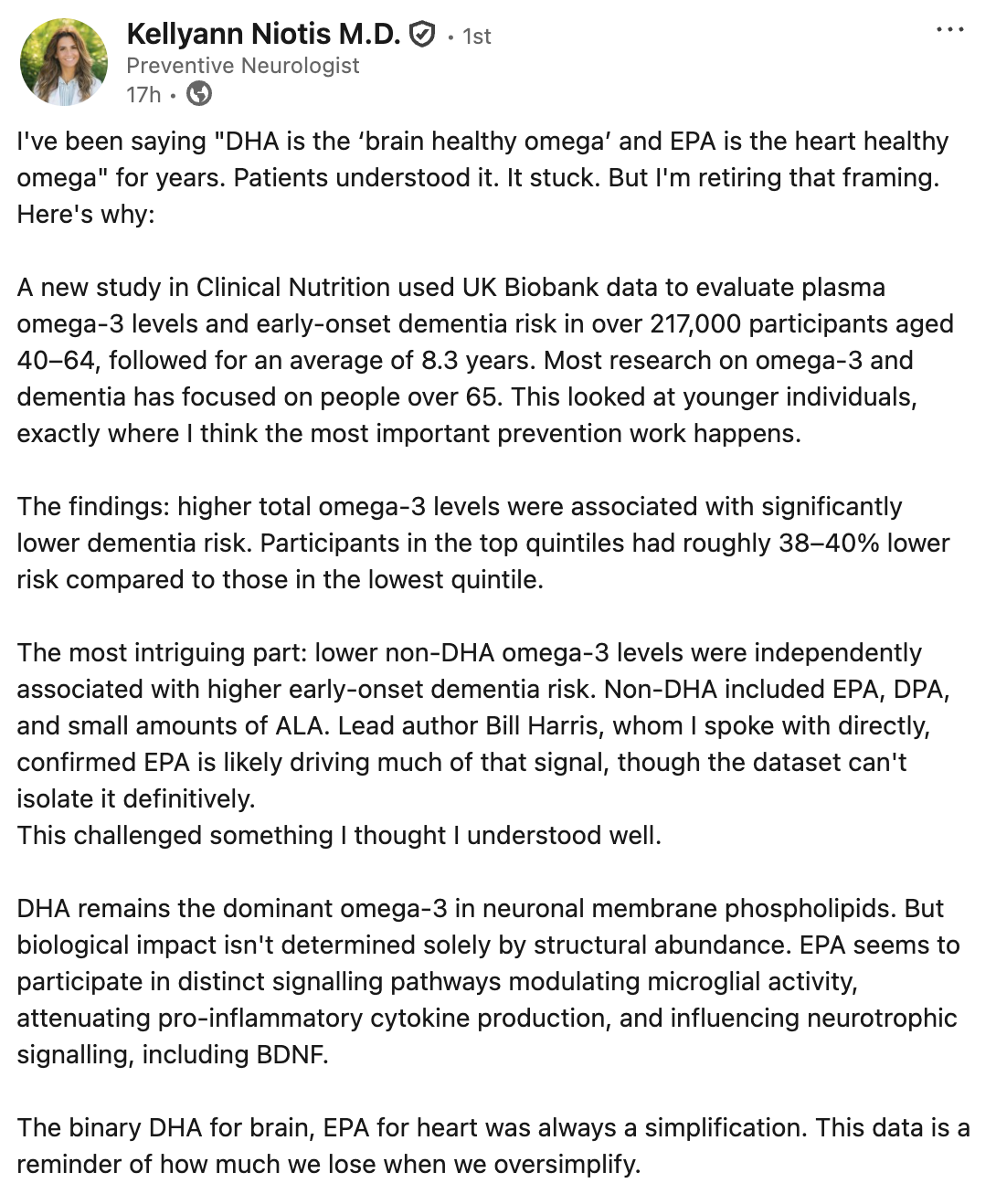
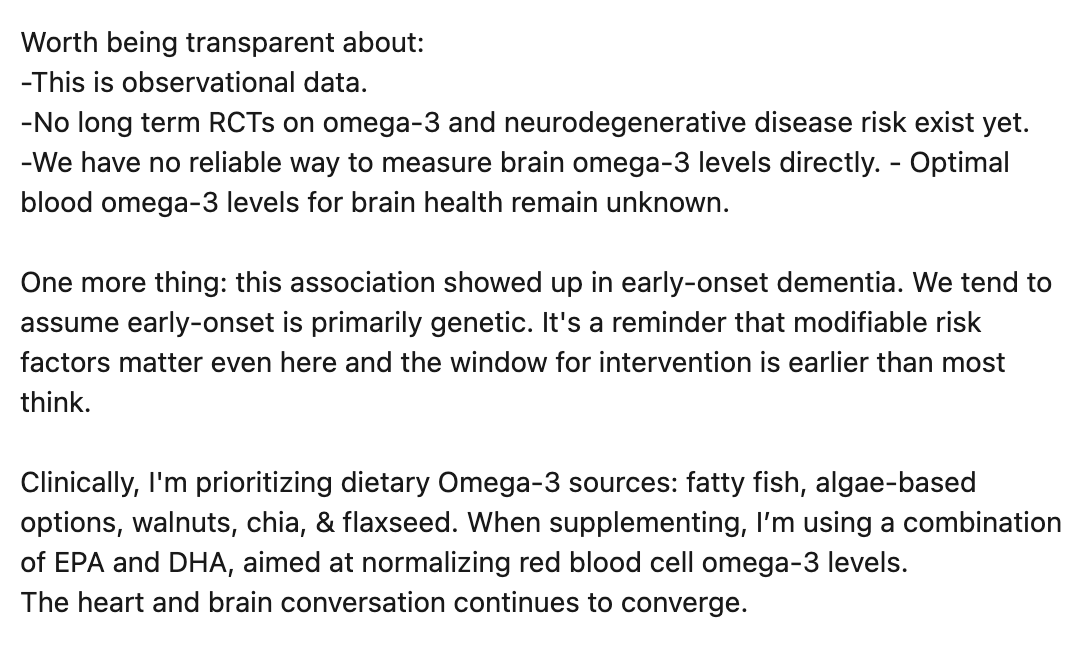
LinkedIn: Blood omega-3 is inversely related to risk of early-onset dementia - PubMed | Kellyann Niotis M.D.
Paper: Blood omega-3 is inversely related to risk of early-onset dementia 2026 (the statistically significant lower-risk pattern was seen especially for non-DHA omega-3, unfortunately they didn’t look at EPA only)
3 Likes
Once again, exercise is a top contender for health and lifespan. I am once again exercising regularly at the gym. But, if a pill could replace the gym I would jump on board. Decades of going to the gym makes going to the gym a boring chore.
3 Likes
There’ve been interviews with terminal care nurses, and they share their experiences of talking to those who are dying. There’s a common thread of “nobody wished they’d have spent more time at the office, most regret not spending more time with family, friends and cultivating human relationships”. I somewhat feel the same way about exercise - I’m unlikely to wish that I’d had spent more time at the gym. I still do exercise, but strictly for health. To me, exercise is a chore, but the issue is not boredom, it’s the loss of time. I’d much rather spend the time differently. Of course, it’s different if you love or enjoy exercise (which I definitely don’t!), then you might think of time spent exercising as a great way of spending your time. YMMV.
1 Like
Preprint was published last year: PreventE4: A Double-Blind Placebo Controlled Clinical Trial Testing High Dose DHA in APOE ε4 Carriers Before the Onset of Dementia 2025
Background: APOE ε4 carriers have increased Alzheimer’s disease risk and altered docosahexaenoic acid (DHA) metabolism. No large-scale prevention trials have tested high-dose DHA supplementation specifically in cognitively intact APOE ε4 carriers for early intervention.
Methods: PreventE4 was a 24-month, randomised, double-blind, placebo-controlled trial (NCT03613844) conducted at University of Southern California between September 2018 and May 2024. Participants aged 55-80 years with normal cognition, low dietary DHA intake (<200 mg/day), and ≥1 dementia risk factor were stratified by cerebrospinal fluid (CSF) collection willingness into lumbar puncture (LP) or no-LP arms. Within each arm, participants were randomised 1:1 to receive 2 g/day DHA or placebo. Primary outcome was 6-month CSF DHA-to-arachidonic acid (AA) ratio change in LP arm. Secondary outcomes included 24-month hippocampal volume and cortical thickness changes. Exploratory outcomes included cognitive performance via Repeatable Battery for Assessment of Neuropsychological Status (RBANS). Analysis used intention-to-treat with mixed-effects models.
Findings: From 739 screened individuals, 365 participants were randomised (181 LP arm, 184 no-LP arm). Mean age was 66.4 years (SD 5.7), 210 (58%) female, 142 (39%) Hispanic, 171 (47%) APOE ε4 carriers. DHA supplementation increased CSF DHA/AA ratio at 6 months versus placebo (0.17 [95% CI 0.15-0.18] vs -0.02 [95% CI -0.03 to -0.0004]; difference 0.19 [95% CI 0.16-0.21]; p<0.0001), independent of APOE ε4 status (interaction p=0.71). No treatment differences occurred for hippocampal volume (left: -0.26% [95% CI -1.43 to 0.91], p=0.55; right: 0.32% [95% CI -0.47 to 1.11], p=0.38) or cortical thickness over 24 months. RBANS scores improved modestly in both groups (+2.73 [95% CI 1.58-3.88]; p<0.001) with no treatment effect (0.22 [95% CI -1.05 to 1.49]; p=0.70). Trial experienced 38% dropout, primarily due to COVID-19.
Interpretation: High-dose DHA achieved brain target engagement but did not modify structural or cognitive outcomes over 24 months, suggesting biochemical brain DHA changes alone may be insufficient for dementia prevention.
3 Likes
Does concurrent supplementation with select B vitamins (B3, B6, B12) change the picture? Or concurrent supplementation with brain penetrant antioxidant cell membrane stabilizers like certain carotenoids (astaxanthin etc.)? When you consume certain fish, carotenoids come bundled in with the various forms of fish oil. Look at choline. Fish come with choline. Supplementing with choline by itself can raise TMAO levels. Fish already have TMAO, and can raise blood levels, at least transiently(*). Yet in general, there doesn’t seem to be evidence of increased atherosclerosis as a result of fish consumption, even though TMAO otherwise can be an exacerbating factor in CVD. Perhaps the supplementation with fishoil alone is suboptimal insofar as its effects are not modified by other molecular constituents found in whole fish. Maybe stick to modest fish consumption?
(*) Circulating trimethylamine N-oxide levels following fish or seafood consumption
1 Like
I don’t understand your question. In the trial, “All participants are also provided and given instructions to take one vitamin B complex supplement”.
1 Like
I would’ve been interested in another arm without the B-vit supplementation. That way, you could be justified in the “alone” claim, otherwise I don’t see how you can claim “alone”, if a study can show differential effects of (fishoil + vit.B) vs (fishoil). I would also like to see (astaxanthin + Fishoil) vs (astaxanthin) vs (fishoil) - all of these in one trial, not just different trials with separate supplementation.
1 Like
A girl can dream!
1 Like
Fish is a complex biological package, not just a vehicle for EPA and DHA. When you eat fish, you are consuming a synergistic “food matrix” that includes:
- High-quality, easily digestible protein
- Crucial trace minerals like selenium and iodine
- Vitamin D and B vitamins
- Astaxanthin, a potent antioxidant (found in pink fish like salmon and trout) that naturally protects lipids from damage.
These compounds work together to lower systemic inflammation. Furthermore, eating fish fundamentally improves your overall diet through the displacement effect. A dinner of sardines or salmon naturally replaces a meal that might otherwise feature red meat or highly processed foods. Taking a supplement alongside a poor diet does not correct the underlying dietary pattern.
But, then again when I eat fish, I eat fish & chips.
5 Likes
Final paper, in eBioMedicine: CNS target engagement of high-dose DHA supplementation in older adults at risk for dementia: a randomised, double-blind, placebo-controlled trial 2026
There are a lot of additions / changes compared to the preprint: https://papers.ssrn.com/sol3/papers.cfm?abstract_id=5456486 Here are some in bold:
High-dose DHA achieved CNS target engagement in non-demented older adults with low baseline omega-3 intake, independent of APOE ε4. Despite biochemical target engagement, no differences in cognition or brain structure were observed over 24 months. Future research should prioritise brain DHA metabolism over further supplementation trials.
DHA supplementation as monotherapy may be insufficient when multiple pathophysiological processes drive neurodegeneration and alter the fate of DHA in the brain
Incorporating more sensitive markers of neurodegeneration, including plasma phosphorylated tau, neurofilament light chain, advanced imaging markers (e.g., DHA PET), or detailed neuropsychological assessments targeting subtle executive function changes could improve the detection of treatment effects.
While 24-month trials are feasible and commonly used, the stability of outcomes in healthy populations over this period may necessitate either longer trials (36 months or longer as suggested by LipiDiDiet extended follow-up).
Future work should shift from uniform supplementation toward mechanistic studies of brain DHA metabolism and personalised multimodal strategies that integrate genotype, lipid and inflammatory biomarkers, and more sensitive CNS endpoints to identify the subgroups most likely to benefit.
1 Like
Here’s a pop-sci article on that study:
Fish Oil Doesn’t Protect Aging Brains? Not Even High-Dose DHA Supplements Improved Memory In 2-Year Trial
Here’s what I am wondering - many advocates of DHA supplementation (such as Nick Norwitz) explain away apparent failures of supplementation as down to most forms of DHA not actually reaching the brain. Does this study alter any of that explanatory framing, given that now we see supplemental DHA actually definitely reaching the brain and yet still not being helpful in key dementia metrics. As I recall, there’s even a company promoted by Nick Norwitz that sells (at a very steep markup!) a special form of DHA which supposedly definitely gets into the brain as an anti AD supplement.
I suppose now it could be argued that “enzymes in the brain may actively break down DHA after it arrives, possibly undoing any benefit before it can build up”, but that’s a new explanation trying to rescue the explanation that failed, and it too would need some kind of evidence beyond a simple assertion.
All in all this does not look encouraging for the ApoE4 carriers hoping to prevent, slow down or ameliorate AD/dementia through DHA supplementation. I’d say there’s more hope for rapamycin in this context than DHA, although of course we would need some good extended human trials to show effects either way.
1 Like