Probably even more true with the massive budget cuts in science and at universities in the USA this year:
Two conversations have stayed with me over the past 25 years. Around 2001, a European Union official in Beijing — where I was then a UK diplomat — told a group of us that the reason countries such as Germany, France and the United Kingdom were allowing technology transfer to China was to see a day when the nation could return the favour. And, in 2017 in Austria, a retired UK security official stated wearily that if there was one constant in policymaking towards China, it was to perpetually be five to ten years behind the times.
Those points resonate in 2025. China has become an important player in research and development (R&D). Yet, most of the outside world has still not woken up to this fact.
On 23 October, China’s Communist Party announced that, for the next five years, it will focus on “high-quality development”with “innovation as the fundamental driving force”. This will require, it says, “substantial improvements in scientific and technological self-reliance and strength” (see go.nature.com/4ahcvj8). Policymakers should take this statement seriously for three reasons.
First, China has an incentive. At a meeting a few days later, Chinese President Xi Jinping and US President Donald Trump agreed to halt their tariff wars and trade skirmishes. But China knows that its technological dependence on the United States and others is a vulnerability, and that it needs to become autonomous.
Second, it is not just words but hard cash that the Chinese government is committing to achieving its goals. The nation’s R&D investments increased nearly sixfold between 2007 and 2023, overtaking the EU’s and coming close to US figures (see go.nature.com/4a2xres). The latest plans indicate that this trend is set to continue.
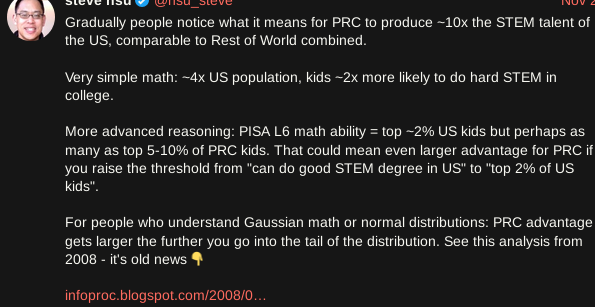
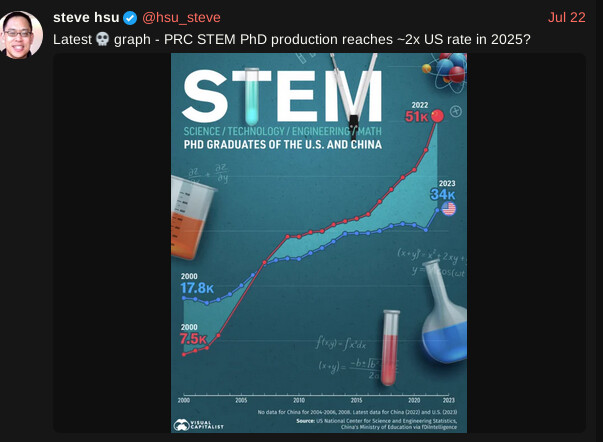
And third, China has the human capital, too. In 2020, the nation produced 3.6 million graduates in science, technology, engineering and mathematics (STEM), compared with 2.6 million in India and 820,000 in the United States (see go.nature.com/4ppekyx). And, in 2022, some 50,000 people in China graduated with STEM PhDs, compared with 34,000 in the United States (see go.nature.com/4iedi4z). China’s leading universities, including Fudan in Shanghai and Tsinghua in Beijing, rank highly on global lists.
Most people in the US, if they think of China at all, still think of China as a backwater under developed country. They have no idea how China has had the STEM pedal to the metal for the last 30 years and are now leaping into the future at warp speed, while Trump and QANON have been doing more damage to the fabric of our society, including our ability to advance technologically and have low cost energy, than a foreign enemy could ever accomplish on their own.
China is graduating more scientists and engineers than we are graduating Lawyers and we graduate a lot of lawyers and very little US born scientists and engineers. And now Trump is chasing away all the foreign born engineers and scientists. The ability to attract the brightest from other countries and have a huge diversity of ideas and people use to be our super power.
The US is accelerating to being a colony of China, sending our raw materials to them and paying to get finished manufactured goods from them. I remember from 5th grade, that’s the definition of a 3rd world country.
This is going to be the hardest thing to recover from after we finally depose Trump and kick all the anti-science people out of the government.
In theory, given the almost infinite scalability of AI, the small number of STEM graduates would seem to be a problem that is something that could be overcome with greater application of AI. Of course, things are more complex in the real world, but it is what the AI/Accel people are proclaiming.
I remember an article in Popular Mechanics from the 80’s about the CEO of a large US TV mfg visiting a Chinese TV factory. He asked the guide who all the people in the white lab coats were, as the workers were dressed in blue.
The guide replied, these are our engineers…
The CEO was more than impressed and a bit terrified. When he came back to the US in a board meeting he said, we have already lost the race and don’t even know it, they have more engineers in 1 plant than we have in the whole company.
20 years ago, when I first visited mainland China, it felt like it was 30 years behind the USA. It was like stepping into the 1970s. This year, it feels like China is 10 years ahead of the USA, and I am stepping into the future. In reality, China has been moving forward while the USA has been stagnating. The only things that feel more advanced in the USA are AI (questionable) and social media (China regulates it highly, and I don’t know Chinese, so I cannot really tell), IMHO. Food, shopping, transport, payment systems, robotics, and general technology are all ahead of where the USA is today.
On the flip side, the Chinese consumer refuses to spend, causing a deflationary spiral and, the economy is only being held up by exports which is probably why tariffs are such a big deal.
I wonder if we will see Chinese grey market sources for these drugs like we do for drugs developed in other countries? I bet there would be much harsher penalties for those trying to sell them.
I think we will see this in the future if Chinese medications start to be seen as good as good Indian generics, or drugs from Europe or the US. I can see small online pharmacies in China selling products online just as they do in India, though the language barrier may be a little larger (but with AI, that is going away). I don’t really think the countries care if people ship these medications out of the Country; India does’t care (hey, it’s revenue for its citizens, all good). I’m suspect the same would be for shipping out of China.
The countries that care are the ones on the importing side, and who have drug companies they need to protect (and also secondarily they don’t want to see their citizens harmed by low quality medicines).
Cruising along a raised highway in eastern China, Marcus Hafkemeyer takes his hands off the wheel and smiles as the car indicates, brakes softly and changes lanes itself. “I’m very proud,” he says.
The German engineer is demonstrating Volkswagen’s rapid progress in offering assisted driving functionality to customers in China. Later, in an underground car park, the vehicle remembers its designated space and reverses effortlessly into the spot.
The technology, a forerunner to completely driverless cars, has taken the German company about 18 months to develop, test and now commercially deploy — all in China. It is the fruit of a 700-person research and development team comprised mostly of Chinese software engineers with masters or PhDs and more than five years’ experience.
Asked how long it would have taken to deliver something similar back home, Hafkemeyer, who worked with Audi, Chinese state-owned auto group BAIC and tech giant Huawei before joining VW in 2022, sighs with exasperation. Typically, he says, the technology development cycle in Germany is a slog of around four to four-and-a-half years, where ideas are bogged down in endless internal debate and commercial negotiations with suppliers.
“This country has in the last 10 years moved from third gear to fifth gear and is going full speed,” he says. “I still hear in the news ‘the Chinese are coming with their cheap cars flooding the European market’. I’m telling you, come here, look at these ‘cheap cars’. They are full of technology. Their quality is so good.”
After years of state, corporate and academic efforts to alleviate basic vulnerabilities, China’s advances are now setting up the country to dominate future global supply chains for energy and transport.
Compounding inertia in the west are the sweeping cuts to US science funding made by Donald Trump since he returned to the White House, a move that threatens to undermine the innovation that has been central to the country’s economic strength for decades.
It appears that the USA is voluntarily giving up scientific leadership. Oh well, it was good while it lasted.
The U.S. Is Funding Fewer Grants in Every Area of Science and Medicine
A quiet policy change means the government is making fewer bets on long-term science.
In the past decade, the National Institutes of Health awarded top scientists $9 billion in competitive grants each year, to find cures for diseases and improve public health .
This year, something unusual happened…. Starting in January, the Trump administration stalled that funding. By summer, funding lagged by over $2 billion, or 41 percent below average.
But in a surprising turn, the N.I.H. began to spend at a breakneck pace and narrow this gap.
There was a catch, however: That money went to fewer grants.
Which means less research was funded in areas such as aging, diabetes, strokes, cancer and mental health.
To spend its budget, the N.I.H. made an unusual number of large lump-sum payments for many years of research, instead of its usual policy of paying for research one year at a time.
As a result of this quiet policy shift, the average payment for competitive grants swelled from $472,000 in the first half of the fiscal year to over $830,000 in the last two months.
While this might sound like a boon for researchers, it’s actually a fundamental shift in how grants are funded — one that means more competition for funding, and less money and less time to do the research.
I still question China’s quality. There are many good sources, but there are too many bad sources that make me concerned. I’ll stick with India for now.