All this time I’ve been taking my medications and supplements within an hour or so window of a smoothie filled with high viscosity soluble fibers (psyllium, inulin, chia, apple, avocado). And only now I’m finding out that I may have been significantly reducing the absorption of the meds/supplements by doing that
Another idea…
Chia seed pudding with yoghurt
We all love a chia seed pudding. But according to Dr Karan Rajan (Superpower’s Medical Director) we should be using yoghurt, not water.
Why?
When you mix chia into yoghurt, the protein, fat, and probiotics slow how the seeds hydrate and release fibre.
That means fermentation happens deeper in the colon, producing a gentler, more balanced short-chain fatty acid profile (more butyrate, more propionate), boosting omega-3 absorption, and adding the perks of dairy’s live cultures and bioactive peptides.
Bottom line: both water or yoghurt-based chia pudding is good, but if you want to squeeze out every benefit, yoghurt wins.
Check out his reel:
For more gut health & microbiome tips follow —> @loamscience
Chia in yoghurt works “better” than in water because the protein, fat, and probiotics in yoghurt slow how the seeds hydrate and release fibre.
This delays fermentation to deeper in the colon, producing a gentler, more balanced SCFA profile (more butyrate/propionate), improves omega-3 absorption, and adds synergistic benefits from dairy’s live cultures and bioactive peptides!
That being said…do whatever you want because chia is great either way!
6 Likes
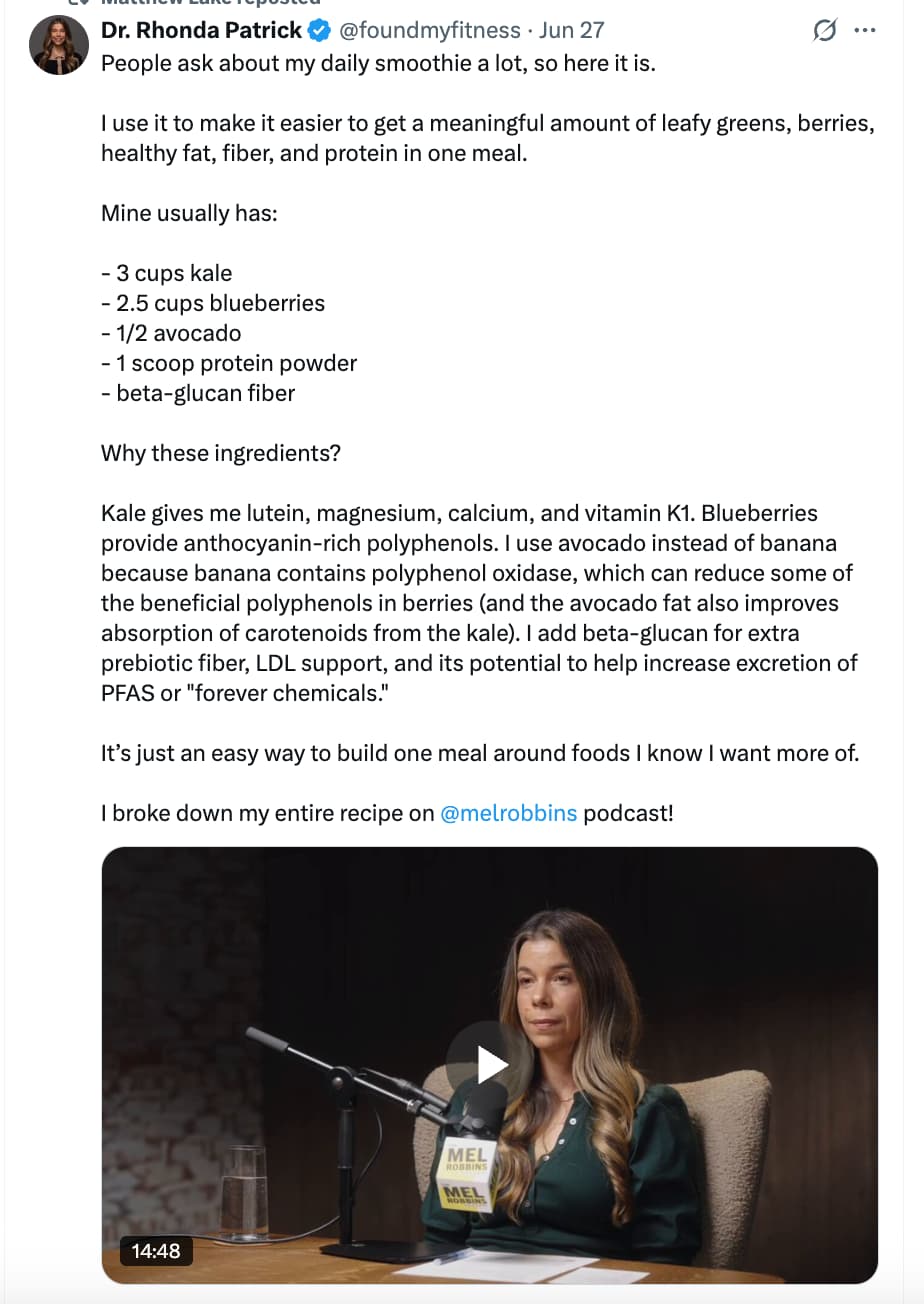
Based on the transcript provided, here is the complete breakdown of Dr. Rhonda Patrick’s daily longevity smoothie recipe exactly as formulated and discussed in the video.
Core Ingredients & Quantities
- 3 cups Raw Kale: Packed firmly into a standard measuring cup. Chosen for its high content of lutein, magnesium, calcium, and vitamin K.
- 2.5 cups Frozen Blueberries: Preferably organic to minimize pesticide exposure. Frozen berries are used to keep the smoothie cold and thick. Rich in anthocyanin polyphenols.
- 1/2 Avocado: Replaces the traditional banana. The monounsaturated fats inside the avocado create a creamy texture and increase the intestinal absorption of the kale’s carotenoids (lutein and zeaxanthin) four-fold.
- 3 tablespoons Barley Beta-Glucan Powder: A soluble, fermentable prebiotic fiber used to feed beneficial gut bacteria, lower LDL cholesterol, and assist in clearing persistent environmental toxins (PFAS “forever chemicals”) from the body.
- 1 to 1.5 scoops Whey Protein Powder: Specifically using Momentous brand in the video (which provides approximately 23 to 35 grams of clean protein without gut-disrupting fillers) to satisfy daily target requirements.
- Water: Added contextually at the end to achieve the preferred blending consistency.
Mentioned Modifications & Variations
- Optional Addition (Carrots): Dr. Patrick notes that she frequently adds whole carrots to this specific blend to further upgrade the carotenoid profile with beta-carotene.
- Strictly Excluded (Bananas): Bananas are explicitly banned from this recipe. Bananas contain high levels of the enzyme polyphenol oxidase (PPO), which rapidly degrades and neutralizes the health-promoting polyphenols found in the blueberries.
Preparation & Equipment Note
- Blender Selection: Dr. Patrick strongly advises using a glass or metal blender carafe rather than a plastic one. High-velocity blending creates heavy internal friction, causing plastic carafes to mechanically shed microplastics directly into the finished smoothie.
4 Likes
What brand of Barley Beta-Glucan Powder is in her smoothie? Is it the same as Barley Grass powder by Micro ingredients?
1 Like
Beta glucan lives in the endosperm of barley. It’s close to 80%. So they beat it out of the grain. I think barley grass powder is made of young barley grass, which would have no beta glucan at all.
2 Likes
The brand of the barley beta-glucan powder is not mentioned in the interview.
Throughout the discussion, Dr. Rhonda Patrick and Mel Robbins refer to it generically as “a beta glucan powder made from barley” or “prebiotic fiber… isolated from barley” without specifying or endorsing any commercial brand.
While Dr. Patrick explicitly names Momentous as the brand for her whey protein powder (noting she had no official affiliation with them at the time), she keeps the barley beta-glucan completely generic in the dialogue, focusing purely on its mechanisms for lowering LDL cholesterol and aiding in the excretion of toxic PFAS “forever chemicals.”
1 Like
FWIW…
A starting point.
AI-generated answer.
Please verify critical facts.
Barley beta-glucan powder is a concentrated soluble fiber ingredient rich in beta(1→3)(1→4)-D-glucan , extracted from barley cell walls using environmentally friendly, non-chemical processes. It is primarily used in dietary supplements and functional foods to support cholesterol management and post-meal glycemic response .
The mechanism of action involves increasing gastrointestinal viscosity, which forms a gel in the small intestine that binds to bile acids and promotes their excretion, forcing the liver to use blood cholesterol to produce new bile acids. Clinical evidence and regulatory approvals from the FDA , Health Canada , and the EFSA support its efficacy, particularly when daily intake reaches approximately 3 grams of beta-glucan under defined diet conditions.
Key considerations for use include:
- Dosage Conversion : Products vary in potency (e.g., 60% to 80% beta-glucan); consumers must calculate powder grams based on the Certificate of Analysis to ensure they meet the effective dose.
- Processing Impact : High molecular weight and viscosity are critical for efficacy, as heat or shear during manufacturing can degrade the fiber’s functional properties.
- Gluten Content : As it is derived from barley, the powder contains gluten and is not suitable for individuals with celiac disease or gluten sensitivity.
- Common Brands : Commercial supplements such as Cerabeta , NutraStat , and Barley Balance utilize patented air-current separation technologies to extract the fiber without solvents or enzymes.
AI-generated answer.
Please verify critical facts.
2 Likes
Note:
Depending on the brand and extraction, 3 tablespoons of beta glucan powder generally weigh between 13.2 grams and 27 grams.
Because density varies by manufacturer, it is best to check your specific product label, but here are a few common examples: [1]
- NutraStat Barley Beta-Glucan: 3 tablespoons equal 13.2 grams (providing roughly 5g of total dietary fiber).
- Cerabeta Barley Beta-Glucan: 3 tablespoons equal 13.2 grams.
- PromOat Oat Beta-Glucan: 3 tablespoons of heaped powder would weigh approximately 27 grams(as 1 heaped tablespoon weighs about 9 grams)
Commercial Providers and Pricing
A market analysis for pure barley-isolated beta-glucan powder in the consumer retail sector reveals an exceptional level of market consolidation. Following the strict exclusion of scientific, analytical, and reagent-grade laboratory suppliers (such as Megazyme, CarboMer, and Sigma-Aldrich), the open retail market across the United States is essentially a monopoly controlled by a single parent producer, Sunny Boy Foods, which manufactures under the NutraStat and Cerabeta brand names using an identical air-milled extraction patent.
Consequently, a true “Top 10” list of distinct consumer brands does not exist under your strict inclusion criteria. The entire landscape of currently active, in-stock retail options with direct “Add to Cart” links is compiled below and ranked by the lowest cost per standardized 13-gram serving.
Sourcing Analysis Matrix
| Rank | Brand Name | Vendor | Form (Powder/Sachet) | Total Grams | Price (USD) | Cost/13g Dose |
|---|---|---|---|---|---|---|
| 1 | NutraStat Soluble Fiber - Value Bag | NutraStat Official | Powder (Bag) | 370g | $44.95 | $1.58 |
| 2 | NutraStat Soluble Fiber - Small Bag | NutraStat Official | Powder (Bag) | 185g | $22.95 | $1.61 |
| 3 | Cerabeta Barley Beta-Glucan Concentrate | GoSupps | Powder (Canister) | 140g | $54.99 | $5.11 |
| 4 | Cerabeta Daily Supplement Powder | eBay (Liquidator) | Powder (Canister) | 140g | $59.99 | $5.57 |
Procurement Notes
- The Bulk Winner: The NutraStat 370g Value Bag represents the largest consumer-facing retail package available on the open market. It serves as the default bulk winner by virtue of market scarcity, as no 1lb or 2lb standalone consumer bags are currently manufactured for direct retail sale.
- Price-Per-Gram Advantage Evaluation: The standard retail canister size for this compound is 140g (4.9 oz), rather than a 7.4 oz canister. Comparing the NutraStat 370g bag to the retail Cerabeta 140g canister reveals a massive 69% price-per-gram reduction ($0.121/g vs. $0.392/g). This disparity is primarily driven by third-party importing and cross-border distribution markups, as NutraStat dropships directly from production facilities.
Dr. Patrick is using Cerabeta, which is made from organic barley.
1 Like
I’m seeing 140g of Cerabta BB-G for $22.95.
1 Like
Updated pricing analysis:
| Rank | Brand Name | Vendor | Form (Powder/Sachet) | Total Grams | Price (USD) | Cost/13g Dose |
|---|---|---|---|---|---|---|
| 1 | NutraStat Value Bag (Subscription) | NutraStat Store | Powder | 370g | $28.48 | $1.00 |
| 2 | NutraStat Small Bag (Subscription) | NutraStat Store | Powder | 185g | $14.54 | $1.02 |
| 3 | NutraStat Value Bag (One-Time) | NutraStat Store | Powder | 370g | $31.64 | $1.11 |
| 4 | NutraStat Small Bag (One-Time) | NutraStat Store | Powder | 185g | $16.16 | $1.14 |
| 5 | NutraStat 4-in-1 Soluble Fiber | Well.ca | Powder | 185g | $17.35 | $1.22 |
| 6 | NutraStat 4-in-1 Natural Fiber | Sweet & Sprouted | Powder | 185g | $17.59 | $1.24 |
| 7 | Cerabeta 4.9oz Pouch | eBay (1st Global Wholesale) | Powder | 140g | $14.21 | $1.32 |
| 8 | Cerabeta Canister (Subscription) | Cerabeta Store | Powder | 140g | $14.54 | $1.35 |
| 9 | Cerabeta 3-Pack Bundle | Cerabeta Store | Powder | 420g | $43.65 | $1.35 |
| 10 | Cerabeta Canister (One-Time) | Cerabeta Store | Powder | 140g | $16.16 | $1.50 |
Procurement Notes
Bulk Winner Evaluation
The NutraStat 370g Value Bag (Subscription) stands as the current commercial volume leader available to consumer procurement channels. When cross-referenced against a standard retail 7.4 oz (209.8 g) canister baseline priced at a market average of $24.99 ($0.1191 per gram), the 370 g NutraStat configuration ($0.0770 per gram) yields an absolute 35.3% price-per-gram advantage. This comfortably exceeds the 15% corporate variance threshold required to justify inventory consolidation.
1 Like
I take beta glucan 1,3 1,6 in the AM but no way I’m going to ruin a delicious blueberry smoothie with it.
2 Likes
I see no mention of raw green banana flour here. I have been using RGB flour added to my protein powder with 1 tbsp of evoo and ceylon cinnamon. I think the RS2 in RGB does its job to mantain colonic health, butyrate generation, microbial diversity and improvement in long-term insulin sensitivity.
Never tried beta glucan. Its MOA is delayed gastric emptying, lowering LDL cholesterol and acute glucose blunting. Any thing else am I missing here?
2 Likes