https://www.youtube.com/@LanceHitchings noticed a huge increase in max_HR (well above what would be predicted by his age) after stem cell infusions. He had to manually change his age on the app because the app would auto-adjust his max_HR by his age, but this auto-adjusting is wrong.
1 Like
Although there is a correlation between age and max heart rate the spread is huge, maybe he didn’t go deep enough before (to reaching your max heart rate or come close to it you need to be very fresh and do a huge effort and continue when you already really felt like dying a minute earlier)
2 Likes
Amongst elite endurance athletes, who have historically the best VO2MAX values in the world, heart rate max is all over the place.
When training/exercising, your heart will adapt to do the work. It takes months and months of training to achieve that type of adaptation. I’ve never put too much emphasis or care into max heart rate. I think a more important metric is stroke volume.
1 Like
This is an old paper, but I had not seen it. An interesting research study would be to test the impact of rapamycin on MaxHR.
I’ve found that my MaxHR is about 20 to 30 years better (i.e. 20 to 30 beats per minute higher) than the typical age-driven predictors would predict, but I haven’t monitored it closely and nor did I do pre and post testing to see the rapamycin impact. Another biomarker for people to track pre and post rapamycin (and report here).
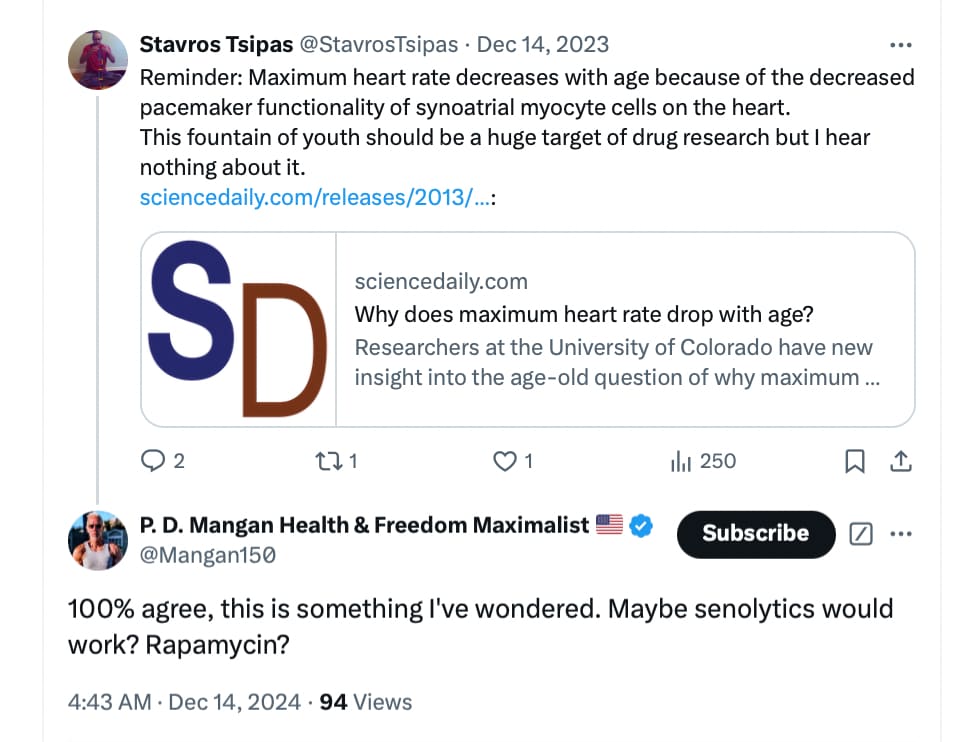
A new study by a group led by Catherine Proenza, PhD and Roger Bannister, PhD from the University of Colorado School of Medicine reports that one of the reasons for the age-dependent reduction in maximum heart rate is that aging depresses the spontaneous electrical activity of the heart’s natural pacemaker, the sinoatrial node.
A dissertation from Eric D. Larson, a graduate from Proenza’s lab in the Department of Physiology and Biophysics, is described in the article. Larson said, “I utilized a method to record ECGs from conscious mice and found that maximum heart rate was slower in older mice, just as it is in older people. This result wasn’t unexpected. But what was completely new was that the slower maxHR was because the individual pacemaker cells – called sinoatrial myocytes, or ‘SAMs’ – from old mice just couldn’t beat as fast as SAMs from young mice.”
The researchers recorded the tiny electrical signals from the isolated cells and found that SAMs from old mice beat more slowly, even when they were fully stimulated by the fight-or-flight response which can be observed in these individual cells. The slower beating rate was due to a limited set of changes in the action potential waveform, the electrical signal that is generated by the cells. The changes were caused by altered behavior of some ion channels in the membranes of the older cells. (Ion channels are proteins that conduct electricity across the cell membrane. Imagine a balloon with little tiny pinholes that open and close to let the air in and out; ion channels are like the pinholes.)
- Eric D. Larson, Joshua R. St. Clair, Whitney A. Sumner, Roger A. Bannister, and Cathy Proenza. Depressed pacemaker activity of sinoatrial node myocytes contributes to the age-dependent decline in maximum heart rate. PNAS, October 2013
My VO2Max at age 60 was 56.8. Recently tested again, age 74=48.6. I do have chronic bronchitis which has slowly crept up in its effects over the decades. Worst possible environment-grew up in heavy smoking household, smoked up until age 21, worked in numerous jobs with exposure to volatile vapors. But, at age 20, I began pretty intensive athletic fitness regimen which, I suppose, may have maintained health well at least so far. But, I think the body remembers and delivers payback to some extent as we age.
2 Likes
Pre Rapa my max HR was 170. Two years later it was still 170. A further year on and I’ve had three readings over that level, the highest of which was 180.
Note this happened in late summer hot temperatures - now it is much cooler my HR doesn’t reach much above 160 when doing HIIT, so l have a “reserve “ for when the body needs extra cooling.
Will be interesting to see where it peaks next summer.
(56y.o.)
1 Like
Sorry if this was already discussed, and most likely it was!, but how does everyone measure their vo2max?
I am not so concerned about getting the most accurate number, meaning, I don’t feel I need to go to a $$$ lab and do anything too fancy.
I’m just looking for a baseline, even if it’s not accurate, so I can track myself over the years to make sure I’m not losing ground. So I guess I’m looking for a way to track my progress accurately.
Hi Beth! You can try this Cooper Test - 12 minute run to assess your vo2max
There are many other websites where you can calculate your VO2Max based on the Cooper test
2 Likes
When I was on the job, the Fire Department tested our VO2Max every three years or so. At one test, the doctor told me I had the second-highest score. The guy with the highest score was a smoker. Go figure.
2 Likes
Some options are discussed in this thread. Typically an academic exercise physiology lab in major cities / major universities (or even community colleges) are cheap options: Budding Supercentenarians: What is your VO2Max target at age 100?
1 Like
Max HR also decrease with elevation - about 1 beat per minute for every 1000 feet of elevation
I live at nearly 7,000 ft
2 Likes
For those who have an Oura ring - there is an option to do a 6 minute walk test which calculates a VO2 max based on how far you walk in 6 minutes.
Look for the 3 bars in the top right corner and scroll down to heart health and take the test.
Mine reports as 44
2 Likes
I did my VO2 max at UC Davis Sports Medicine Clinic only because of standardized methods, their experience and comparison data they have across age groups and different athletic abilities. They have great consultation included to improve performance. I was stunned to learn that ultra athletes can have VO2 Max near 150.
1 Like
I think that’s unlikely. You might be thinking of another stat. Maybe HRV? No one has ever recorded a VO2 max over 100.
2 Likes
I had to take him at his word since I didn’t know anything about levels at the time. But I do recall he said there were some (few) that were above even ultra athlete level which I can only assume place in that category. All I do know, is I’m not one of them.
It is interesting about the standardization. When you look at the Cooper test, distance covered over 12 minutes, it doesn’t account for the reduced mobility of an older walker/runner. If you wanted an equivalent, you could put a younger person in tight jeans or a tuxedo to making him/her “equivalent” a 70 year old’s mobility when taking the test. I think using a rowing machine like Concept 2 would be a fairer standardization between age groups for VO2 max. VO2max Calculator for Indoor Rowing | Concept2
2 Likes
I don’t know if if makes any difference in the test measurements or results between equipment used, but I was hooked up to all the respiratory, CV monitoring gear and did bicycling various levels to (guess calibrate), ramp up, then flat out to failure and a bit beyond.
1 Like
1 Like
Yes, basically accurate. From Gemini:
The absolute highest laboratory-recorded VO2 max values ever reported for human athletes hover between 97.5 and 101.1 mL/kg/min. These figures represent the extreme upper ceiling of mammalian oxygen kinetics.
The two highest recorded data points in sports science literature are:
1. Kristian Blummenfelt: 101.1 mL/kg/min
In 2026, Norwegian triathlete and Olympic champion Kristian Blummenfelt disclosed laboratory testing data showing a peak value of 101.1 mL/kg/min, with an absolute oxygen uptake exceeding 7.7 liters per minute.
- Critical Nuance: While publicized by his coaching team, values exceeding 100 mL/kg/min are viewed with substantial skepticism by mainstream exercise physiologists. At these extreme margins, even minor calibration variances in metabolic carts, gas analyzers, or ambient humidity sensors can artificially inflate the reading.
2. Oskar Svendsen: 97.5 mL/kg/min
The highest peer-reviewed and widely accepted scientific baseline belongs to Norwegian cyclist Oskar Svendsen. Tested in 2012 at the University of Lillehammer as an 18-year-old junior time-trialist, he registered a verified 97.5 mL/kg/min. Svendsen later walked away from professional cycling, demonstrating that an anomalous physiological engine does not automatically guarantee sustained competitive dominance.
Aerobic Capacity Hierarchy
| Cohort | VO2 Max Range (mL/kg/min) | Physiological Reality |
|---|---|---|
| Sedentary Adults | 30 - 40 | Baseline survival kinetics; unconditioned stroke volume. |
| Recreationally Active | 45 - 55 | Developed capillary density and regular stroke volume. |
| Elite Endurance Tier | 75 - 85 | Standard professional range for cyclists, runners, and cross-country skiers. |
| Genetic Anomalies | 90+ | Structural outliers with massive left-ventricular volume. |
The Physiological Constraints
An athlete’s VO2 max is strictly governed by the Fick Equation, which dictates that oxygen consumption equals cardiac output (stroke volume multiplied by heart rate) multiplied by the arterio-venous oxygen difference (the amount of oxygen peripheral muscles can actually extract from the blood).
At values crossing 95 mL/kg/min, the limit is no longer about training volume or mental grit. The ceiling becomes structural and hereditary:
- Left Ventricular Volume: The heart must physically hold and pump a massive volume of blood per beat (stroke volume) without wall thickening that compromises diastolic filling.
- Pulmonary Diffusion Limitation: At extreme cardiac outputs, blood moves through the lungs so rapidly that it can outrun the time required for oxygen to diffuse across the alveolar-capillary membrane, causing arterial hypoxemia—meaning the lungs themselves become the bottleneck.
- Efficiency vs. Capacity: A high VO2 max does not account for fractional utilization (the percentage of that max an athlete can sustain) or gross mechanical efficiency. An athlete with an 80 mL/kg/min engine who is highly efficient often beats a 95 mL/kg/min anomaly who wastes kinetic energy.
Did a MaxVo2 test today. Better than I expected. 62 at a peak HR of 192. Cycle test which I was told runs 10% lower than treadmill. Unfortunately, I’m still recovering from knee surgery so I can’t max out my CV system on the treadmill.
3 Likes