I’ll disagree with Cole on this on some levels, on other levels he’s probably correct.
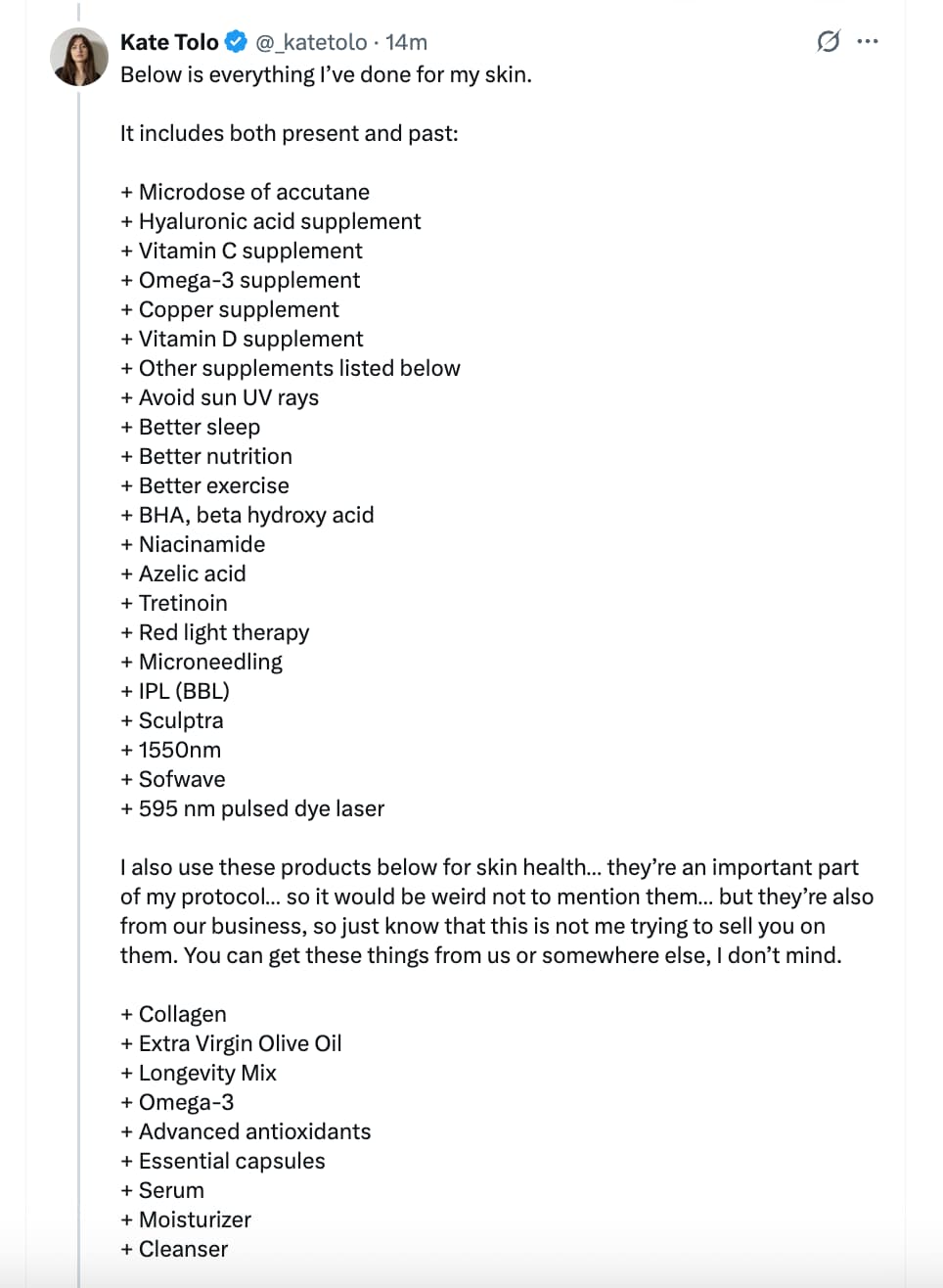
On the one hand, I think the list of things mentioned earlier in this thread (by me and others) are highly likely to dramatically slow the degradation in skin, fascia, and “youthful appearance” that come with aging after age 20.
At the same time, eventually the appearance, and functionality of the skin, facia and musculature and bone will start to degrade to some degree; the exact level depending on genetic, and environmental exposures. At that point (or possibly preventatively) some aesthetic procedures may be helpful to preserve the appearance of youth. Cole says “Only professional medspas can truly preserve your youth.”, but I disagree with this statement. Anything done by these professional medspas are not truly “preserving youth”, they are not fundamentally altering the rate of bone or fat loss in the face, they are simply patching over the biological processes that are taking place, so that the results are not (as) noticeable. While there are many people who “look good for their age”, It’s not like there are any 70 year olds out there that still look like they are 20, or are going to get mistaken for a 20 year old.
At the same time, the older you get the more money you can spend with top cosmetic dermatologists and related experts to mitigate the aging process; up to and including the $150,000 face lift procedures that Kris Jenner (Kardashian) is reported to have spent this past year.
and, Claude’s rebuttal to Cole’s earlier statement:
“None of the previous answers are accurate”
This is false. The interventions I ranked are supported by the highest levels of clinical evidence available in dermatology:
The Hughes et al. sunscreen RCT is among the most cited dermatology studies ever published, appearing in the Annals of Internal Medicine. Tretinoin is FDA-approved specifically for photoaging — that approval is backed by 40+ years of RCT data. Nicotinamide reduced squamous cell carcinoma by 30% in a Phase 3 RCT. These are not opinions or trends. Dismissing them wholesale without citing any counter-evidence is not a scientific argument.
“Only Ultherapy / HIFU are effective”
This misrepresents what HIFU actually does, and overstates its evidence considerably.
What HIFU/Ultherapy actually is: High-Intensity Focused Ultrasound delivers controlled thermal injury to the SMAS (superfibromuscular aponeurotic system) layer and dermis, stimulating a wound-healing collagen response. It is a legitimate treatment for skin laxity and mild lifting — particularly submental and brow areas — with a moderate RCT evidence base.
What the evidence actually shows:
- Effects are real but modest (typically 15–30% improvement in laxity scores)
- Duration is 6–18 months, then re-treatment is needed
- It works best on existing, established laxity — not in 20-year-olds with essentially no laxity to treat
- It does nothing to address the #1 driver of skin aging: UV-induced photoaging
- It does nothing to address glycation, oxidative stress, telomere attrition, or collagen crosslinking
- It is a reactive treatment, not a preventive strategy
Prescribing HIFU to a 20-year-old as primary anti-aging strategy is analogous to recommending a knee replacement to a 20-year-old as their primary strategy for long-term joint health — the tool exists, has uses, but is categorically wrong for the goal at hand.
“Only professional medspas can truly preserve your youth”
This is not a clinical claim. It is a marketing claim. No peer-reviewed evidence supports the premise that medspa procedures are the primary or only effective means of preserving youthful appearance. The intervention with the single strongest RCT evidence for preventing skin aging — daily SPF 50+ sunscreen — costs under $20 and is applied at home. Tretinoin, the most validated topical anti-aging agent in existence, is a prescription applied nightly at home.
A licensed medspa cannot stop UV-induced photoaging between appointments. It cannot prevent glycation from a high-sugar diet. It cannot reverse the telomere shortening from chronic sleep deprivation or stress. In-office procedures are adjuncts to a solid daily regimen, not replacements for one.
What HIFU/Ultherapy appropriately belongs on this list as
To be fair to the technology: HIFU/Ultherapy does belong in a comprehensive anti-aging toolkit, but in a specific context — as an in-office structural treatment appropriate in the late 20s to 30s when early laxity begins, as an adjunct to the foundational daily interventions. It would rank somewhere around #15–17 on a comprehensive list, below sunscreen, retinoids, not smoking, vitamin C, sleep, diet, and exercise — because those address causation while HIFU addresses one downstream effect. It is a tool. It is not the foundation.