https://onlinelibrary.wiley.com/doi/full/10.1111/acel.70530
chatGPT:
Summary
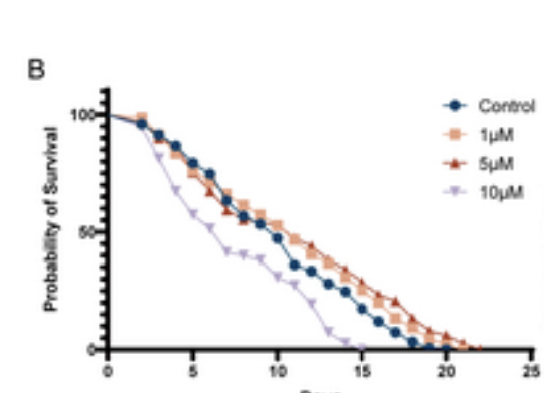
This paper reports that vitamin K2, specifically MK-7, extends lifespan and improves healthspan-like measures in C. elegans, but only within a narrow dose range. The authors found a hormetic pattern: 5 μM vitamin K2 was beneficial, 1 μM had weaker effects, and 10 μM was harmful, shortening lifespan, reducing fertility, impairing motility, raising ROS, lowering ATP, and worsening mitochondrial morphology.
At the effective 5 μM dose, vitamin K2 increased median lifespan from 10 to 11 days in wild-type worms, improved late-life survival, increased body-bending and pharyngeal pumping, preserved intestinal barrier function, and reduced intestinal lipofuscin accumulation. It did not alter body length or fertility at 1–5 μM, suggesting the lifespan effect was not simply due to developmental delay or reduced reproduction.
Mechanistically, the authors argue that vitamin K2 protects against aging by reducing mitochondrial oxidative stress. Treated worms showed lower ROS and MDA, higher SOD activity, increased ATP, improved mitochondrial membrane potential, reduced mitochondrial fragmentation, and lower activation of the mitochondrial unfolded protein response. It also improved survival under acute hydrogen peroxide and heat stress.
The genetic data point to a pathway involving SKN-1 and especially JNK-1/SIR-2.1/DAF-16. Vitamin K2 failed to extend lifespan or improve stress resistance in skn-1, jnk-1, sir-2.1, and daf-16 mutants. It still worked in sek-1, nsy-1, and pmk-1 mutants, suggesting that although p38/PMK-1 components were transcriptionally upregulated, they were not essential for the lifespan effect.
The paper’s model is therefore:
vitamin K2 → improved mitochondrial function / reduced mitochondrial stress → JNK-1 activation → SIR-2.1 activation → DAF-16 nuclear activity → antioxidant and stress-response gene expression → improved stress resistance and lifespan.
What is novel
The main novelty is not simply that vitamin K2 can extend C. elegans lifespan; the paper itself notes that prior work had already linked vitamin K2 to lifespan extension through fat metabolism. The novelty is the proposed mitochondrial-stress mechanism and the mapping of the effect onto the JNK-1/SIR-2.1/DAF-16 axis.
A second useful feature is the dose-response finding. The same compound is beneficial at 5 μM and harmful at 10 μM, with corresponding shifts in ROS, ATP, fertility, motility, and mitochondrial morphology. That makes the paper more interesting than a simple supplement-positive result, because it shows a narrow therapeutic window in this model.
A third novelty is the breadth of phenotyping: lifespan, motility, pharyngeal pumping, intestinal barrier leakage, lipofuscin, ROS, MDA, SOD activity, ATP, mitochondrial membrane potential, mitochondrial morphology, UPRMT, heat stress, oxidative stress, and multiple mutant backgrounds are all used to support one mechanistic story.
Critique
The strongest aspect of the study is that it does not rely only on lifespan curves. The authors combine survival assays with mitochondrial physiology, stress tests, reporter strains, qPCR, and mutant epistasis. The loss of benefit in jnk-1, sir-2.1, daf-16, skn-1, and mev-1 mutants makes the mechanistic claim more credible than a purely correlative antioxidant story.
However, the lifespan effect itself is modest: median survival increases from 10 to 11 days at 5 μM. The paper’s mechanistic measurements are more striking than the survival extension. That does not make the finding irrelevant, but it means the claim should be framed as modest lifespan extension with improved stress-resistance phenotypes, not a large anti-aging intervention.
A major limitation is that this is entirely a C. elegans study. Worm vitamin K biology, mitochondrial biology, bacterial metabolism, and stress-response networks do not translate directly to mammals. The authors appropriately present the work as a basis for study in more complex systems rather than direct evidence for human anti-aging benefit.
There is also a potential confound from the food/bacteria system. In C. elegans, compounds can act on the worm, the bacterial food source, bacterial metabolism, or the interaction between them. The paper uses OP50 feeding but does not appear to fully separate direct worm effects from effects mediated through bacteria.
The mechanistic pathway may also be somewhat over-linearised. DAF-16, SKN-1, JNK-1, SIR-2.1, mitochondrial stress, ROS, and ATP are highly interconnected. Loss of benefit in mutants shows these genes are required for the phenotype, but it does not prove a simple ordered pathway from vitamin K2 to JNK-1 to SIR-2.1 to DAF-16. Some effects could be parallel or compensatory stress-response changes.
Another concern is that many assays use fluorescent dyes or reporters—DCF for ROS, TMRE for membrane potential, GFP reporters for stress genes—which are useful but indirect. These can be affected by uptake, metabolism, tissue condition, autofluorescence, or imaging choices. The convergence across multiple assays helps, but the mitochondrial mechanism would be stronger with direct respiration measurements, oxygen consumption, electron transport chain activity, or metabolomics.
The 10 μM toxicity is important and underlines that vitamin K2 is not simply “more is better.” It may be acting as a mild mitochondrial or redox stressor at lower dose and becoming damaging at higher dose. That hormetic interpretation is plausible but not fully resolved.
Bottom line
This is a solid worm-aging paper showing that low-dose vitamin K2/MK-7 modestly extends C. elegans lifespan and improves stress resistance, probably through mitochondrial stress adaptation involving SKN-1 and JNK-1/SIR-2.1/DAF-16 signalling. The most interesting result is the mechanistic linkage to mitochondrial health and stress-response transcription factors, not the size of the lifespan effect. The main weakness is translational: it does not yet show that vitamin K2 slows aging in mammals, and the pathway may be more complex than the proposed linear model.