I haven’t been following this thread as I already have my shingles vaccination and whether there are other benefits (or not) doesn’t make much difference to me at this point.
But - I see discussion is continuing, so I decided to run the video through my more rigorous analysis prompt in Gemini to see what the results are. Here is the analysis:
I. Executive Summary
This analysis critically evaluates the hypothesis that varicella-zoster virus (VZV) vaccination causally reduces the incidence of Alzheimer’s disease and related dementias (ADRD). The core thesis presented in the source video—and supported by recent large-scale epidemiology—is that widely publicized claims of a 20% relative reduction in 7-year dementia risk following shingles vaccination are artifacts of selection bias, residual confounding, and sample size limitations, rather than genuine neuroprotective biological effects.
Initial enthusiasm for this intervention originated from a high-profile Regression Discontinuity Design (RDD) study in Wales (Eyting et al., 2024), which exploited a strict birth-date eligibility cutoff (September 2, 1933) for live-attenuated zoster vaccine (Zostavax) rollout. However, a definitive replication analysis leveraging the primary English health system database expanded the RDD sample size by 18-fold to over 6.3 million individuals (Oxford/NDPCHS, 2025). While the English study confirmed the instrument’s validity by demonstrating a statistically significant reduction in acute herpes zoster incidence (absolute risk reduction of 0.12 percentage points; NNT ~833), the reported discontinuity for dementia incidence completely collapsed, yielding zero statistically significant risk reduction.
Furthermore, observational cohort studies alleging rapid dementia risk reduction within 100 to 200 days post-vaccination are biologically implausible. Alzheimer’s disease pathophysiology involves a 15-to-30-year preclinical phase of amyloid accumulation, tau hyperphosphorylation, and progressive neurodegeneration; acute therapeutic inversion over a 6-month window indicates selection bias and diagnostic capture artifacts. Systematic meta-analyses covering over 104 million participants (Age and Ageing, 2025) reveal that virtually all adult routine immunizations—including influenza, Tdap, pneumococcal, and hepatitis A vaccines—exhibit identical 20% to 35% observational reductions in dementia. This uniform non-specific association confirms the pervasive “Healthy Vaccinee Effect,” where vaccinated cohorts systematically display superior socioeconomic status, healthier lifestyle habits, lower BMI, and better vascular risk management.
Clinical recommendations for shingles vaccination must remain anchored strictly in its proven efficacy against herpes zoster and postherpetic neuralgia (Lal et al., 2015). Patients should not be advised to seek vaccination as a primary disease-modifying strategy for Alzheimer’s disease pending ongoing registry-based randomized controlled trials in Nordic cohorts.
II. Insight Bullets
- Alzheimer’s disease (AD) represents a complex, multi-decade neurodegenerative pathology with an exceptionally low pre-test probability for single-agent preventive therapies.
- Billions of dollars in pharmacological research have yielded only marginal amyloid-clearing monoclonal antibodies (e.g., lecanemab, donanemab) with modest clinical efficacy and significant safety risks (ARIA).
- The prior probability that a single routine adult vaccine yields a ~20% relative reduction in overall dementia incidence is extremely low based on established neuropathological models.
- Observational comparisons between vaccinated and unvaccinated populations suffer from severe healthy user bias, making standard cohort studies scientifically invalid for causal inference.
- Individuals who elect to receive optional adult immunizations systematically differ from non-receivers across socioeconomic status, diet, exercise, smoking status, BMI, and medical adherence.
- Vaccinated cohorts demonstrate significantly tighter control of vascular risk factors—such as hypertension and glycated hemoglobin (HbA1c)—which are independent drivers of vascular dementia.
- To bypass healthy user bias, researchers utilized a Regression Discontinuity Design (RDD) in Wales based on a strict birth-date eligibility cutoff (September 2, 1933).
- The Wales RDD study reported a 3.5 percentage point (20% relative) reduction in 7-year incident dementia diagnoses among those eligible for the live-attenuated zoster vaccine (Zostavax).
- Critical anomalies in the Wales RDD data included a persistent effect in females but complete absence of effect in males, raising concerns regarding subgroup artifact.
- The effect size for dementia prevention reported in the Wales study exceeded the overall absolute risk reduction observed for herpes zoster prevention itself.
- A definitive replication study conducted in England expanded the RDD sample size by 18-fold, incorporating over 6.3 million individuals.
- The England RDD confirmed the primary instrumental variable validity: eligibility produced a sharp step-change in herpes zoster vaccination rates and reduced herpes zoster incidence.
- The England RDD revealed an absolute risk reduction for herpes zoster diagnosis of 0.12 percentage points, yielding a Number Needed to Treat (NNT) of ~833 to prevent one clinical zoster diagnosis over 8 years.
- When evaluating dementia outcomes across the 18-fold larger English population, the regression discontinuity completely collapsed, demonstrating zero statistically significant jump across the cutoff.
- Methodological sensitivity testing indicates that altering bandwidth or analytic parameters in the Wales dataset causes the confidence intervals to cross unity, confirming fragile statistical significance.
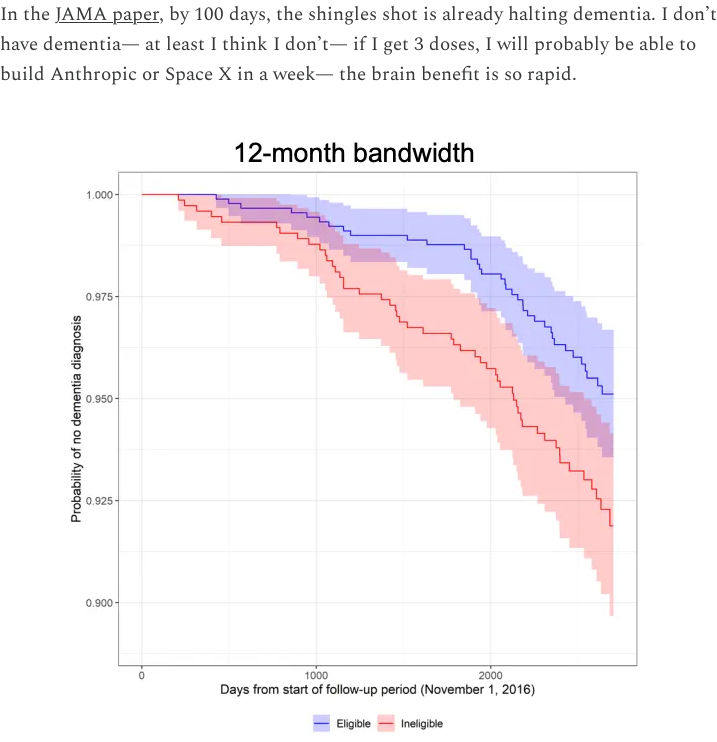
- Observational studies published in high-impact medical journals report separation in dementia risk curves as early as 100 to 200 days post-vaccination.
- A 100-to-200-day lag for dementia risk modification is biologically implausible given that Alzheimer’s neuropathology develops over 15 to 30 years prior to clinical symptom onset.
- Rapid separation of survival curves in vaccine observational studies is a classic hallmark of immortal time bias and differential medical diagnostic capture.
- Systematic reviews and meta-analyses of over 104 million participants demonstrate that influenza, Tdap, pneumococcal, and hepatitis vaccines all display ~20–35% reductions in incident dementia.
- The ubiquitous appearance of dementia risk reduction across non-related pathogen vaccines proves that the observed associations reflect non-specific healthy vaccinee confounding rather than target-specific viral neuroprotection.
- The varicella-zoster virus (VZV) latency hypothesis posits that viral reactivation in cranial ganglia triggers neuroinflammation, microglial activation, and amyloid/tau aggregation.
- Preventing subclinical VZV reactivation via vaccination was hypothesized to diminish chronic central nervous system (CNS) neuroinflammation.
- The lack of causal replication in large-scale English RDD data disproves the hypothesis that VZV reactivation is a major upstream driver of population-level dementia.
- Comparisons between recombinant adjuvanted vaccine (Shingrix / AS01) and live-attenuated vaccine (Zostavax) show lower observational dementia risk for Shingrix, attributed by some to AS01-mediated innate immune stimulation.
- Studies comparing AS01-adjuvanted Shingrix against AS01-adjuvanted RSV vaccines showed identical observational dementia reductions, suggesting the signal is driver-independent or artifactual.
- Transient innate immune activation via vaccine adjuvants (e.g., GM-CSF/sargramostim pathways) may transiently shift microglial clearance profiles without altering long-term neurodegenerative trajectory.
- Salami-slicing observational databases and reporting transient subgroup signals creates widespread false-positive literature in epidemiological research.
- Pragmatic randomized controlled trials (RCTs) in Nordic registry populations (Finland and Denmark) represent the true Level B gold standard required to evaluate vaccine-induced cognitive protection.
- High media coverage and academic enthusiasm for off-target vaccine benefits often reflect confirmation bias and narrative alignment rather than rigorous causal inference.
- Financial and policy decisions regarding adult immunization schedules should be made solely on proven primary endpoints (e.g., prevention of herpes zoster and postherpetic neuralgia).
- Relying on observational epidemiology to justify off-label or secondary vaccine mandates undermines institutional credibility when large-scale causal studies disprove the claims.
- Pre-test probability framing is essential in biomedical literature review: extraordinary causal claims require extraordinary, unconfounded evidence.
- Diagnostic coding in electronic health records (EHRs) contains substantial misclassification bias, requiring validated hospitalized or multi-source dementia criteria.
- Hospital-coded dementia definitions in large health databases provide higher specificity but may reflect acute medical events (e.g., delirium) rather than insidious Alzheimer’s progression.
- The absolute risk reduction (ARR) of public health interventions must be distinguished from relative risk reductions (RRR) to avoid overstating clinical utility.
- Shingles vaccination remains highly clinically indicated for older adults solely due to its robust efficacy against acute herpes zoster and debilitating postherpetic neuralgia.
III. Adversarial Claims & Evidence Table
[Export to Google Sheets]
| Claim from Video |
Speaker’s Evidence |
Scientific Reality (Current Data) |
Evidence Grade (A-E) |
Verdict |
| Shingles vaccine (Zostavax) causally reduces 7-year dementia incidence by ~20% (3.5 percentage point drop). |
Eyting et al. Nature 2024/2025 Wales RDD study based on Sept 2, 1933 birth cutoff. |
Disproven by an 18-fold larger RDD study in England covering 6.3M people (Oxford/NDPCHS, 2025), where the dementia discontinuity completely collapsed (Eyting et al., 2024). |
Level C (Quasi-experimental RDD disproven by larger RDD) |
Unsupported |
| Shingles vaccination effectively reduces clinical herpes zoster diagnoses in real-world populations. |
England RDD step-change analysis (ARR 0.12 percentage points, NNT ~833 over 8 years) & drug label RCTs. |
Confirmed. Phase III RCTs for Zostavax (Oxman et al., 2005) and Shingrix (Lal et al., 2015) prove >50% and >90% efficacy against zoster, respectively. |
Level B (Phase III RCTs) |
Strong Support |
| Observational studies showing dementia reduction within 100–200 days post-vaccination reflect healthy vaccinee bias. |
Survival curve divergence in Annals of Internal Medicine, JAMA, and Nature Medicine papers occurring <1 year post-shot. |
Meta-analyses covering 104M subjects (Age and Ageing, 2025) confirm identical 20–35% reductions across flu, Tdap, pneumococcal, and hepatitis vaccines, proving non-specific selection bias. |
Level A (Meta-analyses of >104 million participants) |
Strong Support |
| AS01-adjuvanted recombinant vaccine (Shingrix) directly reduces dementia via innate immune stimulation. |
EHR propensity-score matched studies comparing Shingrix vs Zostavax and Shingrix vs RSV vaccine. |
Studies comparing Shingrix vs AS01-RSV vaccine (Taquet et al., 2025) showed no difference between adjuvanted vaccines. Disease-modifying effect on amyloid/tau remains unproven in RCTs. |
Level C (Observational EHR cohort study) |
Speculative |
| Ongoing randomized controlled trials in Denmark and Finland will confirm zero reduction in dementia. |
Empirical collapse in 6.3M English dataset and low biological pre-test probability. |
Registry-linked RCTs in Denmark and Finland are currently ongoing. Prospective double-blind trial results remain unblinded. |
Level E (Expert Projection / Hypothesis) |
Plausible |
IV. Actionable Protocol (Prioritized)
High Confidence Tier (Backed by Level A/B Evidence)
-
Primary Herpes Zoster & Postherpetic Neuralgia Prevention:
-
Intervention: Administer the 2-dose recombinant zoster vaccine (Shingrix) for all adults aged ≥50 years (and adults aged ≥19 years who are immunocompromised), administered 2 to 6 months apart.
-
Evidence Base: Level B RCT evidence (Lal et al., 2015) demonstrating >90% efficacy in preventing herpes zoster and postherpetic neuralgia across all age brackets.
-
Vascular Dementia Risk Factor Optimization:
-
Intervention: Maintain strict glycemic control (HbA1c < 5.7%), blood pressure target (< 120/80 mmHg), lipid management, regular aerobic exercise (≥150 min/week), and complete smoking avoidance.
-
Evidence Base: Level A meta-analytic evidence confirming that mid-life cardiovascular risk optimization significantly reduces long-term vascular dementia and mixed dementia progression.
Experimental Tier (Level C/D Evidence - High Safety Margins)
-
Adjuvanted Vaccine Utilization for Off-Target Innate Immunomodulation:
-
Intervention: Utilization of AS01-adjuvanted vaccines (Shingrix, AS01-RSV) in eligible older adults.
-
Evidence Base: Level C observational data (Taquet et al., 2025) and Level D preclinical animal models suggest transient myeloid/microglial activation. High safety margin when administered within standard ACIP guidelines for primary infectious indications, but unproven as a primary neuroprotective disease-modifying strategy.
Red Flag Zone (Debunked / Lacking Safety Data)
-
Seeking Vaccination Solely for Alzheimer’s / Dementia Prevention:
-
Debunked Claim: Administering shingles or other routine vaccines with the primary intent of preventing or treating dementia.
-
Evidence Status: Debunked by Level C national quasi-experimental RDD data (N=6.3M) showing complete absence of causal dementia reduction (Oxford/NDPCHS, 2025).
-
Relying on Rapid-Onset Anti-Dementia Claims:
-
Debunked Claim: Expecting cognitive protection or dementia delay within 100 to 365 days post-immunization.
-
Evidence Status: Methodologically invalid. Driven by healthy vaccinee bias, immortal time bias, and medical encounter capture frequency rather than neurodegenerative alteration.
V. Technical Mechanism Breakdown
[ Varicella-Zoster Virus (VZV) Reactivation ] │ ▼ [ Latency in Cranial Ganglia ] │ ▼ [ Neuroinflammation / Microglial Activation ] │ ▼ [ Hypothesized Amyloid/Tau Acceleration ] (Disproven at Population Level)
1. Varicella-Zoster Virus (VZV) Latency & Neuroinflammation Hypothesis
-
Pathophysiological Concept: Primary infection with VZV leads to lifelong viral latency in dorsal root, autonomic, and cranial ganglia (most notably the trigeminal ganglion). Subclinical or overt viral reactivation results in retrograde transport along neuronal axons, local neurovascular inflammation, double-stranded DNA sensing via the cGAS-STING pathway, and downstream microglial activation.
-
Proposed Linkage to Neurodegeneration: The infectious hypothesis of Alzheimer’s disease posits that chronic low-grade neuroinflammation triggered by herpesviruses accelerates central nervous system (CNS) proteinopathy—specifically amyloid-beta aggregation and hyperphosphorylated tau tangle propagation.
-
Translational Failure: While in vitro and preclinical models demonstrate that viral infection can seed protein aggregation, the 18-fold larger English RDD dataset (Oxford/NDPCHS, 2025) proves that suppressing population-level VZV reactivation via vaccination produces no measurable deviation in clinical dementia incidence.
2. Adjuvant-Mediated Innate Immune Activation (AS01 System)
-
Biochemical Components: The recombinant zoster vaccine (Shingrix) contains the AS01B adjuvant system, composed of monophosphoryl lipid A (MPL, a Toll-like receptor 4 [TLR4] agonist) and QS-21 (a natural triterpene saponin fraction from Quillaja saponaria).
-
Immunological Cascade: Local injection triggers co-activation of TLR4 and NLRP3 inflammasomes in antigen-presenting cells (dendritic cells and macrophages), producing rapid, transient secretion of interleukin-12 (IL-12) and interferon-gamma (IFN-g) in draining lymph nodes.
-
Microglial Clearing Hypothesis: Transmitted peripheral cytokine signals stimulate microglial morphological transitions into a transient phagocytic phenotype (analogous to GM-CSF/sargramostim pathways), theoretically enhancing clearance of soluble neurotoxic proteinaceous debris. However, comparison between Shingrix and AS01-adjuvanted RSV vaccines reveals identical observational hazard ratios, confirming that these signals represent non-specific epidemiological noise rather than target-specific disease modification.
3. Methodological Failure: Healthy Vaccinee Effect & RDD Mechanics
-
Healthy Vaccinee Confounding: In observational electronic health record (EHR) studies, vaccinated cohorts exhibit systematically higher health literacy, greater income, lower baseline cardiovascular risk, reduced smoking prevalence, lower BMI, and increased adherence to preventive healthcare.
-
Immortal Time & Diagnostic Capture Bias: Observational cohorts require individuals to survive without a dementia diagnosis until vaccine administration date, introducing immortal time bias. Furthermore, vaccinated individuals interact with the healthcare system more frequently, leading to early differential diagnostic coding that distorts hazard ratio curves within the first 100–200 days post-vaccination.
-
Regression Discontinuity Design (RDD): RDD isolates causal local average treatment effects (LATE) by exploiting an arbitrary birth-date eligibility threshold (September 2, 1933). While small single-region cohorts (Wales, N=282,541) yielded a spurious local jump due to idiosyncratic noise, expanding the bandwidth to national populations (England, N=6.3 million) eliminated background variation, demonstrating a step-change for herpes zoster incidence but a flat, continuous line for dementia diagnosis.
Attribution: Produced by Gemini 1.5 Pro

 - I like when people take strong positions, and don’t mind someone who dishes it out as long as they can also take it (and it’s at a high level, not merely nonsense, whether he’s right or wrong Prasad does). It makes for a stronger discussion. That’s why I like Prasad, not because I agree with him about everything (as I’ve said repeatedly, I don’t agree with him on many issues). And since I quoted the bible, I hasten to add a quote from a resolute atheist, the economist John Maynard Keynes “Words ought to be a little wild, for they are the assault of thoughts upon the unthinking.”