I have no idea what the cost was because my insurance covered it. I stopped after 2 doses because of that recent study showing that just one may be enough.
3 Likes
Oh and there’s an additional potential benefit for those who are still dating or getting back into dating. The vaccine protects against 9 of the strains that can cause cancer, so even if you’ve been exposed to 1 or more of the strains you’ll be protected against new exposures to the others.
1 Like
My Prompt:
How can people in the USA over the age of 45 get the HPV vaccine if they want it? What options would be available to them and what would be the possible range in the price?
Gemini Pro Response
In the United States, obtaining the HPV vaccine (Gardasil 9) after the age of 45 is possible, though it falls outside current FDA-approved indications and CDC routine recommendations. Because it is considered “off-label” for this age group, the process, legalities, and costs differ significantly from younger populations.
1. Clinical and Legal Path to Access
Since the vaccine is not FDA-approved for those over 45, you cannot simply walk into most retail pharmacies and receive it as you would a flu shot.
- Prescription Required: You must obtain a physical or electronic prescription from a licensed healthcare provider (MD, DO, NP, or PA). A physician can legally prescribe a drug or vaccine “off-label” if they believe it is medically appropriate for the patient based on their specific health profile and risk factors.
- Shared Clinical Decision-Making: You will likely need to discuss your sexual health history, potential for new partners, and overall longevity goals with your doctor. They will evaluate whether the potential benefit (protection against new strains) outweighs the cost, especially since most adults have already been exposed to some HPV types by this age.
- Administration Site: Once you have a prescription, you may need to receive the injection at your doctor’s office. Many pharmacies’ internal protocols prevent them from administering vaccines to age groups outside the FDA-approved labeling, even with a prescription.
2. Estimated Costs and Financial Options
Because this use is off-label, it is highly unlikely to be covered by private insurance, Medicare, or Medicaid. These payers typically follow ACIP (CDC) guidelines, which currently stop at age 45.
| Item | Estimated Cost (Per Dose) | Total for 3-Dose Series |
|---|---|---|
| Manufacturer List Price | ~$300 – $370 | ~$900 – $1,110 |
| Retail Pharmacy Price | ~$370 – $450 | ~$1,110 – $1,350 |
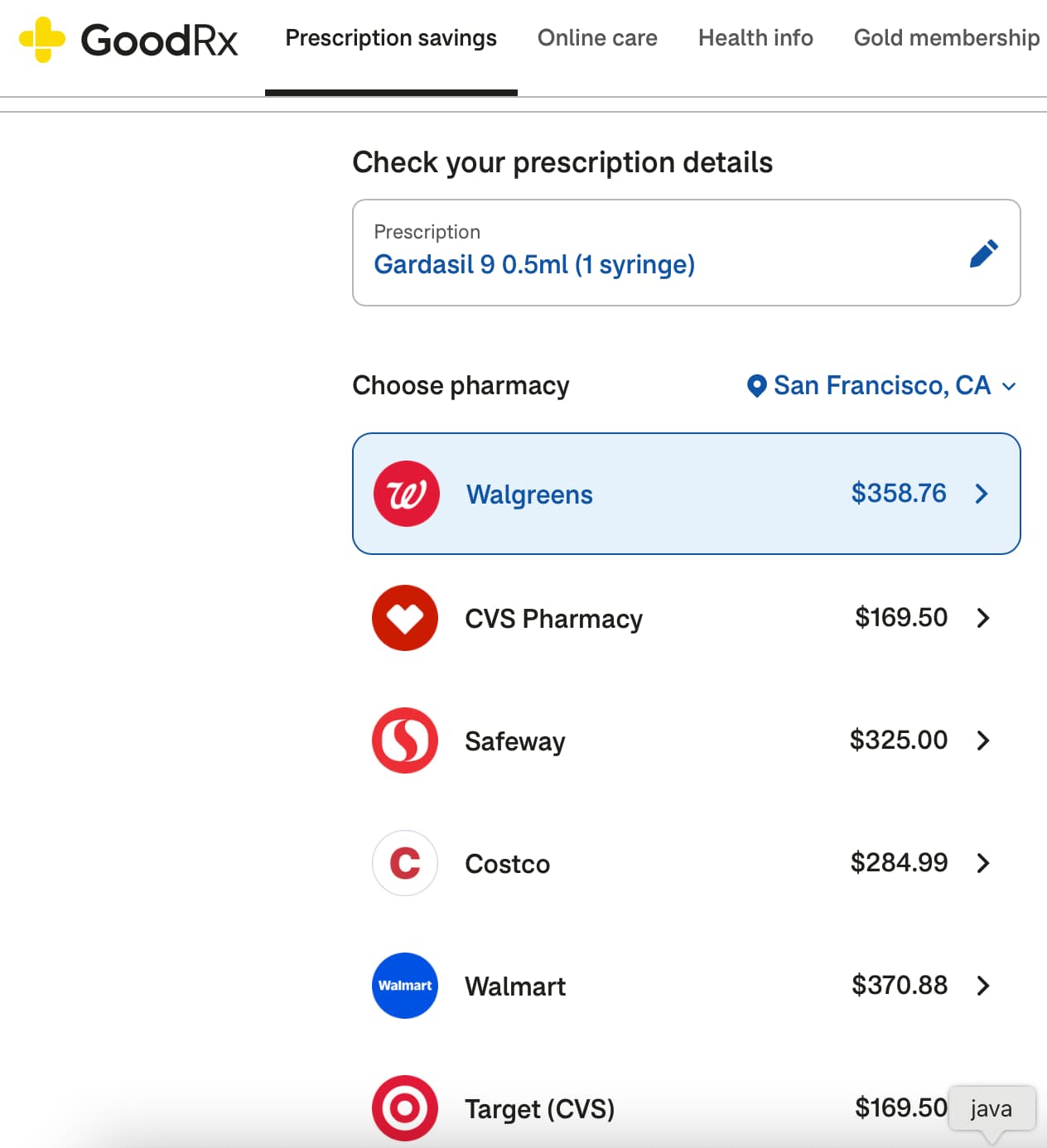
| Discounted Price (e.g., GoodRx) | ~$170 – $250 | ~$510 – $750 |
| Administration Fee | ~$30 – $70 | ~$90 – $210 |
Total Estimated Out-of-Pocket Range: $600 to $1,500 for the full series.
Options for Reducing Costs:
- Prescription Discount Cards: Services like GoodRx or SingleCare can significantly lower the retail price at participating pharmacies.
- Manufacturer Assistance: Merck (the manufacturer of Gardasil 9) has a patient assistance program called MerckHelps. However, their formal eligibility usually aligns with the FDA age limit (up to 45). You may still apply, but approval is not guaranteed for off-label use.
- Planned Parenthood: Some Planned Parenthood clinics or community health centers offer sliding-scale fees based on income, though they still must adhere to medical protocols regarding age.
3. Strategic Considerations for Longevity
For a longevity-focused individual, the rationale for vaccination post-45 typically centers on preventing oropharyngeal (throat), anal, and cervical cancers that can develop from new HPV exposures later in life.
- Knowledge Gap: There is limited clinical trial data on the efficacy of the vaccine in populations over 45, as most studies focused on younger cohorts where the immune response is more robust.
- Alternative Data: Some clinicians argue that if an individual is entering a new relationship or has multiple partners, the risk of acquiring one of the high-risk strains (like 16 or 18) remains present regardless of age.
Next Step: Would you like me to find a template or list of talking points you can use to discuss an off-label HPV prescription with your healthcare provider?
Example of Pricing using GoodRX (best pricing seems to be around $170 per injection syringe):
3 Likes
Anyone can go to planned parenthood and get one. I did, 3 vax over a year. Out of pocket was $700ish.
1 Like
I wonder if that works (is available) for men too. I’ll call and check.
Very interesting, thanks! I wasn’t able to find much online about it. I hadn’t found that Lancet paper, though it’s not directly related to our question. I asked ChatGPT Pro to analyse the paper and the recommendations about HPV vaccination. It gave a pretty complex answer, but the gist is that it’s definitely a promising signal. As you said, it does at leats suggest that there are immunity gains to be made, though the nuance might be around the fact that the patients in the trial had an excision and will need to then heal the tissue. The vaccine in this people may be reducing the infection rate of the new tissue, which wouldn’t apply to you or I who didn’t have excision.
Still, maybe I’m going to try and find out if I can get an HPV vaccine now.
I would really hope it should. HPV causes anal cancer, penile cancer, oral cancer etc. It affects men just as much as women. While we can’t get cervical cancer, we can get penile cancer, which sounds extremely unpleasant… And also, the women are catching it from the men and vice-versa, so there’s no sense only vaccination one sex.
1 Like
This paper is more relevant to the question, but needs replication. Women with established HPV were then given the vaccine:
“In the vaccinated group, the rate of HPV disappearance was significantly higher over the follow-up period than in the control group. This applies especially to the complete disappearance of the HPV - in 72.4% vaccinated women compared to 45.7% unvaccinated.”
2 Likes
I’m male. I was just over the 45 age limit. I got the rec from the Peter Attia subreddit of others doing it. No issue, no hassle, no questions really.
1 Like
This is all great info!!
Ok, I’ll get a note from my doc and I’ll go get one at CVS… it sounds like a win…
Here’s my big question… argh, I just skipped taking rapa for a couple weeks because I got my pneumonia vax. (And flu/covid prior to that one).
Should I skip rapa yet again?
Are all of you still skipping when you get vaccines? If so, how may weeks? I have been skipping two doses… the one prior and one afterwards.
From the Biotech/medical website Stat News:
I’m getting the HPV vaccine at 24. That’s a problem
Even before the childhood vaccine schedule’s update, doctors often overlooked the shot that can prevent cervical cancer
Recently, I walked into my doctor’s office and receive my first dose of the HPV vaccine at 24. I felt a bit ridiculous sitting in the waiting room, a third-year medical student who can discuss the mechanism of E6/E7 over-expression but never got the vaccine that prevents it.
I grew up in New Jersey with excellent health care access. My parents never skipped a checkup or a vaccine. But when I asked them recently if they had ever discussed the HPV shot at my pediatrician’s office, they didn’t know what I was even talking about. To our knowledge, it never came up at an annual visit with my primary care doctor. Not at 11, the recommended age, or even 13 or 15.
When I dug a little deeper into my memory, however, I remembered that it was mentioned once. I was 17, at my first OB-GYN appointment — a follow-up after being hospitalized with severe anemia from heavy menstrual bleeding earlier that year. My OB-GYN brought up the HPV vaccine briefly, but I was there with my dad. I kept my eyes on the floor and shook my head, cheeks burning. She didn’t push. Looking back, I think she sensed the discomfort too — a South Asian father and his teenage daughter, a vaccine associated with STIs. I could feel him stiffen at the thought of his well-behaved daughter needing protection against a sexually transmitted infection. I’m too embarrassed to ask my dad whether he remembers this moment.
When it comes to vaccine schedules, the U.S. is now the outlier
Within what felt like minutes, the appointment was over. The vaccine was mentioned once, framed as optional, in a context so awkward that I barely registered what it was for. Then never brought up again. I didn’t actually learn about the HPV vaccine until medical school. Years later, I found myself on my OB-GYN rotation counseling patients on this very vaccine. I explained its importance and encouraged them to get it all while I hadn’t gotten it myself — the dissonance was impossible to ignore. How could I advocate for something I hadn’t done myself? That’s when I decided I had to go get it.
If the HPV vaccine had been bundled with my Tdap and meningococcal vaccines at age 11 and presented as routine cancer prevention, my parents would have consented without hesitation, the way they did for every other vaccine. There would have been no awkward moment in the office, no teenager too embarrassed to ask questions, no doctor walking on eggshells.
But instead, by waiting until I was 17, by mentioning it only once during a follow-up visit for an emergent problem, by not following up when the moment got uncomfortable, the system created space for cultural and interpersonal barriers to get in the way. The data show that my experience isn’t just anecdotal: Immigrant mothers who were more inclined toward their home culture were less likely to initiate HPV vaccination for their children.
This feels especially urgent now. On Jan. 5, CDC and HHS issued a revised childhood and adolescent immunization schedule that reorganizes vaccines into three buckets: recommended for all children, recommended for certain high-risk groups, and “shared clinical decision-making.” In practice, “shared clinical decision-making” can land as “optional.” Several vaccines that had been universally recommended, including influenza and rotavirus, were moved into the shared clinical decision-making bucket.
HPV is still “recommended for all,” but the guidance was changed to a one-dose recommendation in a process that, according to multiple reports, bypassed the traditional review-and-vote ACIP pathway.
Read the full article: I’m getting the HPV vaccine at 24. That’s a problem (STAT)
1 Like
Can you please share the gist of why they are promoting it?
So dumb. I hope never to traumatise and embarrass my children like this. They are human beings and I’m sure they will have sex, just as their parents had sex to create them. What is the hangup about acknowledging that? Even crazier that this was when the daughter was 17, since you can catch HPV by oral sex, which is probably more common for younger people before they commit to full penetrative sex.
3 Likes
It has anti-cancer protection is why. The framework is viewing the HPV vaccine as an geo-protective and thus possibility another longevity tool.
1 Like
Juan Peron’s first wife died of cervical cancer at the age of 28. Medical experts suspect that Perón unknowingly transmitted the HPV virus to both his wives. Eva Perón, the second wife of Argentine President Juan Perón, died of cervical cancer at the age of 33.
2 Likes
That really drives the point home. Given the knowledge we have about the cause/effect relationship, can you imagine how someone would feel if they accidentally infected and killed their wife(s)?
1 Like
If you are monogamous in a committed marriage, I don’t see the need for this vaccine.
2 Likes
How many people get an HPV test before marriage? Is it even available? I’ve never heard of one. So if a person has had sex before marriage - they could easily be a carrier… thus great risk.
Turns out virtually no men have ever gotten HPV tests… so every woman is at risk.
" Availability and Types of Tests
In the U.S., HPV testing is primarily used for cervical cancer screening (detecting high-risk HPV strains on the cervix).Tests for HPV in men (e.g., anal or oral swabs) exist but are not routinely recommended by the CDC for general screening due to a lack of actionable clinical protocols for positive results in asymptomatic men.
Based on data from the CDC National Survey of Family Growth (NSFG) and analyses by the Institute for Family Studies (IFS) , approximately 80% of married men in the United States have had premarital sex with someone other than their future wife.
2 Likes
Well, I am assuming that during the 20 years I’ve been married to my wife, we’ve crossed that bridge many a time. 
1 Like
We didn’t get married until we were 40, 
And the value of vaccines for general health have gone mainstream… my husband, who is not on here, has been sending me article after article about how vaccines prevent xyz!!
1 Like
I’m very thankful that my free spirited youth was spent in a time where even the two STDs of concern then were uncommon. Then I picked up this girl in a bar…
I’m still married to her for 46 happy years. Conveniently reduced exposure.
5 Likes
That’s interesting, but also super unlucky. End of the day, the majority of adults have had HPV and obviously cancers are still fairly rare at the individual level.
I think the case for vaccinating children before puberty is very strong, since you can prevent initial HPV infection and you massively reduce the incidence of several nasty cancers. But for people like us, I think the big question is whether the vaccine can still reduce cancers even if you’ve had previous HPV exposure. From some posts shared earlier, it does seem that this might be possible. The secondary question is whether there’s any negative effect from getting the vaccine in adulthood. I have not seen any, so on that basis I’m quite interested in getting this vaccine for myself. At the worst, maybe it’s just a waste of money. At the best, maybe I do have prior HPV infection and this will work to quash its cancer-causing potential.
2 Likes