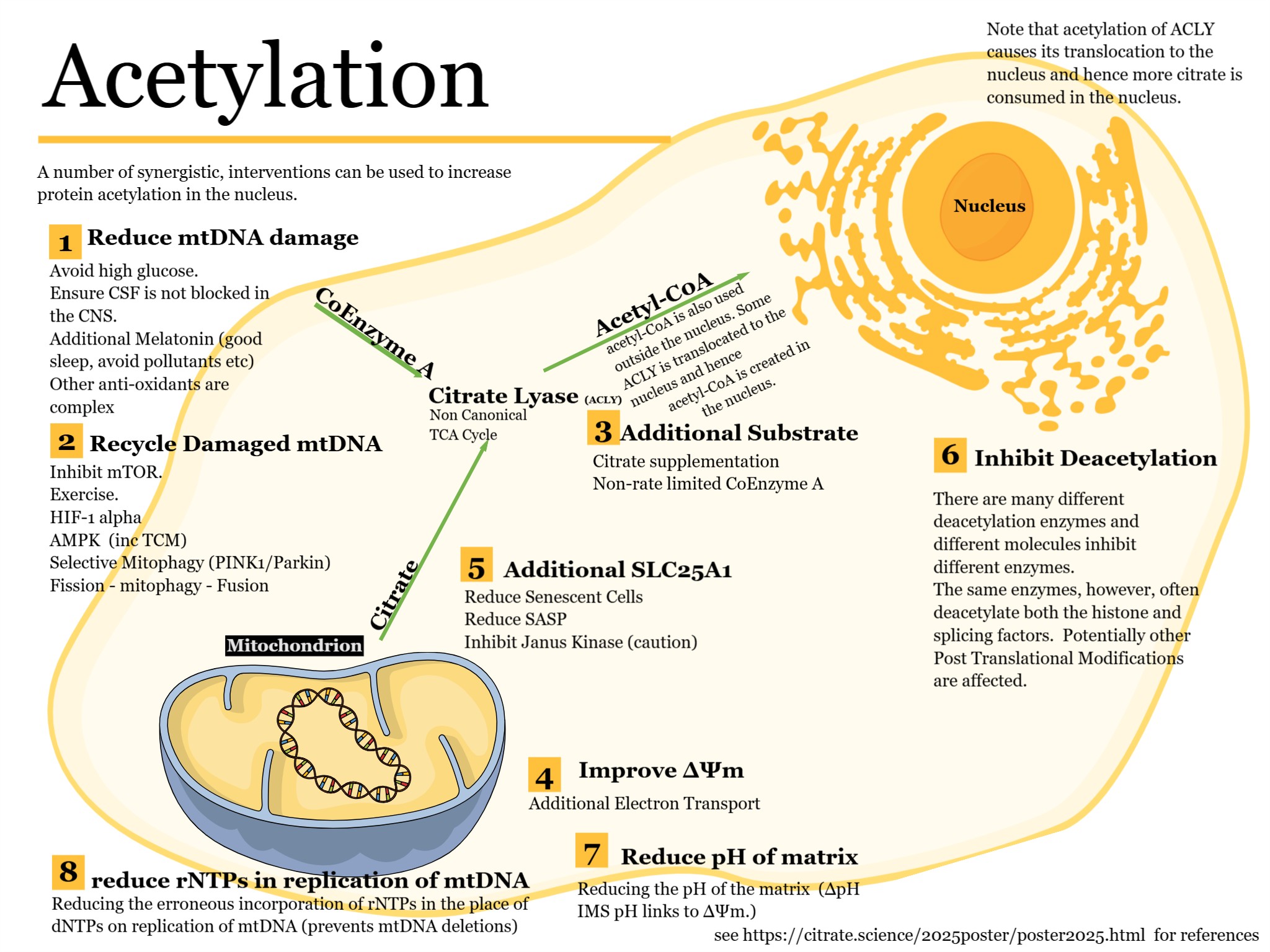
Here is a response from Gemini on my hypothesis relating to Sarcopenia:
Recent research supports the premise that sarcopenia is driven in part by aberrant RNA splicing and that this process is mechanistically linked to reduced protein acetylation. Consequently, increasing acetylation (primarily through HDAC inhibitors) has emerged as a promising therapeutic strategy to prevent or reverse muscle loss.
Short Answer
To a significant extent, sarcopenia is linked to aberrant RNA splicing caused by “epigenetic drift,” specifically a reduction in histone and non-histone protein acetylation. In aging muscle, the enzymes that remove acetyl groups (Histone Deacetylases, or HDACs) often become overactive or dysregulated. This leads to:
Hypoacetylation of Histones: Causing chromatin to “close,” which represses regenerative genes and alters the splicing of key muscle transcripts.
Hypoacetylation of Splicing Factors: Disrupting the machinery (spliceosome) responsible for processing RNA, leading to defective muscle proteins.
Evidence indicates that increasing acetylation (e.g., via HDAC inhibitors or metabolic interventions like ketone bodies/butyrate) can restore normal splicing patterns, reactivate regenerative pathways, and reduce muscle atrophy.
Detailed Mechanistic Breakdown
1. The Link Between Acetylation and RNA Splicing
While acetylation is traditionally known for regulating gene transcription (turning genes “on” or “off”), recent studies have revealed it is also a critical regulator of RNA splicing (how gene instructions are edited).
The Mechanism: Splicing factors (proteins that edit RNA) and the spliceosome itself are regulated by acetylation. When these factors are acetylated, they function correctly. When they lose acetylation (due to aging or high HDAC activity), they mis-splice RNA.
In Sarcopenia: Aging muscle shows a decline in the precision of these splicing events. For example, crucial muscle proteins like Titin (responsible for elasticity) and Ryanodine Receptors (calcium handling) undergo aberrant splicing in sarcopenic muscle, leading to weaker, dysfunctional fibers.
2. How Reduced Acetylation Drives Sarcopenia
The user’s premise that “reductions in acetylation” drive this process is supported by the “HDAC Barrier” hypothesis in muscle aging:
Histone Deacetylase (HDAC) Overactivity: As we age, specific HDACs (enzymes that remove acetyl groups) can become upregulated or dysregulated in muscle tissue.
Consequences:
Repression of Regenerative Genes: Reduced histone acetylation compacts the DNA, making it harder for muscle stem cells (satellite cells) to access the genes needed for repair.
Production of “Atrogenes”: The altered acetylation landscape can inadvertently activate atrophy-related genes (atrogenes) like MuRF1 and Atrogin-1, which actively break down muscle protein.
3. Can Increases in Acetylation Prevent or Cure Sarcopenia?
Yes, increasing acetylation is a validated therapeutic target.
Current research focuses on using HDAC inhibitors (HDACi)—compounds that block the removal of acetyl groups, thereby sustaining high acetylation levels.
Intervention
Mechanism of Action
Effect on Sarcopenia/Muscle
HDAC Inhibitors (e.g., Givinostat, Trichostatin A)
Inhibits the enzymes that strip acetyl groups, causing hyperacetylation of histones and splicing factors.
• Restores “youthful” gene expression profiles. • Promotes compensatory regeneration (hypertrophy) to network deficits. • Currently in trials for muscular dystrophies and showing promise for age-related atrophy.
Butyrate (SCFA)
A natural HDAC inhibitor produced by gut bacteria.
• Increases histone acetylation in muscle. • Prevents muscle loss in aging mice by reducing atrogene expression.
Ketone Bodies (Beta-hydroxybutyrate)
Acts as an endogenous HDAC inhibitor.
• Links metabolism to epigenetics; maintains acetylation during calorie restriction or fasting, potentially preserving muscle mass.
Limitations & Nuance
Not Just “More is Better”: While general hypoacetylation is a driver of atrophy, the acetylation of mitochondrial proteins is different. In some cases, hyperacetylation of mitochondrial enzymes (due to low NAD+ and reduced Sirtuin activity) decreases their efficiency. Therefore, the goal is targeted acetylation (nuclear/histone) rather than global, non-specific acetylation.
Splicing Complexity: While acetylation fixes many splicing defects, sarcopenic splicing is also driven by the loss of specific splicing factors (like TDP-43 or SRSF proteins) which may not be fully recoverable solely by increasing acetylation.
Next Step
Would you like me to find specific dietary protocols (such as ketogenic or high-fiber diets) that naturally act as HDAC inhibitors to potentially support muscle maintenance?
However,
I would generally go down the broader acetylation interventions
Inhibition of 15-hydroxy prostaglandin dehydrogenase promotes cartilage regeneration
Aging or injury to the joints can lead to cartilage degeneration and osteoarthritis (OA), for which there are limited effective treatments. We found that expression of 15-hydroxy prostaglandin dehydrogenase (15-PGDH) is increased in the articular cartilage of aged or injured mice. Both systemic and local inhibition of 15-PGDH with a small molecule inhibitor (PGDHi) led to regeneration of articular cartilage and reduction in OA-associated pain. Using single cell RNA-sequencing and multiplexed immunofluorescence imaging of cartilage, we identified the major chondrocyte subpopulations. Inhibition of 15-PGDH decreased hypertrophic-like chondrocytes expressing 15-PGDH and increased extracellular matrix-synthesizing articular chondrocytes. Cartilage regeneration appears to occur through gene expression changes in pre-existing chondrocytes, rather than stem or progenitor cell proliferation. 15-PGDH inhibition could be a potential disease-modifying and regenerative approach for osteoarthritis.
So potentially 15-PGDHi can rejuvenate blood (expansion of bone marrow stem and progenitor cells, niche rejuvenation, suppression of myeloid skewing), in addition to muscle and now cartilage.
If you’re making a list of the most promising longevity therapies currently, this is near the very top.
PGDH Inhibition as a Hematopoietic Rejuvenation Strategy in Aging: A Longevity-Focused Analysis
This study identifies inhibition of 15-hydroxyprostaglandin dehydrogenase (15-PGDH)—the enzyme that degrades PGE₂—as a mechanism to rejuvenate aging hematopoiesis. In aged mice, chronic administration of the PGDH inhibitor SW033291 expands functional HSC pools, restores balanced lineage output, suppresses myeloid bias, and dramatically accelerates post-transplant recovery—all without disturbing steady-state blood production, a major translational advantage.
Mechanistically, PGDHi increases local PGE₂ signaling, a known regulator of HSC self-renewal and survival. This shifts the marrow niche toward an anti-inflammatory, pro-regenerative phenotype, marked by reduced IL-3/IL-12/MIP-2 and increased LIF, Arg1, Mrc1, Kitl, and Angpt1. The immune landscape transitions toward M2-like macrophage polarization, consistent with mitochondrial and stromal remodeling that supports HSC quiescence and metabolic fitness. Although the work doesn’t directly assay mTOR/AMPK or autophagy, elevated PGE₂ signaling generally favors survival pathways, niche adhesion, and improved mitoregulation, offering a plausible mechanistic bridge to improved stem-cell function.
The novelty lies in demonstrating that:
15-PGDH expression persists with age, making it a viable therapeutic target;
PGDHi expands aged HSCs over months without exhausting them;
PGDHi-conditioned donor marrow yields faster neutrophil and multilineage recovery after HSCT ; and
PGDHi reduces age-associated myeloid skew in secondary transplants, indicating partial restoration of youthful lineage balance.
On the trail of natural inhibitors of 15-pgdh I ended up ordering some dried leaves that are normally put into fish tanks. Im currently wondering how to consume them…
Wondering where the big money biohackers are relative to this topic. Certainly not liking the wait to 2033 for anything available for us bottom feeders.
Brilliant! So putting aside the sodium/ toxicity etc risks we have the increased cancer risks of suppressing 15-pgdh but then again if OA is inhibiting you exercising thats also increasing your cancer risk presumably…
Based on the scientific literature, there is direct preclinical evidence identifying Artocarpus heterophyllus (Jackfruit) extracts as potent inhibitors of 15-hydroxyprostaglandin dehydrogenase (15-PGDH).
While there are no Phase I-III clinical trials specifically testing Jackfruit leaves for 15-PGDH inhibition in humans to date, in vitro and animal data strongly support this mechanism.
1. The Core Scientific Evidence
The “smoking gun” evidence comes from a screening study that identified Artocarpus heterophyllus as a top candidate among 98 medicinal plants for this specific enzymatic activity.
Study:In-vitro Wound Healing Effect of 15-Hydroxyprostaglandin Dehydrogenase Inhibitor from Plant (PubMed ID: 28479736).
Findings: The ethanol extract of Artocarpus heterophyllus (EEAH) was identified as a potent 15-PGDH inhibitor.
Potency: It demonstrated an IC50 of 0.62 µg/mL, which is considered highly potent for a crude natural extract.
Mechanism Observed: The extract inhibited 15-PGDH activity, leading to a concentration-dependent elevation of Prostaglandin E2 (PGE2) levels in HaCaT (keratinocyte) cells.
Result: This elevation in PGE2 accelerated wound closure in scratch assays, validating the regenerative mechanism.
2. Mechanism of Action: The “Gerozyme” Connection
For a longevity specialist, the context of this inhibition is critical. 15-PGDH is currently characterized as a “gerozyme” (an aging-associated enzyme) by researchers like Helen Blau at Stanford.
The Pathway: 15-PGDH degrades PGE2.
The Logic: PGE2 is essential for tissue regeneration (muscle stem cell proliferation, mitochondrial function, cartilage repair). As mammals age, 15-PGDH levels rise, PGE2 levels fall, and regenerative capacity declines.
Jackfruit’s Role: By inhibiting 15-PGDH, the active compounds in Jackfruit leaves/bark “spare” PGE2, effectively mimicking the regenerative environment of younger tissue. This is the same mechanism of action as the synthetic drug SW033291, which has been shown to regenerate muscle mass and liver tissue in aged mice.
3. Source Material & Extraction
The evidence points specifically to ethanolic extracts, not aqueous (water) teas.
Leaves vs. Bark: While the primary 15-PGDH study utilized a general extract (likely aerial parts), related studies confirm that Jackfruit leaves specifically contain the bioactive prenylated flavonoids (such as artocarpin, artocarpesin, and norartocarpetin) responsible for this activity.
Solubility: These bioactive flavonoids are poorly soluble in water. Scientific data suggests that to achieve the 15-PGDH inhibitory effect, an alcohol-based extraction (ethanol) is required to pull the necessary prenylflavonoids from the leaf matrix.
4. Clinical Evidence & Gaps
Clinical Evidence:None. There are no registered clinical trials validating Jackfruit leaf extract specifically for 15-PGDH inhibition in humans. Current human evidence is limited to traditional use for wound healing and diabetes (which involves different pathways).
Animal Evidence:Strong. Studies on diabetic rats and wound models show that Jackfruit leaf extracts accelerate tissue repair, a phenotype consistent with elevated PGE2 levels via 15-PGDH inhibition.
No clinical trials confirm this specific pathway in humans yet.
Extraction
Critical
Must be Ethanolic; water extracts likely inactive for this target.
Conclusion
The scientific evidence validates that ethanol extracts of Jackfruit leaves/biomass are potent 15-PGDH inhibitorsin vitro, capable of elevating PGE2 and driving regeneration. This offers a natural analogue to synthetic 15-PGDH inhibitors currently under investigation for sarcopenia and tissue rejuvenation.
I havent been able to find any source of extract here in the UK so ended with a bunch of fishtank leaves from India on ebay. I can find fruit extract but not leaf extract and presumably I would need the latter. Does the above mean that if I blend the leaves up with water and drink them its not going to have the same impact as extracting the active elements using ethanol? Or is ethanol extraction just a way of avoiding eating a lot of leaves? I guess this is a little academic as ive now ordered some liquorice root extract…
Im going by feel. If i can exercise without pain I will assume its working. Of course that could be wrong because you could have a steroid injection and feel less pain but you’ve actually degraded your cartilage faster…
The randomized, double-blind, placebo-controlled single and multiple-ascending dose (SAD and MAD) trial was designed to assess the safety, tolerability, PK and PD of MF-300 in healthy adults, including younger (≥18 to ≤65 years of age) and older (>65 to ≤75 years of age) participants.
A total of 100 healthy participants were enrolled and received oral administration of MF-300 or placebo as part of single- and multiple-ascending (once daily dosing for 5 days) dose cohorts. MF-300 was well tolerated across all cohorts, with no serious adverse events and all participants completed the study. Most adverse events were assessed as mild. PK analyses demonstrated a half-life supporting a convenient once-daily oral administration. Evidence of on-target biological activity was observed, in a dose-dependent manner, as measured by changes in PGE2 and its metabolites, guiding dose selection for Phase 2. Findings were consistent between younger and older participants.
The company plans to initiate a randomized, placebo-controlled, Phase 2 clinical trial in patients with sarcopenia in mid-2026.
So no-one got cancer… yet. That’s good news. Bring on the liquorice root extract! I was going to speculate as to whether suppressing 15-pgdh will be shown to have benefits in other tissues besides muscle and cartilage, but looking back through the thread i can see blood brain barrier, rejuvenation of stem cells etc. Looks very promising except for the cancer risk. I’ve listened to a lot of Helen Blau interviews/podcasts and not heard her address the cancer question anywhere. No-one is asking I guess.
Interesting that the press release says “neuromuscular and fibrotic diseases”. I guess you could say OA is a fibrotic disease in that the joint compensates for injury by generating fibrotic cartilage rather than the smooth hyaline stuff that you want. And the fibro cartilage just doesnt do the job of the original and ends up breaking down. But that raises another question. I believe some joints ie your intravertebral discs are fibro rather than hyaline so what does it do there?