I think it has to be top 5. In the elite category with Rapamycin, SGLT2, statins, and Acarbose (and maybe GLP1).
3 Likes
I have been taking tadalafil at 5 mg daily for quite some time. I guess this dose is not optimal.
But maybe 10 mg isn’t either, since I can’t find any info for 15 mg daily. Maybe 15 mg daily is closer to the optimal dose?
The optimal number might be closer to 5 mg. Even at 20 mg, I do not feel any dizziness upon standing.
FWIW: Gemini:
1. The Mathematical “Sweet Spot”
If we apply a quadratic fit (a parabola) to the data points from the Morin paper—5 mg (HR ~0.82), 10 mg (HR 0.72), and 20 mg (HR ~0.95)—the calculated “optimal” dose actually lands at approximately 11 mg, not 10 mg.
The data suggests that the benefit begins to diminish after the 10 mg mark. In the UK Biobank dataset, the 20 mg dose actually performed worse than the 10 mg dose. This could be due to two factors:
- Selection Bias: Patients prescribed 20 mg often have more severe underlying vascular disease (which necessitates the higher dose), potentially skewing their mortality risk higher regardless of the drug.
- Dosing Frequency: While 5 mg is almost always a daily dose, 20 mg is frequently used “on-demand.” The longevity benefits of PDE5 inhibitors are thought to come from steady-state endothelial protection, which is better achieved through consistent daily dosing than intermittent high doses.
2. The Accumulation Factor (Steady State)
Tadalafil has an exceptionally long half-life of roughly 17.5 hours. When taken daily, the drug accumulates in your system until it reaches a “steady state” after about 5 days.
- 5 mg daily: Leads to a steady-state concentration roughly equivalent to a single 8 mg dose.
- 15 mg daily: Would lead to a steady-state concentration equivalent to roughly 24 mg.
Since 20 mg is the FDA-approved maximum for a single 24-hour period, a 15 mg daily regimen would likely keep you permanently above the recommended safety ceiling. At age 85, this significantly increases the risk of orthostatic hypotension (dizziness when standing), which is a major contributor to falls and related mortality.
3. Other Research on “Optimal” Dosing
While the Morin paper is exciting, most other “biohacking” and clinical research points toward a lower “sweet spot”:
- The AgelessRx/Longevity Community: Generally favors 2.5 mg to 5 mg daily. The logic is that this dose is sufficient to inhibit PDE5 enough to lower systemic inflammation and improve flow-mediated dilation without taxing the system or causing “tachyphylaxis” (diminishing sensitivity).
- Kloner et al. (2023): A large study of 70,000 men found that those with the highest cumulative exposure to PDE5 inhibitors had the lowest mortality, but this was more about consistency of use over years rather than the intensity of the daily dose.
Summary Table: Dose vs. Risk
| Daily Dose | Estimated HR (Morin) | Concentration | Primary Risk/Benefit |
|---|---|---|---|
| 5 mg | ~0.82 | Moderate | Standard “protection” dose; very safe. |
| 10 mg | 0.72 | High | Maximum benefit in UK Biobank data. |
| 15 mg | ~0.85 (est.) | Very High | Likely exceeds safety ceiling; risk of low BP. |
| 20 mg | ~0.95 | Extreme | Diminishing returns; often used “on-demand.” |
4 Likes
In this UK Biobank study that sometimes gets right up here, people who took 10mg had slightly lower all cause mortality than 5mg.
“Tadalafil reduced mortality at all doses, and most pronounced at 10 mg (HR 0.72, CI 0.58–0.89). Sildenafil, likewise, reduced mortality at all doses, with a more pronounced effect at 50 mg (HR 0.85, CI 0.75–0.96).”
Personally, any more than 2.5mg and my eyes are red all day so I take that before bed.
5 Likes
I’ve been taking Tadalafil at 5 mg, and will be switching to 10 mg this summer.
I’ve been taking 5mg for some time now also. I feel the effects taper down a bit, like the body becomes used to it. But, I notice if giving it a week off, things seem to bounce back to original level. Maybe just my perception.
4 Likes
Counterpoint on tadalafil (although I hope that I’m wrong and that you’re right): Large Study Finds Viagra Is Linked to Almost 70% Lower Risk of Alzheimer's - #129 by adssx
6 Likes
Yeah, as I said in that thread, I’m staying away from this class of drugs, not having ED, HT, T2DM or CVD. The MR preprint was the nail in the coffin for me, although the relatively high prevalence of eye issues (11%) was also not encouraging. YMMV.
1 Like
Very interesting. A little hard to interpret overall, but the MR study in particular is thought-provoking for sure. Thanks for sharing.
2 Likes
This has been talked about all over X in recent days.
PDE5’s mechanistically could prevent cancer with additive effects when combined with a statin
5 Likes
Then don’t mess with Melanotan !
Melanotan 2, specifically. Not an issue with melanotan 1.
David sinclair
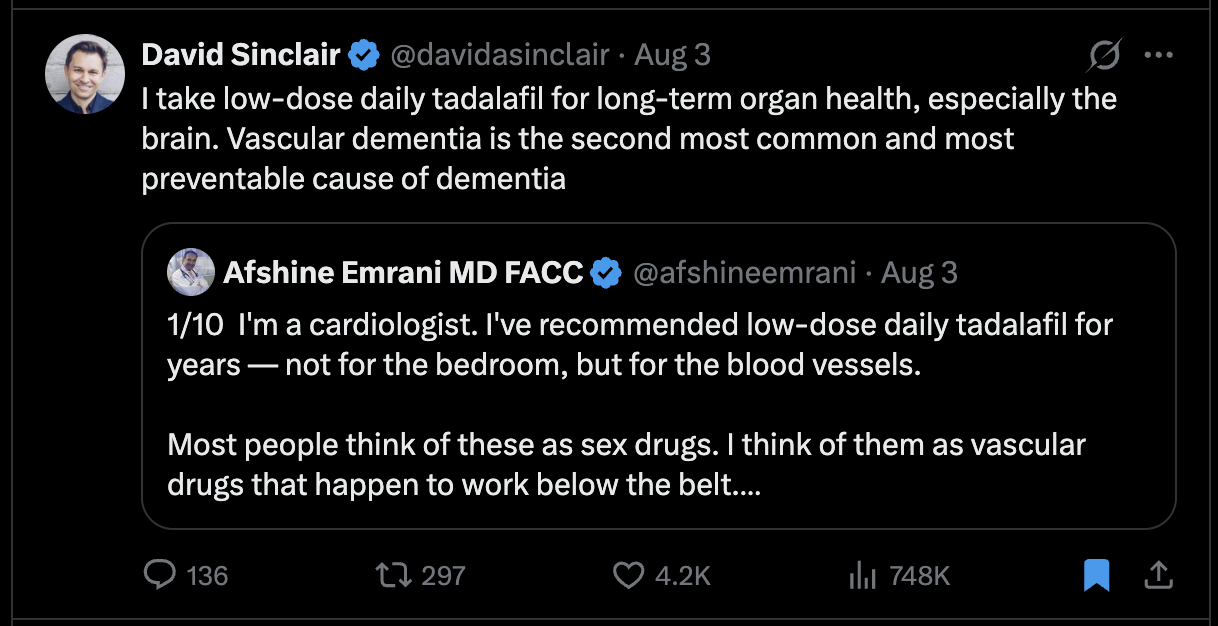
Note: the Rapamycin dose is 1mg daily
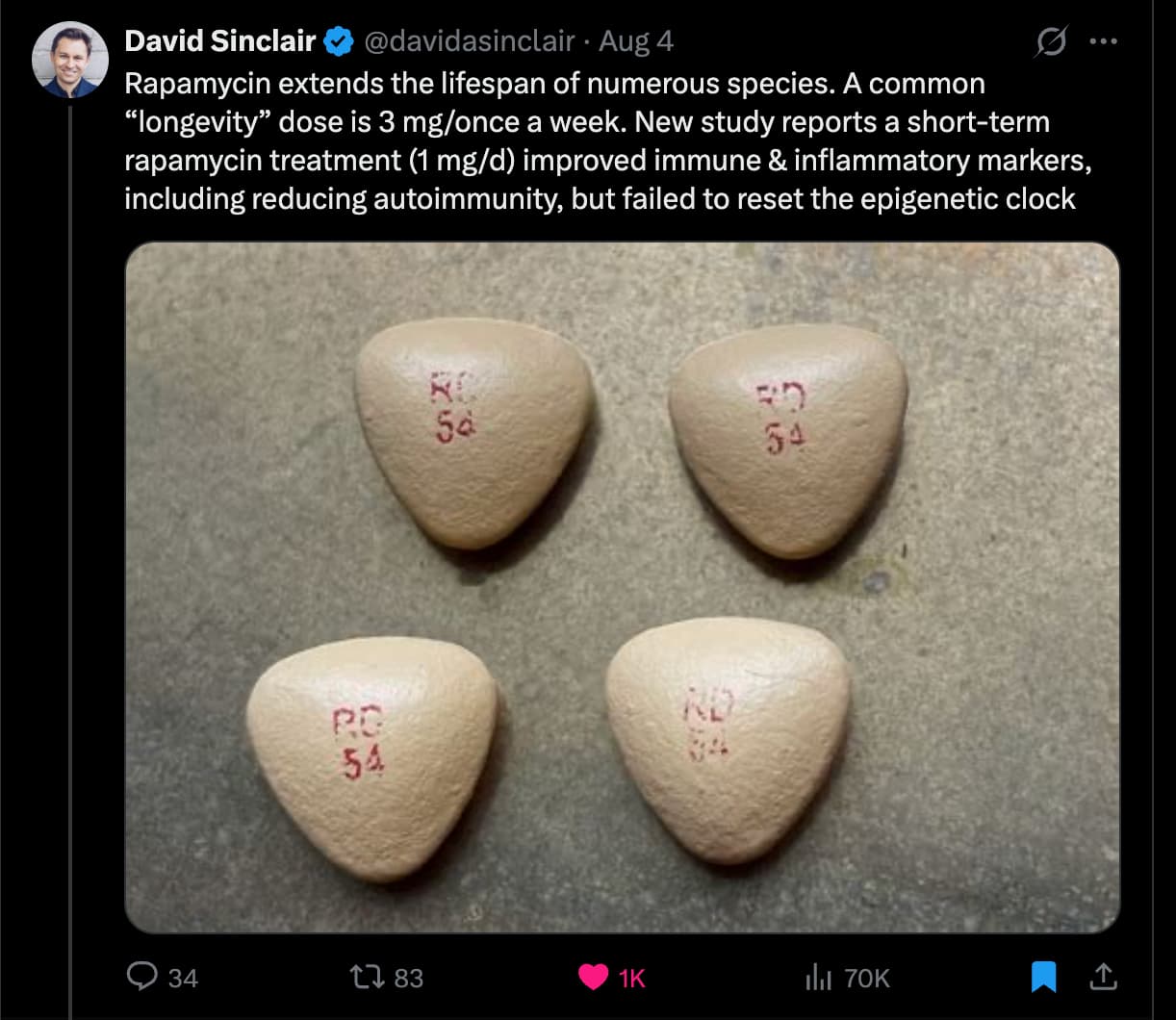
https://academic.oup.com/jimmunol/article/215/Supplement_1/vkag141.802/8745417?login=false
4 Likes
Good to see some dosing protocols from professionals.
My urologist put me on tadalafil years ago for vascular health. The side effects aren’t too bad every morning either… if you are a dude … you know.
My rapamycin dose is 6 mg rapamycin weekly… straight…no GFJ or VOO. 3 months rapamycin… one month HGH. Repeat.
1 Like
Another Rapamycin study showing 1mg daily yields benefits. At this point, we might have more positive human data with that dose than we do with intermittent (not that we have a large sample size to go off of).
3 Likes
I have held the view that if you want to “tame” the hypoactive mTor (per Dr Kennedy) as we aging, a daily dose with some breaks indeed may be better.
I would just follow my NLR ratio to decide if I am not overly depressing my immune function.
To have weekly dose means creating a rebound every time, does the rebound increasingly higher?
2 Likes
Thanks for the info on your experiences. I just started sildenafil recently. Have 50 mg tablets that I break in half for once-a-day dosing (25 mg). I have started taking it only on workout days for the benefit there. I have started buying it from Friday Plans that you constantly see ads on TV. About a buck or so a pill. Not sure what you pay for stuff from India, but would be interested in knowing.
1 Like
Damn… that’s a let’s get jiggy dose!
I take 5 mg daily… and get plenty of effect.
He was talking about Viagra, not cialis. 25mg is a low dose of viagra
1 Like
I don’t know why I keep doing this to myself but whenever I attempt to start taking Tadalafil again, my eyes get extremely red and it’s like that all day. I am surprised more people don’t mention that side effect. I am usually not an outlier when it comes to certain side effects.
3 Likes
If I was interested in tadalafil (I’m definitely not!), this is what would stop me dead in my tracks - the pretty high risk of eye problems, and even hints of ototoxic effects (hearing). Even if you don’t experience diagnosable severe pathology, it may still put detectable strain on your eyes (10% of users), and who knows what is happening that you’re not feeling in the moment - no thanks. YMMV.
7 Likes