A reasonably good summary of the state of things:
One thing I have noticed from my stack is that I am much more tolerant to stress and anxiety. I can keep my cool a heck of a lot better nowadays.
My own experience says it’s mainly the lithium. 
I think you are correct. It’s amazing what lithium does. I love it!
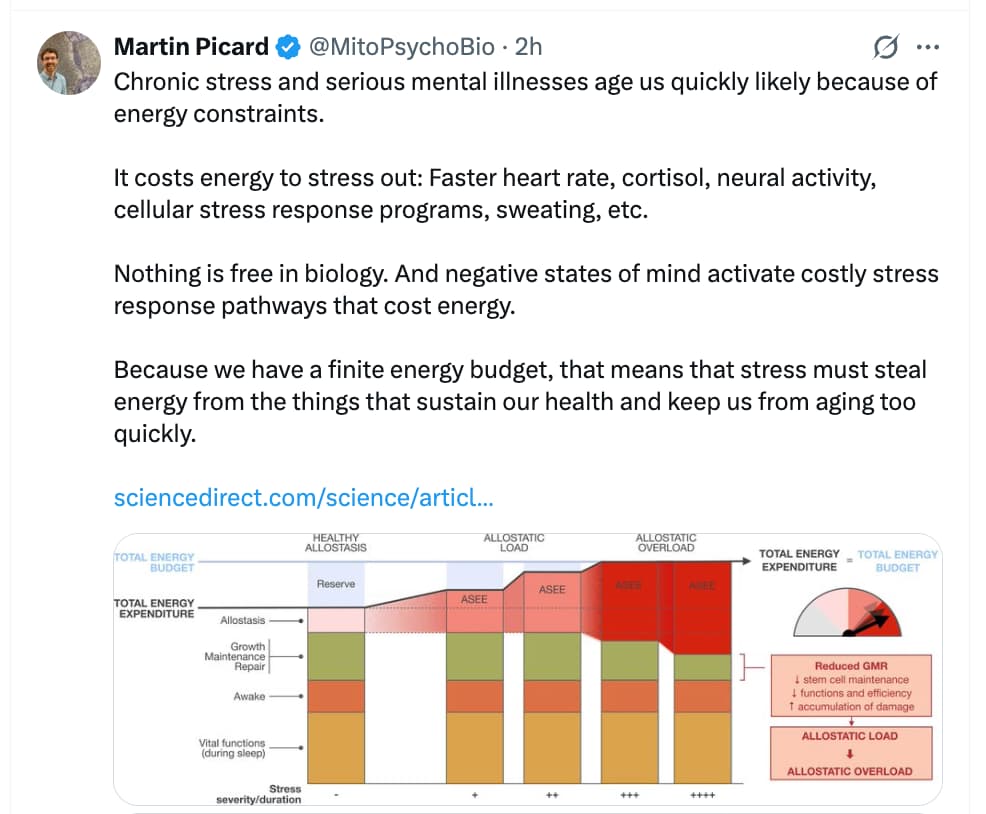
Paper: https://www.sciencedirect.com/science/article/pii/S030645302200292X?via%3Dihub
Source: https://x.com/MitoPsychoBio/status/2039739832985915403?s=20
All the more reason to chill and relax. 
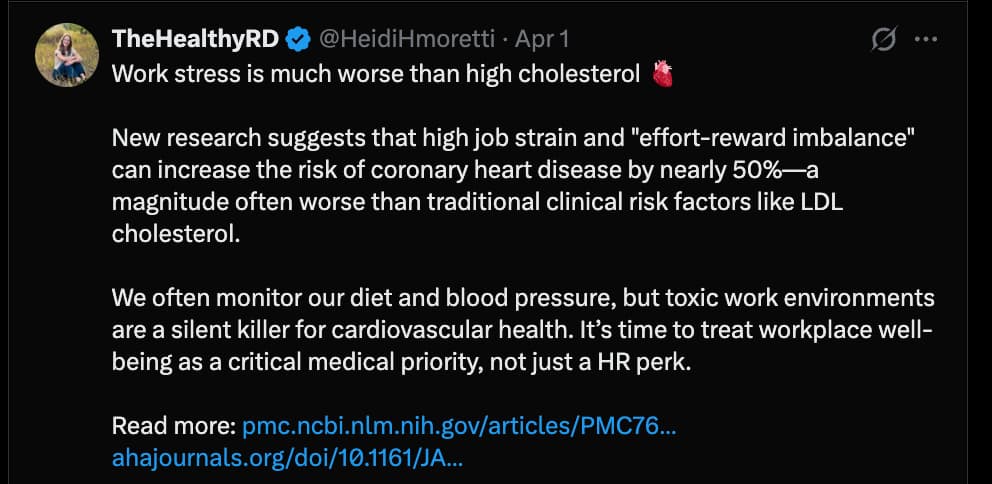
Psychological Stress as a Risk Factor for Cardiovascular Disease: A Case-Control Study
Paper: Psychological Stress as a Risk Factor for Cardiovascular Disease: A Case-Control Study - PMC
Association of Low‐Density Lipoprotein Cholesterol Levels with More than 20‐Year Risk of Cardiovascular and All‐Cause Mortality in the General Population
Paper: https://www.ahajournals.org/doi/10.1161/JAHA.121.023690
“ …Because we have a finite energy budget….”
Maybe finite (vs infinite) but not fixed / unchangeable. Build mitochondria to increase the energy budget. Exercise is good for a lot of things.
I do not see how any assertions in that tweet can be derived from the linked studies.
Published in 2020 (‘New research suggests…’  )
)
Six month single site observational study of a hundred Afghans with cardio events that brought them to the hospital, with the family/friends/caregivers that accompanied them used as controls. No adjustments for… anything. Based on a questionnaire filled out after the event.
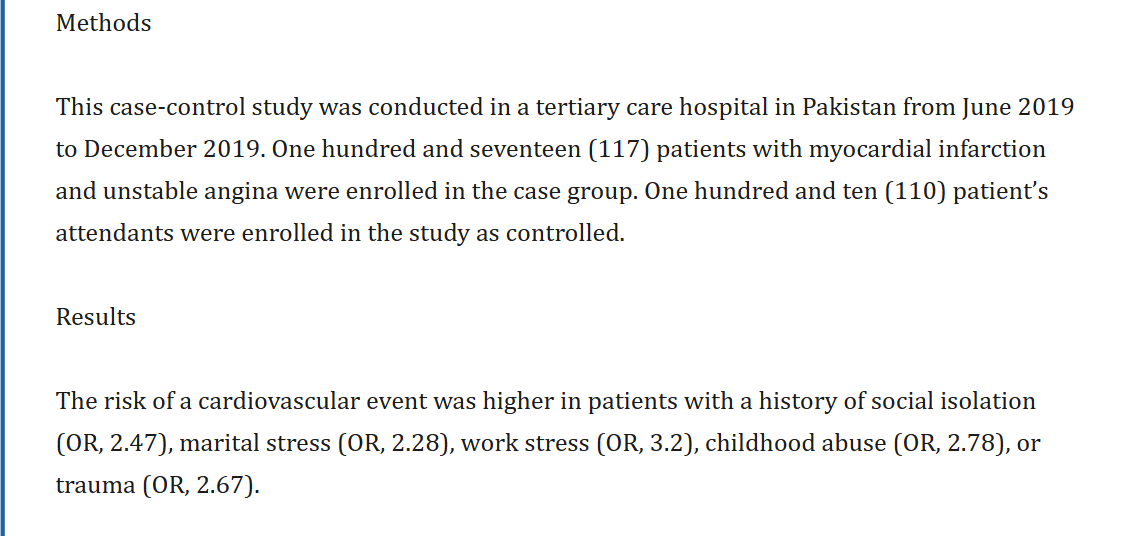
This is the money quote from the second study (which is from 2022): Summarized - ‘LDL > 100 healthier than LDL <70’.
After adjustment for age, sex, race and ethnicity, education, socioeconomic status, lifestyle factors, C‐reactive protein, body mass index, and other cardiovascular risk factors, individuals with LDL‐C<70 mg/dL, compared to those with LDL‐C 100–129.9 mg/dL, had HRs of 1.45 (95% CI, 1.10–1.93) for all‐cause mortality, 1.60 (95% CI, 1.01–2.54) for CVD mortality, and 4.04 (95% CI, 1.83–8.89) for stroke‐specific mortality, but no increased risk of coronary heart disease mortality.
Looks like the ACC/AHA need to revise their new guidelines.
Can we ‘vaccinate’ ourselves against stress?
A traditional vaccine primes the immune system to build better defences. Researchers think we can do something similar to increase our resilience to the pressures and worries of life
It might sound strange to talk about inoculating ourselves against stress, but we might be able to do just that.
Just as a vaccine safely trains the immune system so it can defend against later attack, researchers think we can do something similar with stress.
This idea is often studied in military personnel. Exposing soldiers to simulations of stressful events, while giving them the tools and support to cope, can minimise the impact of future stress. In one study, cadets who received resilience training had lower cortisol levels in later intense military exercises than those who hadn’t received the training. Likewise, paramedics who have received resilience training are also at lower risk of developing post-traumatic stress disorder (PTSD) and depression.
Fortunately, most people don’t need military-style training to gain these benefits. Deliberately exposing yourself to manageable, everyday stress can build resilience, says Julie Vašků at Masaryk University in the Czech Republic.
Recent research shows that successfully navigating stressful situations remodels the brain, provoking changes across the “stress network”, including the prefrontal cortex, which regulates emotions; the hippocampus, involved in memory; and the amygdala, which detects threats. When people voluntarily face mild stressors, these circuits adapt in ways that make future challenges easier to handle and help your body return to baseline more quickly.
The key is that the stress must remain manageable. A mild stressor is a situation in which you feel some sort of bearable discomfort, says Vašků. “It cannot be overwhelming. Once it’s overwhelming, it’s traumatising.” She suggests going somewhere unfamiliar or speaking with people you wouldn’t normally approach. Additional support can help. “Bring someone else with you,” she says.
This kind of exposure therapy works well in adults, but should we apply it in childhood, too? Severe childhood adversity clearly increases the risk of later mental and physical health problems, yet small amounts of mild adversity may bring benefits. In rodents, continuous maternal separation from birth increases adult stress responses, whereas the same amount of maternal separation but given in small bursts produces more resilient adults. Similar patterns have been observed in primates exposed to short periods of maternal separation.
It is difficult to translate such findings to humans, and unethical to run comparable experiments. Still, Carmine Pariante at King’s College London suggests “we could be slightly less protective as a society”. By this, of course, he doesn’t mean deliberately exposing anyone to trauma, but occasionally allowing ourselves – and our children – to experience more manageable challenges.
Read the full story: Can we ‘vaccinate’ ourselves against stress? (New Scientist)
That sounds quite a reasonable suggestion. We do need a good understanding of how to manage the ANS. (Autonomic Nervous System).
“Managing” the ANS is a tall order. Maybe we can make progress with a few effective means to nudge it regularly back toward balance of sympathetic vs parasympathetic activation. I find my Pulsetto is useful used daily before bed. Breathing drills are more reliable, especially resonance frequency breathing which is nice way to meditate before bed. I should do breathing drills / meditation during the day, perhaps right after I workout. I think the issue is staying “on alert” too much of the time. Being productive all the time trains the body to not relax so well that I cannot relax without drugs (in the past).
You’re talking about this device? Buy Pulsetto Vagus Nerve Stimulation Device for Calm and Sleep
How long have you used it for? What are the benefits you’ve noticed?
Yes that’s the one. It’s a simple device that applies rapid electric pulses to each side of the neck in the vicinity of the vagus nerve. I don’t think there is any scientific proof that such a design works. The FDA approved device is implanted exactly on the vagus nerve. But, having used it for 2 years steadily, I can report it puts me to sleep. I use it everyday before bed and use it again if I wake up in the middle of the night. It definitely relaxes me. Perhaps it is a conditioned response but since it seems to work I keep using it.
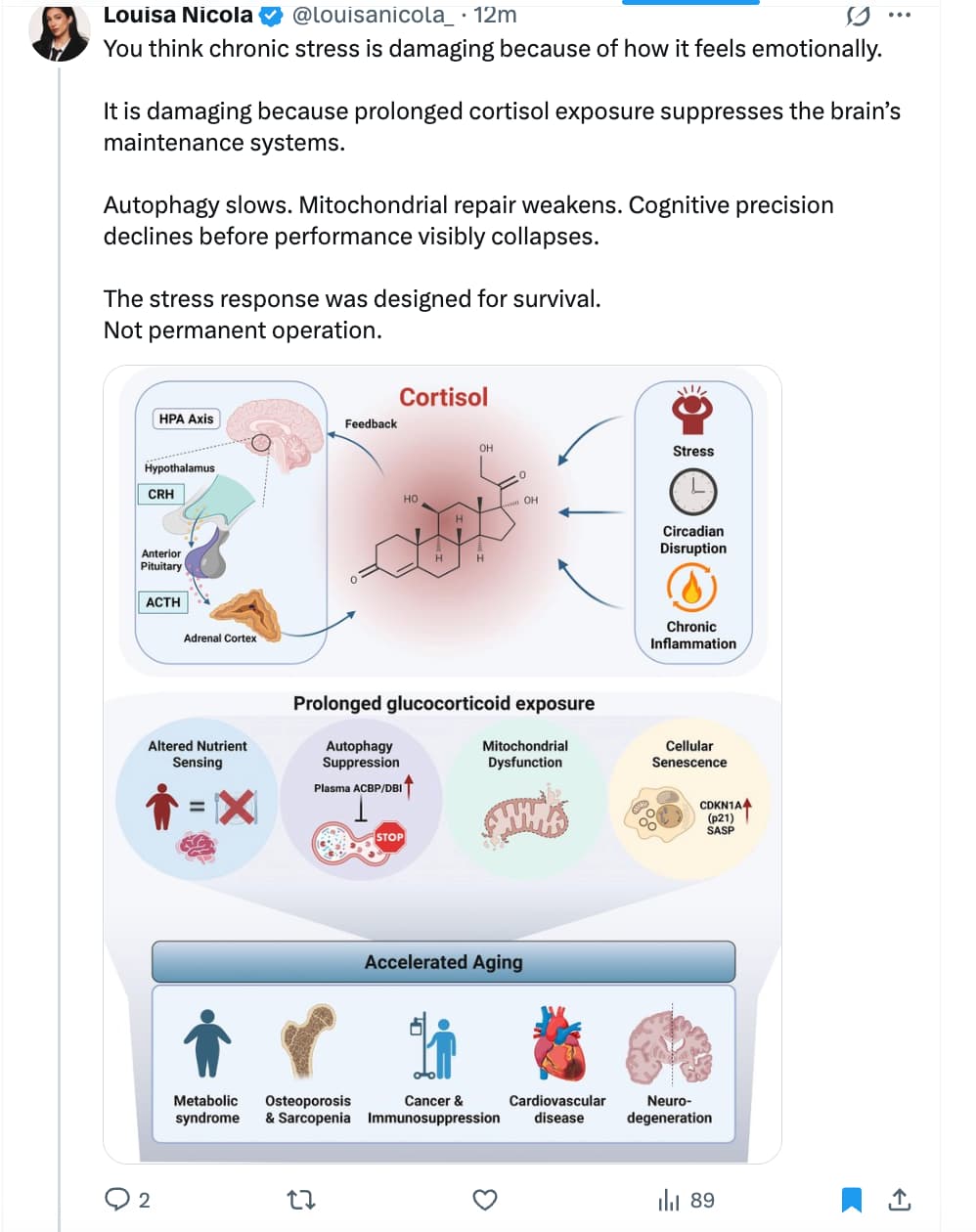
Source: https://x.com/louisanicola_/status/2060078590025519223?s=20
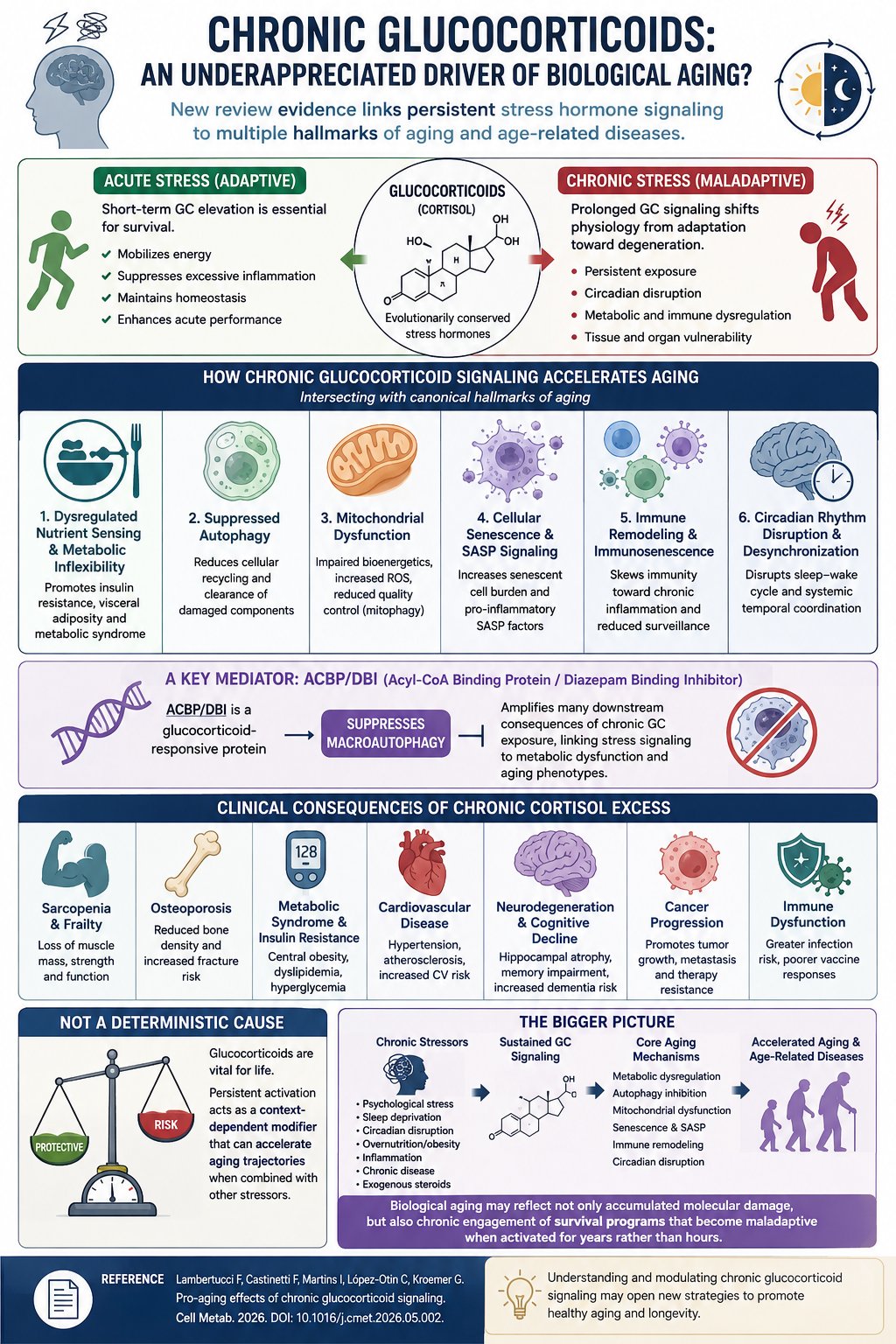
Paper: Pro-aging effects of chronic glucocorticoid signaling
The Lifelong Toll of Trauma: Cumulative Life Stress Permanently Depletes Aging Physiological Reserves
The World Health Organization introduced the paradigm of “intrinsic capacity” to serve as a holistic, multi-dimensional gauge of healthy aging, reflecting an individual’s combined physical and mental reserves across locomotion, vitality, cognition, psychology, and sensory health. While traditional longevity interventions prioritize metabolic, pharmacological, or genetic optimization, a prospective multi-cohort study published in 2026 reveals that psychological and environmental trauma across the life course acts as a direct drain on these biological reserves.
Analyzing data from 14,927 aging adults across the United States, England, and China, researchers tracked how exposure to stressful life events (SLEs)—such as childhood financial hardship, parental divorce, adulthood unemployment, or the death of a spouse—manifests as functional decline in later life. The findings demonstrate a clear, cumulative degradation of intrinsic capacity as stress accumulates across decades. Individuals who experienced trauma during both childhood and adulthood exhibited the steepest, most uniform declines in functional health across all three geographically and socioeconomically distinct cohorts.
Crucially, the study upends the assumption that early-life trauma is the sole definitive driver of chronic adult vulnerability. Adulthood stress independent of childhood history showed a more pronounced negative association with later-life intrinsic capacity than childhood stress alone. This lifelong accumulation of stress appears to “get under the skin,” potentially driving sustained hyper-activation of stress pathways and immune dysfunction. Ultimately, this depletes the physiological margins required to withstand the standard challenges of biological aging, accelerating functional decline long before explicit clinical disease states manifest.
Actionable Insights
For longevity enthusiasts and clinicians, the primary take-home message is clear: aggressive stress mitigation and psychological resilience frameworks are mandatory physiological requirements to maximize healthspan. The study highlights an alarming cumulative effect size: individuals exposed to trauma in both childhood and adulthood face a 24% to 28% higher relative risk of falling into the lowest tier of intrinsic capacity in late life (HRS RR = 1.25, ELSA RR = 1.28, CHARLS RR = 1.24). Even isolated adulthood stress increases this risk of low functional capacity by 10% to 24% across populations.
To preserve long-term functional reserves, individuals must actively engage in somatic and psychological interventions that modulate the perceived severity of threats and lower chronic cortisol burdens. This includes establishing highly active social and objective support systems, which have been shown to buffer against adulthood adversity. Furthermore, because the negative impacts of lifetime stress were found to be significantly stronger in younger-old adults compared to old-old individuals, these stress-deceleration strategies must be deployed aggressively during mid-life and early adulthood to protect biological reserves before irreversible baseline degradation occurs.
Source:
- Open Access Paper: Association of life-course stressful life events with later-life intrinsic capacity: A multi-cohort study
- Lead Institutions: School of Public Health, Zhejiang University School of Medicine (Hangzhou, China); Hubert Department of Global Health, Rollins School of Public Health, Emory University (Atlanta, GA, USA); UNSW Business School, The University of New South Wales (Kensington, NSW, Australia).
- Journal Name: The Journal of Nutrition, Health and Aging.
- Impact Evaluation: The impact score of this journal is 4.3, evaluated against a typical high-end range of 0–60+ for top general science, therefore this is a Medium impact journal.