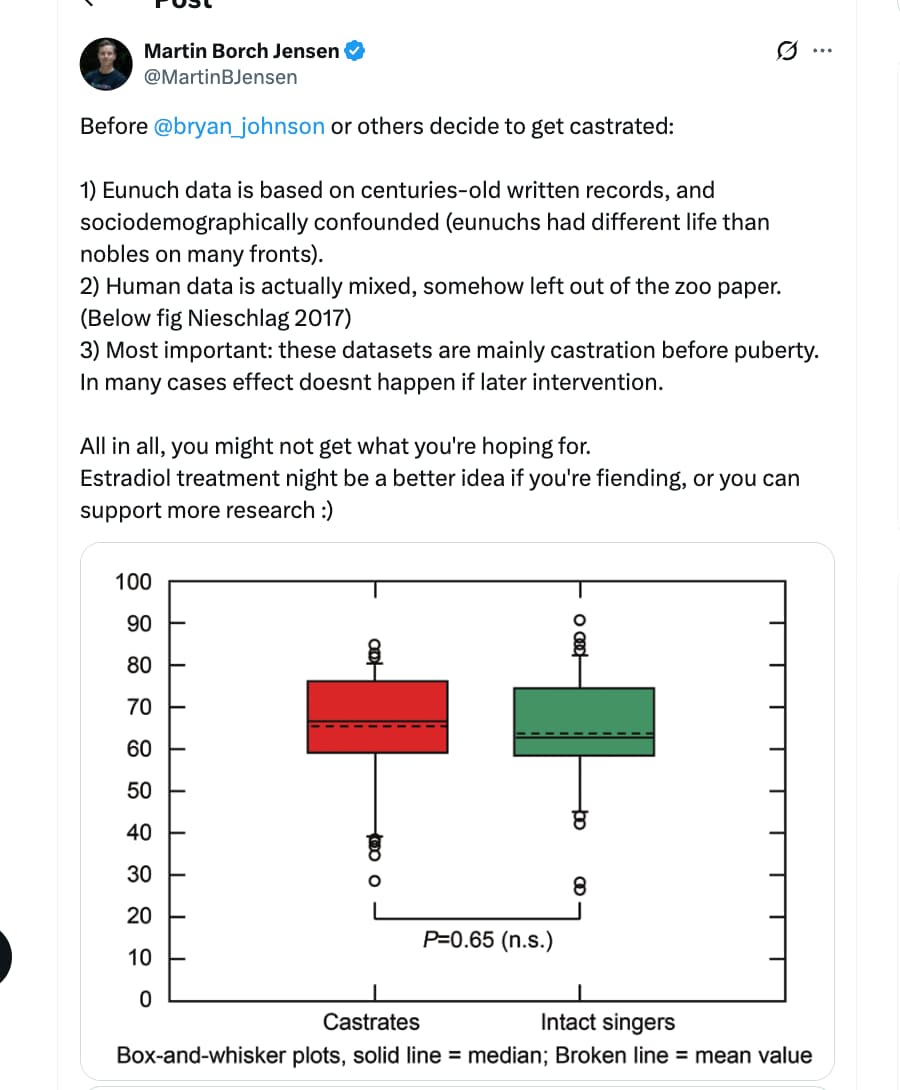
We’ve had this discussion before in another thread and taking 17a-estradiol or doing exercise achieves the same or better longevity results as castration. There is also frailty to consider.
Does finasteride extend lifespan? Is it DHT or testosterone that makes male lifespan shorter than female? (Or neither —both) It is embarrassing how much we don’t know at this late date.
As 17aE2 is a 5 alpha reductase inhibitor (Schriefers et al., 1991), one such mechanism might involve inhibition of testosterone’s conversion to dihydrotestosterone, which is a more potent binder of the AR. This could inhibit specific effects of testosterone on metabolism, which include protein anabolism and inhibition of urea cycling (Lam et al., 2017; Rossetti, Steiner & Gordon, 2017), and contribute to the observed elevation of amino acids and urea cycling. Under this hypothesis, inhibition AR expression in mice would be expected to inhibit 17aE2 responses, and other 5-alpha reductase inhibitors might induce similar effects to 17aE2.
Another related hypothesis is that the activity, metabolism and/or signaling effects of 17aE2 are dependent on testosterone, and without the presence of testosterone the biological effects of 17aE2 are weaker. Two of the liver metabolites that showed strong, sex-specific responses to 17aE2 were the estrogenic compounds estriol-3-sulfate and 16-oxoestradiol 3-sulfate—products that can be generated from metabolism of estradiol. Estriol is produced from the placenta during pregnancy in females and during nonpregnant states is generated from estradiol or estrone via 16-alpha hydroxylation (Longcope 1984).
With 5ar inhibition at least, the causal pathway for how it extends lifespan in male mice could be reduction of prostate cancer death rates which likely make up a significant portion of all deaths in male mice (since mice primarily die of cancer).
Sounds plausible as it seems consistent with the antagonistic pleiotrophy model. The hormones and other factors that contribute to fecundity and growth may be harmful in old age.
My N=1 experience: had a healthy pregnancy and healthy baby at age 34, but shortly after had two miscarriages, and then very early menopause. So my fecundity was short lived. (I realized that I had probably had my child at the last possible moment). Will never know for certain whether there was something “wrong” with me or whether my early fertility shutdown was just another expression of my overall low-growth, catabolic-leaning phenotype.
My internet friend has tried N=1 experiment. Here is his experience:
"To be precise, during the first week after my testicle removal, the scrotum area was painful and bruised. The swelling made the skin look so puffy that for a moment I even thought the two “eggs” were still there, just hidden in the edema.
The fatigue eased by the third day after surgery. I started getting out of bed to buy breakfast, but I couldn’t shower—only wipe my body with a warm towel to prevent infection, and take antibiotics as instructed.
Later, I began to feel weak and tired easily, always wanting to sleep. This was a sign that the last bit of testosterone in my body had finally metabolized. At that moment, my eunuch-like physiology had begun. A month later, the scrotal swelling disappeared and the skin became dry—like a lantern with the air let out. I used to have oily skin, but now I needed moisturizing spray just to feel comfortable.
A year later, I started experiencing hot flashes and sweating. Even though I worked out daily, I couldn’t maintain my muscle mass.
The following year, I gained more than ten jin (about 5–6 kg), even while dieting. I also lost a lot of muscle. My friends said I looked like a frail, bookish scholar.
I lost interest in sex. I just want to save money—save enough to open a milk tea shop, then a flower shop. And that’s how I plan to spend the rest of my life."
Gosh, that n=1 is hardly a compelling endorsement - sounds more like a mini horror movie!
I had a friend in Uni who lost one testicle trying to jump over a fence post. He was a huge Star Wars fan. After that incident, we nicknamed him “Only one kenobi”
RapAdmin, Anyone who researches the Castrati Singers of Italy in the late 16th century will not find a pretty picture. The Catholic Church allowed pre-pubescent boys to be castrated in order to retain their high-pitched voices into adulthood because women were not allowed to sing in choirs. This happened almost exclusively to boys from poor families with the hope of possible economic gain. However, very few ever reached the level of successful Castrati with it’s accompanying fame and large incomes.
The Castrati, successful or not (mostly not), had a host of health problems listed here from ChatGPT:
Concise Summary of Health Problems in Castrati
Permanent hypogonadism: Absence of testosterone led to lifelong endocrine deficiency.
Abnormal skeletal development: Delayed epiphyseal closure caused tall stature, long limbs, narrow shoulders, wide hips, and eunuchoid body proportions.
Low bone density: High risk of osteopenia, osteoporosis, and fractures.
Reduced muscle mass and strength: Sarcopenia with increased fat mass.
Sexual dysfunction and infertility: Absent or markedly reduced libido; complete sterility.
Metabolic vulnerability: Likely increased risk of insulin resistance and frailty with aging.
Cardiopulmonary effects: Altered thoracic mechanics; not clearly protective or harmful overall.
Psychological morbidity: Elevated risk of depression, identity disturbance, social isolation, and trauma-related effects.
Surgical risks in childhood: Infection, hemorrhage, and mortality from non-sterile castration procedures.
Whew! That’s a lot of problems for a possibly longer life.
Maybe the title of this thread could be more appropriately named the “Two Off” Procedure! It makes me shudder just to think about it. Anyone who has witnessed the castration of piglets probably has a vivid memory of that event. And, that memory alone is enough for me to say “No Way Jose!”