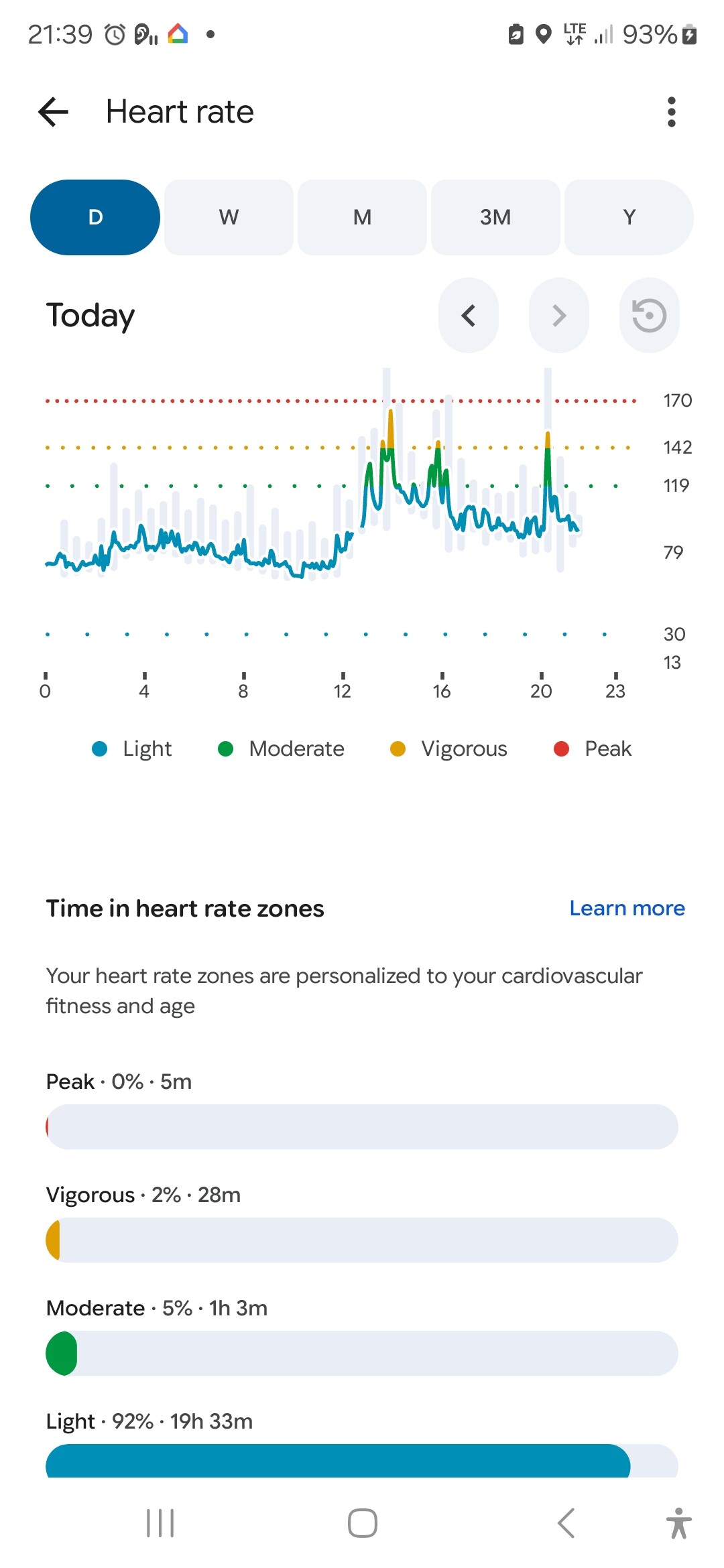
Not totally HIIT. But you can get this simply by running uphill, esp to catch buses (like I did to catch the 101 today…)
I often do this by just barely managing to catch buses (there is risk b/c I sometimes jaywalk in the process)
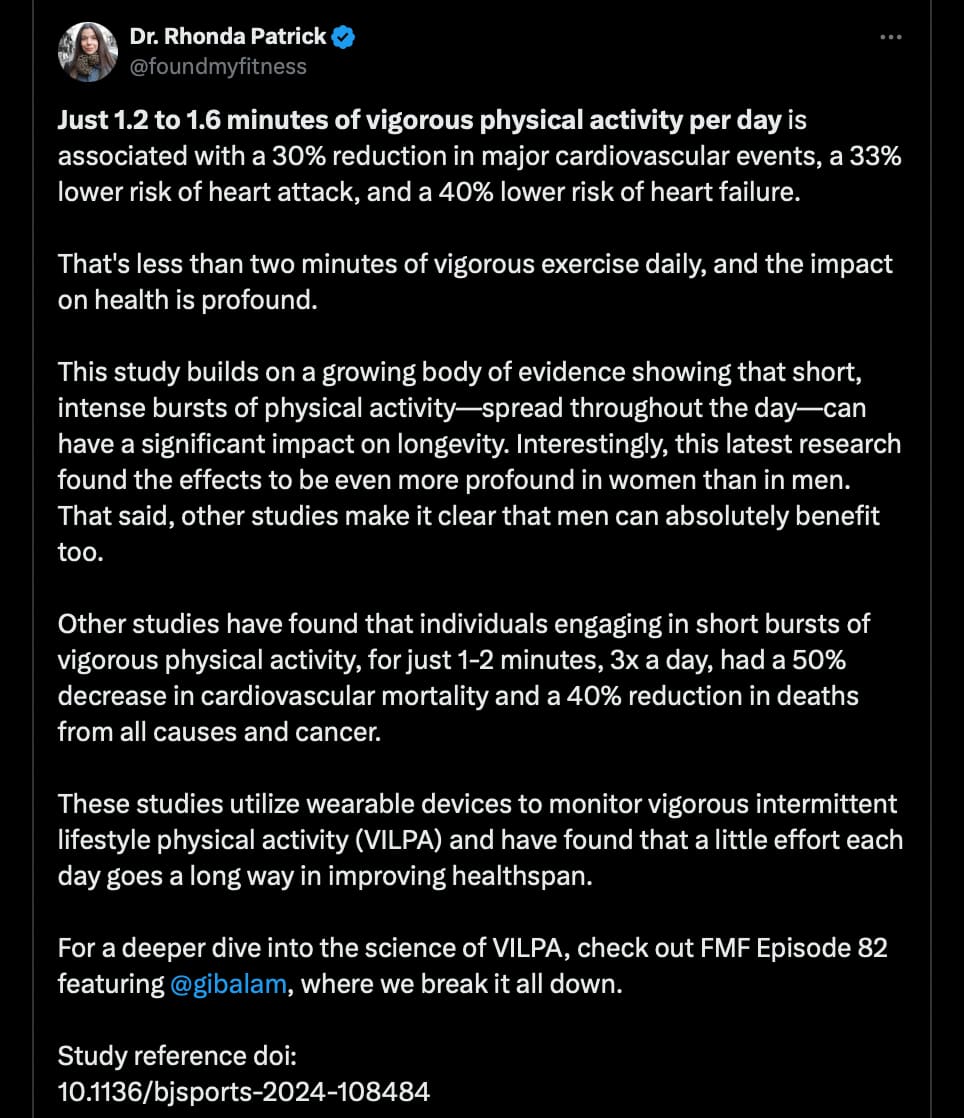
Just 1.2 to 1.6 minutes of vigorous physical activity per day is associated with a 30% reduction in major cardiovascular events, a 33% lower risk of heart attack, and a 40% lower risk of heart failure.
That’s less than two minutes of vigorous exercise daily, and the impact on health is profound.
This study builds on a growing body of evidence showing that short, intense bursts of physical activity—spread throughout the day—can have a significant impact on longevity. Interestingly, this latest research found the effects to be even more profound in women than in men. That said, other studies make it clear that men can absolutely benefit too.
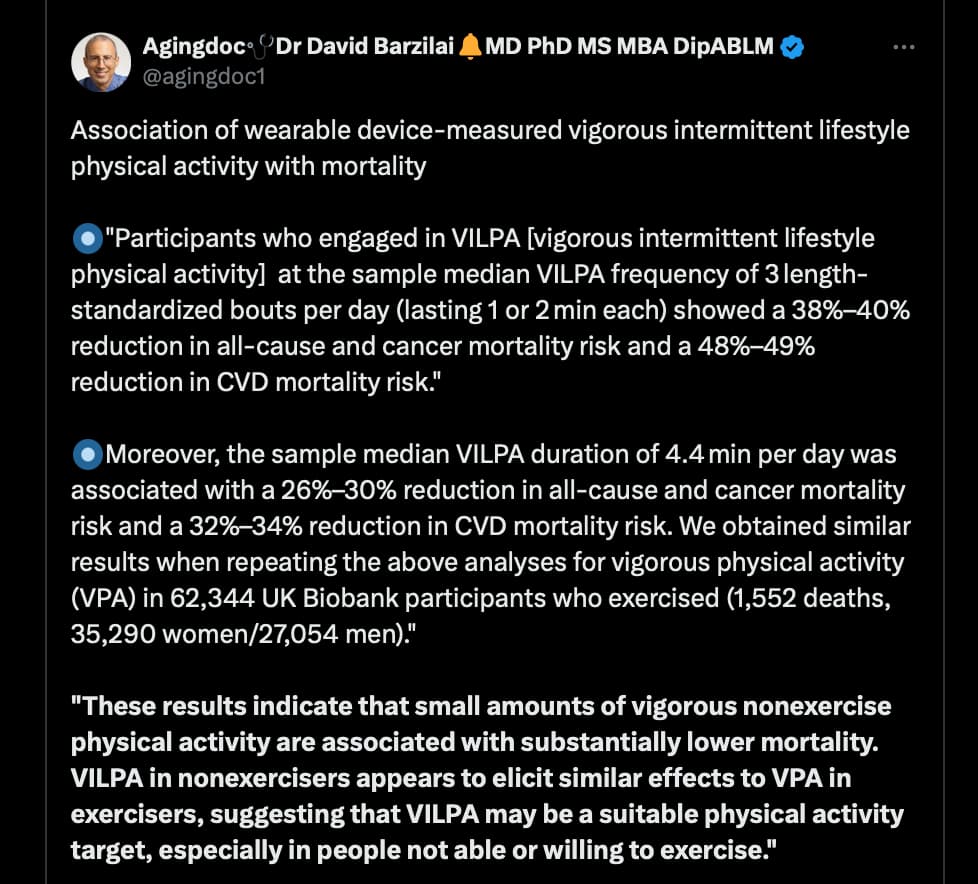
Other studies have found that individuals engaging in short bursts of vigorous physical activity, for just 1-2 minutes, 3x a day, had a 50% decrease in cardiovascular mortality and a 40% reduction in deaths from all causes and cancer.
When I swim for 20 minutes, I just make sure I sprint for at least 100m… Either 25m or 50m at a time. Your heart rate needs to be over 80% of your max. I get close to 95% for at least 1 or 2 minutes, 4x a week. Aim for about 6 to 7 minutes a week of high intensity.
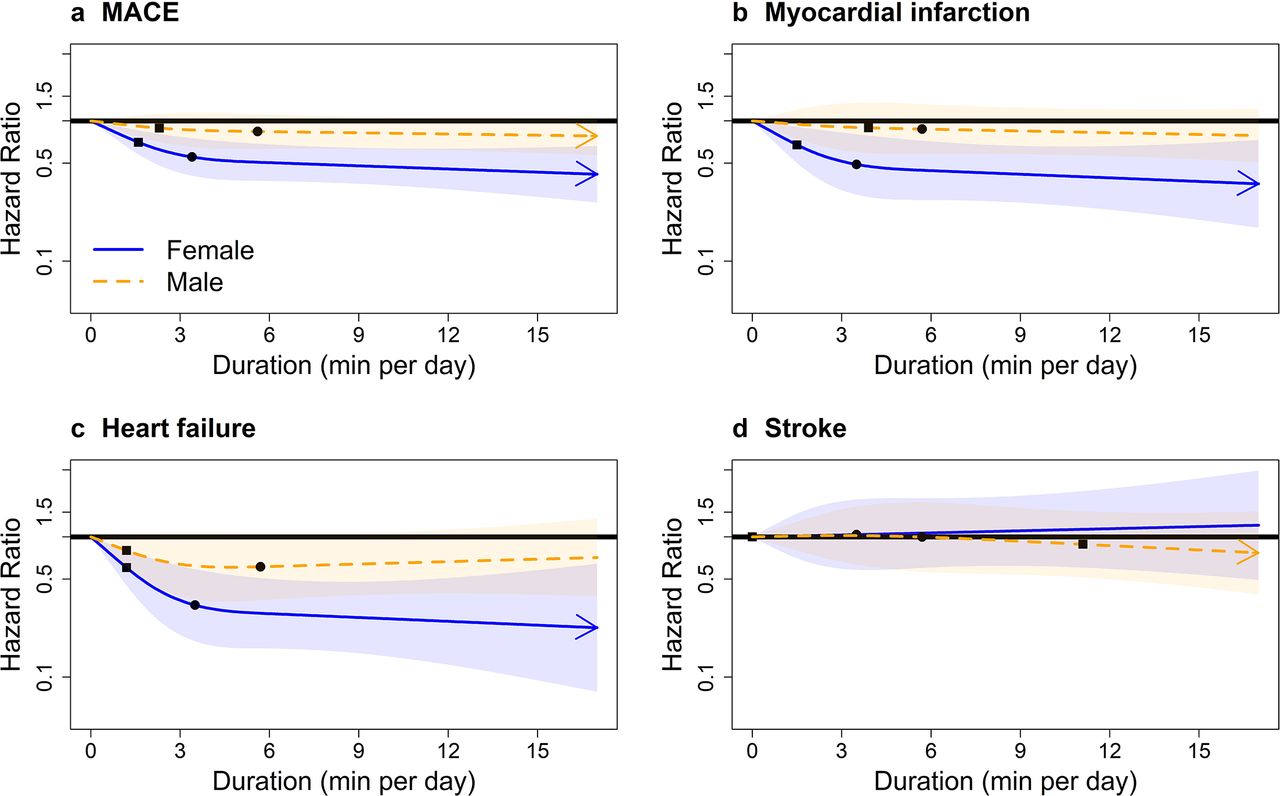
⇒In women, VILPA exhibited a near- linear dose–response association with most major adverse
cardiovascular events. Such associations were
less evident in men.
⇒Small amounts of VILPA in women were associated with substantially lower risk of
overall major adverse cardiovascular events, myocardial infarction and heart failure.
⇒Women’s median VILPA duration of 3.4 min per day was associated with 45% (25% to
59%) lower risk of overall major adverse cardiovascular events; and with 67% (41% to
82%) lower risk of heart failure.
Anyone can absolutely do it at home, no matter how small the space. You simply do very vigorous “high knees” in place. You have to be quite fit to do 2 minutes of vigorous high knees. Most people can’t do 10 seconds. It’s far more challenging than 2 minutes of burpees. Plus you need less space to do high knees than burpees. If you have enough space to stand straight and bend your knees to 90 degrees, that’s all the space you need, i.e. you can do it literally anywhere, including a sidewalk.
That said, I’m not sure about this research. If you can do a SIT (Sprint Interval Training - supramaximal effort) or a burst of vigorous high knees for 2 minutes, you are already in exceptional shape - I have no doubt such people have 50% lower ASCVD mortality compared to the average person out there. In fact, even well trained athletes can manage about 30 seconds of SIT, so 2 minutes is the top elite. It’s a chicken egg problem.
Probably no lower limit, but usually more is better. Depending on mood, music, and weather, I do from 10-20 sprints, with a good breather in between. Running is euphoric.
The amount of movement required to blunt a glucose spike is far smaller than almost anyone assumes.
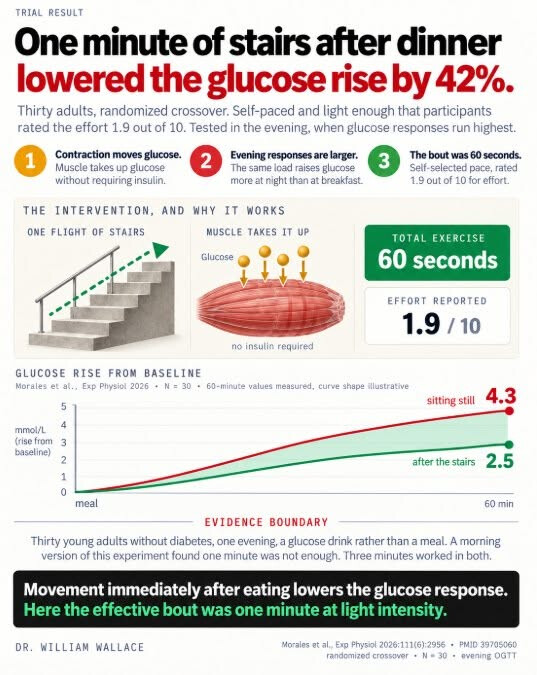
Contracting muscle takes up glucose without insulin. The transporter responsible, GLUT4, moves to the muscle cell surface in response to two separate signals, and contraction is one of them. That is why movement lowers blood sugar in people whose insulin signalling works poorly, and why the effect appears within minutes rather than requiring any training adaptation.
A 2026 trial tested how small the dose could go. Thirty adults completed two evening sessions after a 75 gram glucose drink, one seated and one with a single minute of stair stepping at a self selected pace. Participants rated the effort 1.9 out of 10, which is barely above sitting. The rise in blood glucose from baseline to 60 minutes was 2.5 millimoles per litre after the stairs against 4.3 after sitting, a difference of about 42 percent. Total glucose exposure over the session was lower as well. The evening was chosen deliberately, because the same carbohydrate load raises blood glucose more at night than in the morning.
One minute sits right at the edge of what works, and it does not work everywhere. The same research group ran the identical comparison in the morning with 1, 3 and 10 minute bouts. Three minutes and ten minutes lowered glucose. One minute did not, and the result was nowhere near significant. Then they ran it again after a real mixed meal of 650 calories rather than a glucose drink, and one minute did work, lowering glucose by 14 milligrams per decilitre. So the honest reading is that one minute is enough after a normal meal and enough in the evening, but not reliably enough after a morning glucose challenge. Three minutes worked in every version. If you want a duration that is robust across conditions, it is three, not one.
Timing turns out to matter more than duration. A 2023 meta analysis of eight crossover trials in 116 people, about 40 percent of whom had type 2 diabetes, compared exercising before a meal, after a meal, and not at all. Exercising after the meal beat exercising before it and beat doing nothing. Exercising before the meal was statistically indistinguishable from doing nothing at all. The analysis also found that the gap between finishing the meal and starting to move independently predicted the size of the benefit, with shorter gaps producing larger effects. A short walk taken immediately outperforms a longer one taken an hour later.
What this changes: not whether you exercise, but what you do in the ten minutes after you finish eating. Sitting down is the default and, for some people, it is the worst option available. Stairs if you have them, a walk if you do not, and starting sooner matters more than going longer.
==
idk, cole k (from anthropic) remembered that i once ate his chickpeas and i noticed my glucose spike and i ran outside for like 30 minutes and it didnt decrease the spike. but stair-climbing is a step extra.
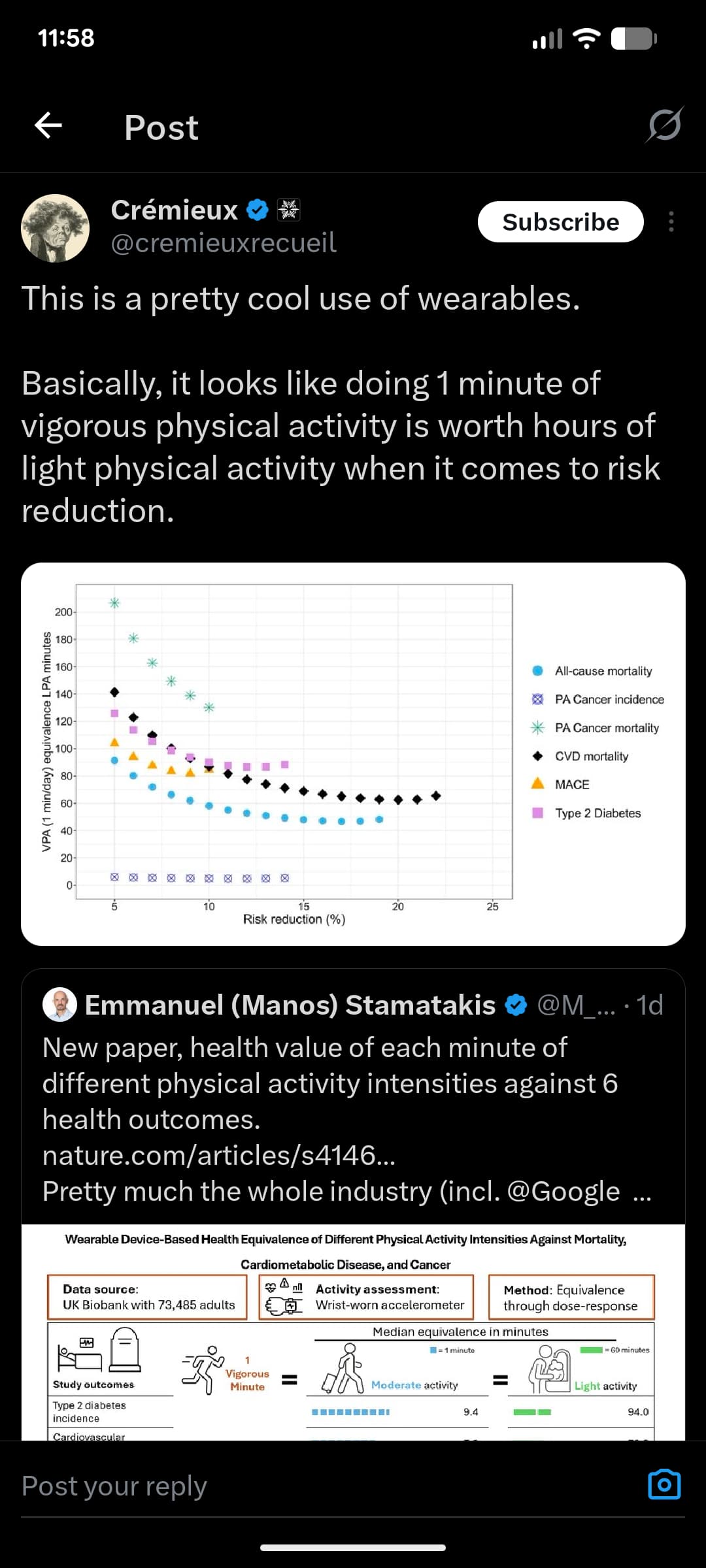
The typical amount of vigorous activity, like taking stairs at pace or carrying heavy shopping, was 4.75 minutes a day, and it came with 38% lower risk. The typical 24 minutes a day of moderate activity came with 33% lower risk. One vigorous minute matched about 6 moderate minutes or 47 light ones. Light activity showed no steady benefit as it increased.