Saw this mention of the pilot study here:
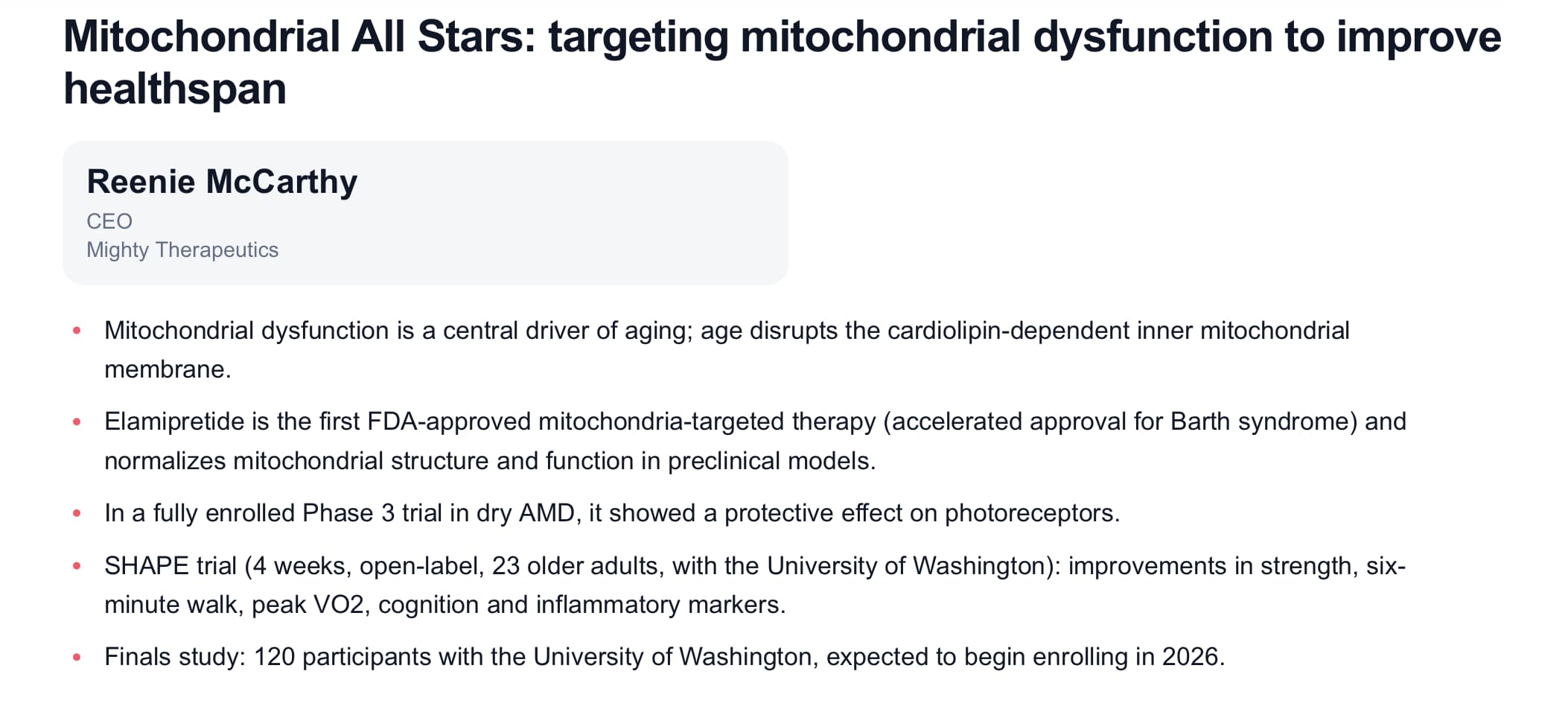
So had Claude find and summarize the data:
SHAPE Study
SHAPE is the Study of Healthy Aging and Physical function with Elamipretide, the Marcinek lab’s XPRIZE Healthspan pilot. The trial is real and well documented, but I could not find any public source for the N=23 or the efficacy numbers: no abstract, preprint, paper, or posted registry results.
What the trial is
- Registration: NCT07275424, an open-label, single-arm Phase 2a pilot of daily subcutaneous elamipretide in older adults.
- People: David Marcinek (University of Washington) is sponsor-investigator, with Stealth BioTherapeutics as collaborator. Suman Jayadev is co-investigator, and visits ran at the Fred Hutchinson Cancer Center Prevention Center. Stealth is now Mighty Therapeutics.
- Design: 4 weeks of daily injections, a midpoint phone check, post-intervention visits mirroring baseline, and a 2-week follow-up, with planned enrollment of 30.
- Dose: the registry gives no milligram dose, only an 80 mg/mL multi-dose vial. The 40 mg/day used in earlier trials is likely, but that is my inference.
- Population: ages 65 to 80, with VO2peak at or below 37.3 mL/kg/min (men) or 25.7 (women), no exercise routine, and no CoQ10, creatine, or L-carnitine.
- Primary endpoint: treatment-related adverse events and completion of 4 weeks of injections.
- Secondary endpoints: BDNF, VEGF, IGF-1, IL-6, and TNF-alpha; six-minute walk; MoCA, Trail Making A and B, and Stroop; one-rep-max knee extension.
Peak VO2 is an inclusion criterion but not a registered outcome, so any VO2 result is outside the prespecified endpoint list.
Timeline and what has been disclosed
- November 2025: the trial started on November 26, with primary completion estimated for March 15, 2026.
- April 2026: Marcinek said data collection had just finished, and findings were expected at the American Aging Association meeting in June. I found no abstract from that meeting.
- May 2026: David Brown of Stealth presented SHAPE data at a Reagan-Udall Foundation meeting, reported only as encouraging open-label functional gains over 30 days.
- August 2026: the team won a $1 million XPRIZE Milestone 2 award premised on the pilot data. The press release has no numbers, and Marcinek calls the results feasibility data.
- Registry today: still listed as recruiting, last updated December 2025, no results posted.
The XPRIZE landscape report says 9 of 10 awardees submitted small randomized trials and one submitted a single-arm open-label study, which matches SHAPE’s design. That report’s awardee lookbook (page 78) is the most likely origin of your summary line, but I could not extract that page.
How much weight the claims can bear
- Evidence level: uncontrolled pre-post data from a small, sponsor-partnered pilot, with no public effect sizes, confidence intervals, completer counts, or adverse event data. High confidence the direction was reported as positive; low confidence in magnitude or causality.
- Regression to the mean: participants were selected for low VO2peak, so some rebound in that measure is expected without any drug effect.
- Practice and effort effects: six-minute walk, one-rep max, Trail Making, Stroop, and MoCA all improve on retest, and open-label participants may push harder.
- Enrollment: if 23 is correct, the trial fell short of its planned 30. Whether 23 means enrolled or completers is unknown.
- Controlled history: a single-dose randomized trial in 39 older adults improved mitochondrial ATP production. But in the Phase 3 mitochondrial myopathy trial, week-24 walk gains were about 15 m on drug versus 17 m on placebo, and an earlier trial found VO2 changes no different from placebo.
- Conflict of interest: Marcinek has been a paid scientific advisor to Stealth.
What comes next
A Phase 2 double-blind, placebo-controlled trial will test one year of treatment on muscle, cognition, and immune health, running through 2029. Under XPRIZE rules, a team must show at least 20% more participants than control achieving meaningful improvement across all three domains.
Sources:
- ClinicalTrials.gov NCT07275424
- ITHS study listing
- Marcinek lab SHAPE page
- Mighty Therapeutics press release, Aug 11, 2026
- UW ISCRM feature, Oct 5, 2026
- Longevity.Technology, Apr 2, 2026
- Longevity.Technology, Jul 9, 2026
- XPRIZE Healthspan 2026 Innovation Landscape Report
- XPRIZE finalist announcement
- Single-dose elamipretide trial in older adults (PMC8282018)
- MMPOWER-3 results, NCT03323749
- MMPOWER dose-escalation trial, Neurology
- Mitchell et al. 2025, Aging Cell