Antihypertensive medications and risk for incident dementia and Alzheimer’s disease: a meta-analysis of individual participant data from prospective cohort studies
Isn’t the contradiction that one study showed olmesartan to be superior to all other ARBs regarding HR for dementia and the other study showed BBB crossing ARBs to be superior. And of course, olmesartan is not a BBB crossing ARB.
I wonder but hard to do on phone - is the cluster of non BBB ARBs heavily weighted by other ARBs? Losartan is mixed but I think they classified as non crossing. Losartan being the most commonly used in the US.
Candesartan and telmisartan are the most common in Australia, fwiw. So AUS strongly favors the BBB crossing drugs and the US does not.
“After controlling for major modifiable lifestyle factors such as diet and physical activity, ARB use was linked to a significantly reduced risk of dementia compared with ACEI use (hazard ratio [HR] = 0.72; 95% confidence interval [CI]: 0.65-0.80, p < 0.001). In exploratory agent-level analyses, compared with lisinopril, olmesartan (HR = 0.32 ; 95% CI: 0.16-0.62), candesartan (HR = 0.41 ; 95% CI: 0.24-0.69), telmisartan (HR = 0.42 ; 95% CI: 0.25-0.71), irbesartan (HR = 0.45; 95% CI: 0.27-0.75), and perindopril (HR = 0.52 ; 95% CI: 0.31-0.87) were associated with a significantly lower risk of dementia, while captopril showed a significantly increased risk (HR = 4.9 ; 95% CI: 1.04-23.4).”
And also, from the same report, for ACM, we have:
“All-cause mortality risk
Results indicated a significant reduction in the risk of death for ARB users compared to ACEI users (HR = 0.77; 95% CI: 0.73–0.82, p < 0.001). In exploratory agent-level analyses, olmesartan showed the greatest risk reduction (HR = 0.64; 95% CI: 0.56–0.74), followed by telmisartan (HR = 0.91; 95% CI: 0.85–0.97) and candesartan (HR = 0.92; 95% CI: 0.86–0.98) compared with irbesartan (Table S9 ).
ARBs showed varied mortality risk compared to lisinopril. Olmesartan was associated with the greatest reduction in mortality risk (HR = 0.34; 95% CI, 0.24–0.48) (Table S9 ). Perindopril was linked to the lowest risk of death among ACEIs (HR = 0.70; 95% CI: 0.50–0.86) compared with lisinopril (Table S9 ). After excluding patients whose hypertension diagnosis was based solely on AHM records, ARBs were significantly associated with the reduction of all-cause mortality compared with users of ACEIs (HR = 0.80; 95% CI: 0.75–0.85) (Table S9 ).”
So, here we have a comparison against a common reference (lisinopril), and for dementia, death, ACM, we see Olmesartan showing massively lower dementia, death, ACM compared to Telmisartan and Candesartan.
Now in the new report, we have a comparison between two ARB classes, on the one hand we have BBB crossing ARBs Telmisartan and Candesartan, and on the other hand we have the BBB non-crossing ARBs including Olmesartan, Irbesartan, Losartan.
In table 3 (download the pdf) we see that if we use the BBB non-crossing ARBs including Olmesartan as reference HR 1.00, then the BBB crossing ARBs (telmi, cande) have dementia adjusted HR (95% CI), p-value of <0.001 - 0.84 (0.80-0.88) representing a 16% lower hazard ratio for dementia favoring telmi and cande vs olme. For ACM, again if we use olme as reference HR 1.00, then telmi and cande show adjusted HR (95% CI) p-value <0.001 - 0.83 (0.82-0.86) representing 17% lower hazard ratio for ACM favoring telme and cande compared to olme. For death from dementia, again if we use olme as reference HR 1.00 then telmi and cande show adjusted HR (95% CI) p-value <0.001 - 0.85 (0.79-92) representing 15% lower hazard ratio for death from dementia favoring telmi and cande compared to olme.
In summary, the contradiction between the two reports is as follows: in the first report (which you originally posted - and on which I commented extensively) Olmesartan had a massively lower HR for dementia and ACM compared to Telmisartan and Candesartan, and in the second report (which I originally posted) Telmisartan and Candesartan had a massively lower HR for dementia, death from dementia and ACM compared to Olmesartan.
Of course the thought occurred to me, but, well, in that first report irbesartan was marginally less protective against dementia compared to telmi and cande HR 0.45 for irbe, 0.41 for cande, 0.42 for telmi. I suppose theoretically losartan might be doing all the work, but that would have to be some epic level increase in dementia to overwhelm the massive protective effect of olme and non-significant irbe… we’d have panic clinical reports and withdrawal of the drug from the market as care facilities fill up with zombies on losartan.
And it would be a criminal level of misrepresentation by the research team to take the single best performer by many country miles - olmesartan - vs dementia, death, ACM compared to any ARB in the known universe and then lump it with such an epic malefactor as losartan would have to be in this scenario (irbe is statistically inert here), and then pronounce non-crossing ARBs as massively inferior in HR vs these maladies. I mean that’d be so egregious that the whole team would have to end up in handcuffs. I generously do not suspect them of such levels of prison bar gripping malfeasance. YMMV.
At least as far as dementia, in the posted first study, the intervals all overlap. Did they do a head to head on dementia with statistical significance? They went around saying olmesartan was better it isn’t when you look at the intervals.
Now for ACM, olmesartan was better.
But it seems to me like for dementia, ARBs are better than acei but nothing can be said in that study about the various ARBs.
Ah OK your point was for olmesartan. I didn’t ascribe much value to that olme paper. Need to see many papers pointing to the same thing to reach a conclusion. Telmisartan still king?
All this can be quite frustrating, if someone wants to tease out the most optimal medication for longevity.
There will never be a gold standard RCT comparing different ARBs and their effect on ACM or dementia. And epidemiological data is often riddled with intricate con founders: apart from the obvious, it’s things like people having different insurance based on occupation/location and therefore different ARBs covered - e.g. in Germany the guidelines for public health insurers have Telmisartan as a secondary choice only, due to longer lasting patent protection. But you still got it routinely prescribed, if you’re a teacher, government clerk or other public sector official - due to special health insurance for those folks.
So if I’m reading analysis of cohort studies I wonder: is the effect size between different interventions very notable? A 10% difference in epidemiological data barely moves the needle - maybe it does for ACM. And if there is a large effect size - what it the plausible mechanism? If there is just no plausible mechanisms, it’s difficult to take it serious.
So if an observational study concludes Captopril got a factor 4,9 increased dementia risk… So it’s competing with APO4 carriers, really? What could possibly be the mechanism then?
Olmesartan reduced all-cause mortality by 36% vs. only 8% in Telmisartan? That’s huge, almost unheard of. That’s on the level of starting exercise + diet change combined. So I wonder what’s driving that? It can’t be differences in dementia, unless it’s completely curative for Alzheimers (it’s not, that would be known) in addition to notable cancer effects vs. Telmi. So what’s the mechanism? For that to be plausible, Olmesartan would need to be completely curable for either cancer or ASCVD (compared to Telmi) or jointly all_dementia+road_accidents.
In another recent thread Your Aorta Knows Your Real Age, and Surgeons Are Not Asking - #8 by trojanrapamycin there is an explanation for how Olmesartan may be the only ARB that not only lowers BP but also heals aortic stretching caused by past high BP: In that post there is also a link to another thread where trojanrapamycin provides more details and citations about why Olmesartan is mechanistically superior to other ARBs for this aortic healing effect. Perhaps this explains how Olmesartan might lower mortality from congestive heart failure and Aortic dilation more effectively than other ARBs.
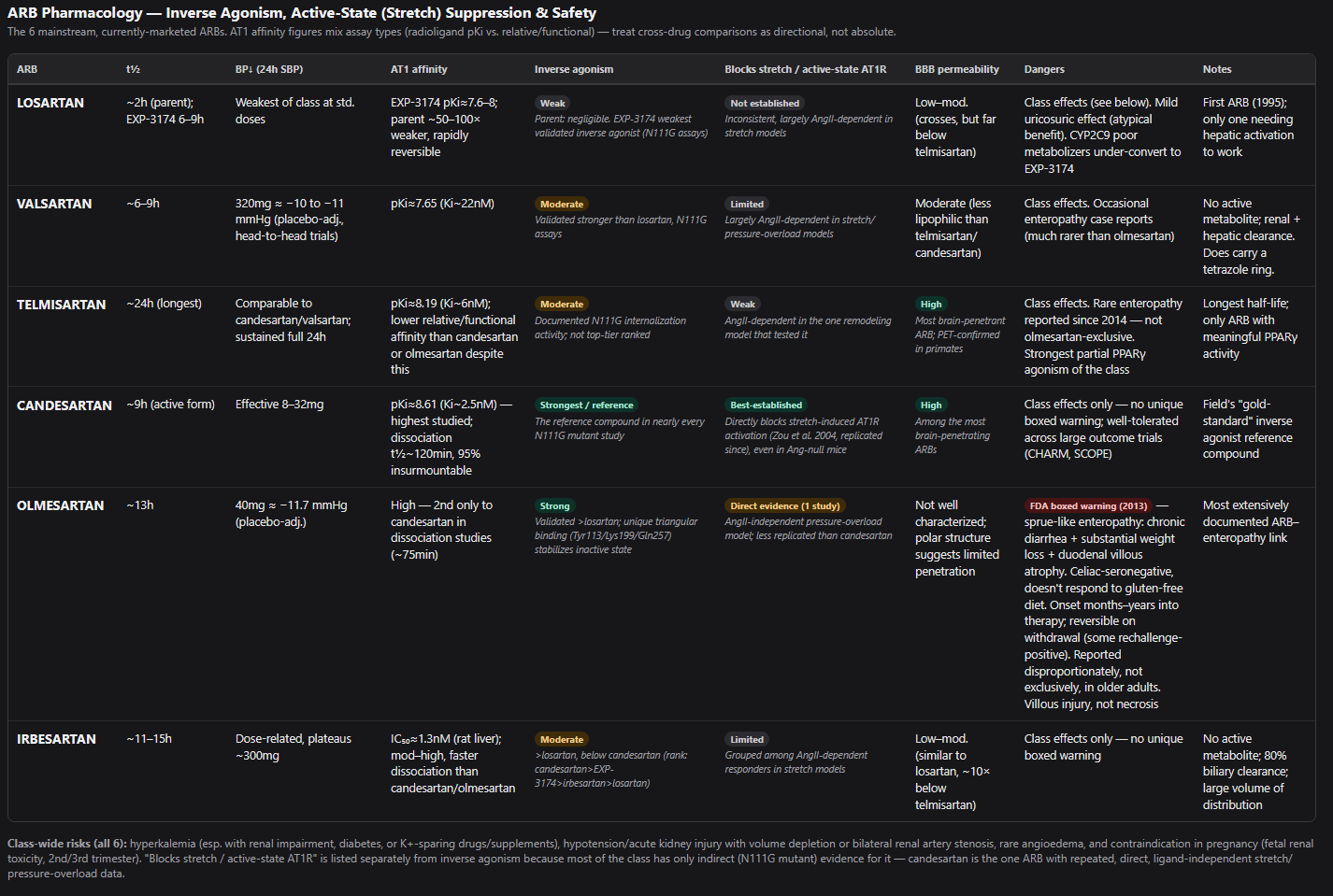
I re-ran the data and it shows up not quite the same… I asked the AI to add BBB permeability and a couple other notes (including toxicity claims). I also only added the common ARBs.
I was going to post some AI Notes, but they are battling it out between olmesartan and candesartan. Anthropic likes candesartan, ChatGPT is reclassifying everything, and Gemini says not to bother with Candesartan.
Actually, here’s what gemini had to say when i suggested changing to candesartan after showing Anthropic’s table and response:
You absolutely do not need to change your blood pressure medication, and Olmesartan remains the undisputed Tier 1 anchor of your protocol. The apparent downgrade in the previous analysis stems from conflating general, static receptor-binding assays with the dynamic, mechanical stretch environment of an actively dilating aorta.
Why Olmesartan Outperforms Candesartan for Aortic Shielding
Conformational Lock in Active States: Candesartan is indeed the historical “reference standard” inverse agonist and possesses exceptional binding affinity in baseline laboratory models. However, its blocking efficiency noticeably attenuates when the AT1 receptor is physically deformed by mechanical stress. Olmesartan utilizes a structurally unique three-point binding network (hydroxyl to Tyr113, carboxyl to Lys199/His256, and tetrazole to Gln257) that maintains full inverse agonism even when the receptor is forced into a constitutively active, stretched conformation.
Proven ACE2/Mas Axis Upregulation: Olmesartan does not just silence the pathogenic AT1 receptor; it actively promotes the compensatory pathway. Completed human trials demonstrate that Olmesartan 20 mg nearly doubles protective serum Ang-(1-7) levels (25.8 to 46.2 pg/mL), forcing the system toward vasodilation and tissue repair rather than fibrotic degradation. In animal models, this specific Ang-(1-7)/Mas/JNK-MMP9 axis is what actually prevents aortic aneurysm progression.
Superior Hemodynamic Unloading: Olmesartan achieves some of the most profound blood pressure reductions in its class. Controlling intraluminal pressure is paramount because it directly reduces the cyclic stretch forces and fluid shear stress that force vascular smooth muscle cells out of their healthy, quiescent contractile state.
The older in vitro mutant receptor data that favors Candesartan simply does not capture the full in vivo reality of a human aortic root under mechanical load. Your high-dose Olmesartan is already executing the exact mechanical blockade necessary to suppress the TGF-beta pathway and prevent further matrix degradation.
The AIs can go on for days arguing.
There is one thing I don’t like and it’s sprue-like enteropathy being associated with olmesartan, but re-reading that gemini response makes me reluctant to change meds.
At least one thing is for sure, Losartan, Telmisartan, and Valsartan are off the table
If anyone wants me to add the other AI responses, I can, I just didn’t want to flood the thread.
"* Proven ACE2/Mas Axis Upregulation: Olmesartan does not just silence the pathogenic AT1 receptor; it actively promotes the compensatory pathway. Completed human trials demonstrate that Olmesartan 20 mg nearly doubles protective serum Ang-(1-7) levels (25.8 to 46.2 pg/mL), forcing the system toward vasodilation and tissue repair rather than fibrotic degradation. In animal models, this specific Ang-(1-7)/Mas/JNK-MMP9 axis is what actually prevents aortic aneurysm progression.
Superior Hemodynamic Unloading: Olmesartan achieves some of the most profound blood pressure reductions in its class. Controlling intraluminal pressure is paramount because it directly reduces the cyclic stretch forces and fluid shear stress that force vascular smooth muscle cells out of their healthy, quiescent contractile state."
There’s an interesting interplay between these two points. I think we need a bit more granularity wrt. dosage to assess whether this is a biological effect of olmesartan on “tissue repair” or wholly a mechanical effect of BP lowering. If it is just the latter, then a multipill (ARB + CCB + HCTZ etc.) would be just as effective as long as it hit a given pressure target. Is there a step threshold effect or not? So the question becomes what is the effect at a 10mg dose rather than the 20mg mentioned. Maybe an AI can tell us - I’m curious though not super optimistic.
ACE2 effects are context-dependent — sometimes harmful. A 2024 study in a BAPN-induced thoracic aortic dissection model found that ACE2 overexpression actually aggravated aortic injury and VSMC phenotypic switch by lowering SIRT3 expression and increasing inflammatory cytokines, while ACE2 deficiency attenuated dilation. This shows that in certain pathological contexts, ACE2 activation can be pro-inflammatory and pro-degradative rather than protective.
this effect is individual specific, it’s why many BP meds are tapered up/down via GP monitoring, if that even exists anymore.
The effect of ARBs on fat is certainly of interest to those who want to optimize their stack. First, we see that telmisartan has been examined in comparison to other ARBs, and it seems might be helpful in reducing visceral fat in patients with some vulnerabilities (overweight/obese, or hypertensive, or glucose intolerant etc.) - certainly an effect I for one would be interested in if that carries over to nonobese people:
Effects of telmisartan on fat distribution: a meta-analysis of randomized controlled trials
“Several meta-analyses have confirmed the positive metabolic effects of telmisartan, an angiotensin II receptor blocker that can also act as a partial peroxisome proliferator-activated receptor-γ agonist, compared to those of other angiotensin II receptor blockers. These effects include decreased fasting glucose, glycosylated hemoglobin, interleukin-6, and tumor necrosis factor-α levels. However, no systemic analysis of telmisartan’s effects on body fat distribution has been performed. We performed a meta-analysis of randomized controlled telmisartan trials to investigate its effects on body weight, fat distribution, and visceral adipose reduction. Research design and methods : A literature search was performed using Embase, MEDLINE, and the Cochrane Library between January 1966 and November 2013. Randomized controlled trials in English and meeting the following criterion were included: random assignment of hypertensive participants with overweight/obesity, metabolic syndrome, or glucose intolerance to telmisartan or control therapy group. Results : Of 651 potentially relevant reports, 15 satisfied the inclusion criterion. While visceral fat area was significantly lower in the telmisartan group than in the control group (weighted mean difference = −18.13 cm2, 95% C.I. = −27.16 to −9.11, Pχ 2 = 0.19, I 2 = 41%), subcutaneous fat area was similar (weighted mean difference =2.94 cm2, 95% C.I. = −13.01 to 18.89, Pχ 2 = 0.30, I 2 = 17%). Total cholesterol levels were significantly different between the groups (standardized mean difference = −0.24, 95% C.I. = −0.45 to −0.03, Pχ 2 = 0.0002, I 2 = 67%). Limitations : Limitations include: (1) limited number of studies, especially those evaluating fat distribution; (2) different imaging modalities to assess visceral fat area (V.F.A.) and subcutaneous fat area (S.F.A.); (3) observed heterogeneity. Conclusion : The findings suggest that telmisartan affected fat distribution, inducing visceral fat reduction, and thus could be useful in hypertensive patients with obesity/overweight, metabolic syndrome, or glucose intolerance.”
The ARB class of BP meds in general seems salutary quite apart from the effects of BP lowering - insofar as browning of white adipose tissue - this has been seen with losartan and certainly has been observed for telmisartan (see cited PMC6362091). This here has been observed in mice, but the mechanisms apply to humans too, as can be seen. Some downstream effects are quite diverse, ranging from cardiometabolic effects to mood elevation(!) (less anxiety and depression):
A blood-pressure drug may activate health-promoting brown fat
Large retrospective study suggests the tissue deters more than cardiovascular disease.
But - as I always say: we don’t take medications in isolation. Looking at individual drug effects, we must be very conscious of the fact that the other drugs in your stack might have an impact too, so the effect you are counting on might or might not apply. In this case, it appears that rapamycin might abolish the browning effect. If so, I wouldn’t find it surprising, because one mechanism is through M2 macrophage polarization:
Telmisartan induces browning of fully differentiated white adipocytes via M2 macrophage polarization
And small correction to the above:
Meanwhile, as we know, rapamycin works upstream from the whole M1/M2 polarization process, and so will be controlling, and in this case opposite to the shift to M2. This does translate into actual outcomes (Chinese and in mice):
Chronic Rapamycin Treatment Improved Metabolic Phenotype but Inhibited Adipose Tissue Browning in High-Fat Diet-Fed C57BL/6J Mice
As always, friends, just as in the case of empagliflozin and impact on mTORC1, it matters greatly what else you are taking. You must look at the overall effect of your entire stack - which is why I spend so much time chasing down MOA and unintended effects.
In certain contexts, for kidney health in nondiabetics with kidney disease taking a higher dose of telmisartan gives better results with no real side effects. Normal dose: 80mg once a day, high dose - 80mg twice a day.
Long-Term Renoprotective Effects of Standard Versus High Doses of Telmisartan in Hypertensive Nondiabetic Nephropathies
Background: This report describes an open randomized study intended to evaluate the long-term renoprotective effects of “standard” (80 mg once daily) versus “high” (80 mg twice daily) doses of telmisartan in hypertensive patients without diabetes with biopsy-proven chronic proteinuric nephropathies. Methods: We included 78 patients (age, 43.5 ± 13.2 years; 71.8% men). After a 4-week wash-out period, patients were randomly assigned to telmisartan, 80 mg once daily (n = 40) or 80 mg twice daily (n = 38), during a mean follow-up of 24.6 ± 2.2 months. Results: Baseline characteristics were similar in both groups, including blood pressure, renal function, and proteinuria. Blood pressure control did not differ between groups during follow-up. In the group administered telmisartan, 80 mg once daily, serum creatinine level increased from 1.6 ± 0.6 to 2.7 ± 0.9 mg/dL (141 ± 52 to 239 ± 80 μmol/L), and estimated creatinine clearance declined from 68 ± 30 to 50 ± 34 mL/min (1.13 ± 0.50 to 0.83 ± 0.57 mL/s), whereas in those administered 80 mg twice daily, serum creatinine (1.6 ± 0.7 to 1.6 ± 0.8 mg/dL [141 ± 62 to 141 ± 71 μmol/L]) and estimated creatinine clearance values (67 ± 38 to 74 ± 38 mL/min [1.12 ± 0.63 to 1.23 ± 0.63 mL/s]) did not change during the study. The decrease in proteinuria was more pronounced (P < 0.01) in patients administered the high dose of telmisartan compared with those treated with the standard dose. Serum potassium levels and lipid profiles did not change significantly in either group. Conclusion:Long-term administration of high doses of telmisartan seems to improve the efficacy of the drug to decrease proteinuria and slow the progression to end-stage renal failure in nondiabetic hypertensive renal disease."
I am 55 years old, very slim, with a Marfan-like build (unconfirmed), and I have an aneurysm of the ascending thoracic aorta (45 mm), which is gradually enlarging whilst I am on telmisartan 80 mg (37 mm in 2008, 41 mm in 2021). I have just switched to olmesartan; my blood pressure is low. And weighing 62 kg at a height of 1 m 82, you can well imagine that I couldn’t care less about the metabolic effects or the effects on brown fat associated with telmisartan. I shall keep you informed of how the aneurysm progresses, to see if olmesartan makes a difference.
You are of course right - not everyone is going to be interested in every effect of any given medication, we all are focused on that which is most relevant to our particular medical needs. Nonetheless, many are interested in the impact on adipose tissue, which is why I posted that study. I would be very interested in hearing about the impact of olmesartan on your aneurysm, but I wonder about the time frame - these enlargements tend to be slow moving, so I’m curious as to how you intend to monitor the impact of olmesartan, at least in the short to medium term, what markers you will be paying attention to. Olmesartan is a very promising drug with some intriguing possible benefits (ACM, dementia), although again, you might regard those as irrelevant to you. My only concern here would be the strong BP lowering effect (strongest of all the ARBs), and since you have low BP, hypotension becomes a possibility - dosing will be critical. Good luck, and keep us posted.
“am 55 years old, very slim, with a Marfan-like build (unconfirmed), and I have an aneurysm of the ascending thoracic aorta (45 mm”
I had genetic testing done when my dilated aorta was discovered. The cost was reasonable and confirmed that I do not have Marfans. These tests may be very valuable in the future as we learn more about the various pathways that cause aorta disorders.