I didn’t know that everolimus was available? Can doctors prescribe it? Generic?
Some are bringing up bodybuilders in response. Yes, most of us are not bodybuilders, not trying to be Schwarzenegger. But one huge problem with aging is muscle loss, sarcopenia, frailty. So in being concerned about healthspan, healthy aging, I think one has to consider muscular effect?
2 Likes
But rapa dosing protocols are very speculative to begin with? For example, why do most take it once weekly? Is there any science behind that? (In animal studies, didn’t the animals receive it every day?)
2 Likes
Absolutely. It’s arbitrary. There is a variety of dosages and protocols, sometimes based on specific goals (like in transplant patients). The once a week at 6mg protocol is based on the famous Joan Mannick study, where a variety of dosages and protocols of everolimus (a close, though not identical rapalogue) were used in elderly subjects to test the effect on immunity. Based on effectiveness and side effect profile, 5mg once a week seemed most favorable. Based on that the 6mg once a week rapamycin was implemented by among others Dr. Green who had a lot of people taking rapamycin for longevity purposes - from this patient cohort Dr. Green developed a lot of clinical experience with rapamycin, and the 6mg once a week was the most popular option. Since then a lot of people in the longevity space experimented with rapamycin with a variety of dosages and protocols, and a lot of experience was gathered. The 6mg once a week remained the most popular option.
3 Likes
I had previously shifted from once per week to once every two weeks and the study just made me a little more confident in that decision. I’m not trying to build any more muscle though.
I had considered monthly dosing but it’s likely that isn’t enough for optimal lifespan extension. Once every two weeks probably isn’t enough either but I’ll take suboptimal with lower chances of side effects.
1 Like
A few questions worth considering if thinking about stopping rapamycin because of loss of muscle building. (1) why do you want more muscle? If you are frail, then more muscle is a lifesaver. If you are muscular but want more muscle, be sure to think about what you aren’t doing to build / maintain physical capacity: cardio (endurance), HIIT (max heart rate), mobility/ balance (full range of motion), coordination (hand-eye, running fast, eye tracking), fast reaction speed (rough ground, reacting to opponent). (2) if you are not building muscle despite effort to do so (assuming you are not at your genetic limit), make sure you are working hard enough, often enough, eating enough (protein), and sleeping enough. It’s probably not the rapamycin, in my opinion.
7 Likes
This protocol is actually rooted in pharmacokinetics. Trough concentrations exceeding 15 μg/L correlate with adverse reactions—primarily thrombocytopenia and hyperlipidemia. Since a 5mg dose in kidney transplant patients yields a trough level of 13.6 μg/L, the 6mg figure was selected. Consequently, you can see why this dosing regimen is highly questionable.
The once-weekly frequency is driven by the drug’s prolonged half-life, as chronic mTOR inhibition can trigger rebound hyperactivation.
https://onlinelibrary.wiley.com/doi/10.1111/jcpt.13753
An approved sirolimus dosing regimen (kidney transplant recipients) consists of 6 mg oral loading dose followed by 2 mg once daily. The recommended target trough concentration is 4–12 μg/L when combined with cyclosporine and 12–20 μg/L following cyclosporine discontinuation. Given sirolimus long half-life, the whole blood levels should be measured at least 5 days after the last dosing adjustment when new steady-state has already been reached. The recommendations for sirolimus dosage individualization are summarized in Table 1.
My view ia that a low (~zero) trough needs to be maintained for a material period of time
1 Like
I went from 6mg weekly to 5mg with GFJ every 15 days about 6 months ago. No noticeable changes that I could tell.
1 Like
I also aim for a zero trough. I do so by using a 2 week cycle. I think 10 days is enough but the brain damage from dosing every 10 days isn’t worth it (a different day of the week each dose is murder on everything else). When I followed your lead into larger doses I extended to a 4-week cycle but I no longer like the immune system depression risk from a large (30mg-ish) dose. I’m around sick people too often.
1 Like
The point about the trough, however, is that it needs to last. Hence you don’t want to just get down to essentially zero, but you need to last for a bit.
That, of course, depends on the dosing and everything else. There is clearly something else in my protocol that strengthens the immune system, probably the citrate, melatonin and mk7 as I tend not to have side effects.
1 Like
What is happening during the extended trough where more zero rapa time is better? MTORC2 is less impeded but I don’t think you mean that.
I prompted Claude with my experience as a marathon skier/runner since age 18 and my experience with 5mg weekly. Here’s what I got
Why this may not apply to you: The trial enrolled participants aged 65–80 — older sedentary adults, not trained endurance athletes. Extrapolating those findings to a lifelong runner doing marathon and ski training is a stretch. Your baseline fitness, training stimulus, and muscle physiology are dramatically different from that population. NMN
On the PEARL trial (which is more relevant to your dose): The PEARL trial followed 114 participants aged 50–85 over 48 weeks taking either 5mg or 10mg rapamycin weekly. It found low-dose intermittent rapamycin was relatively safe and was associated with improvements in lean tissue mass and pain, particularly in women taking 10mg. Aging-US
The honest picture: The science here is genuinely mixed. Trials have yielded ambiguous evidence on muscle protein synthesis — some studies show rapamycin blunts post-exercise protein synthesis, while others show no significant effect. Aging
I’ve seen substantial improvements in running related injuries and the associated lack of flexibility since starting on the rapamycin. My weight and muscle mass resemble that of my 20’s per a recent dexascan. 2 years on Rapa.
1 Like
Its the anabolic phase where muscle growth is maximised.(Inter alia)
2 Likes
You are touching on a tricky subject. I makes lots of guesses and have many questions. My protocols are based on cycles of growth and renewal. Rapamycin plays a part as it drives a reduction in mTOR which may be turned on excessively due to aging. The rapamycin effect only lasts in force a few days, and maybe lasts a week before back to zero. The reduction in anabolic response is the question. I’ve assumed it’s like 50% for 24 hours, then <30% for the next 24 hours, then <20% for the next day, then essentially nothing. So even if I was taking a weekly dose, most of my anabolic stimulus would get through if I was lifting hard throughout. And if I shifted my lifting (or other physical activity to a lesser extent) away from the rapamycin dose I could keep essentially all of the anabolic effect. However I do get worn out (maybe not going to a zero trough?) from weekly dosing so I use a 14 day cycle. I don’t think (or feel or see) that I’m losing any anabolic effect. I am probably losing some rapamycin effect (lowering of mTOR to get higher autophagy) with half the dosing frequency but I try to get a bigger effect with a double dose. What can you add here? What am I getting wrong?
2 Likes
As I have said before. There is no direct evidence that the weekly dosing of rapamycin used by any of the forum members suppresses mTORC2. If you can find it, direct me to it. mTORC2 is not easily measured, certainly not by any self-prescribed tests. Direct measurement is usually by biopsy.
“To the best of available knowledge, rapamycin, as an mTOR inhibitor drug, inhibits mTORC1. Although mTORC2 is insensitive to acute rapamycin treatment, some evidence proposes that chronic treatment with rapamycin can inhibit mTORC2 as well as mTORC1.”
"The Basic Mechanism of mTORC2 Suppression (Claude)
Rapamycin’s canonical mechanism is binding FKBP12, which then allosterically inhibits mTORC1. mTORC2 is acutely insensitive to rapamycin because its architecture doesn’t permit the FKBP12-rapamycin complex to access the catalytic site in the same way.
The chronic mTORC2 suppression effect was first clearly described by Sarbassov et al. (2006, Molecular Cell) — they showed that prolonged rapamycin exposure in cell culture prevented de novo assembly of mTORC2 by sequestering the free mTOR pool that would otherwise be incorporated into new mTORC2 complexes. This is a pool depletion mechanism, not direct catalytic inhibition."
Oddly, Aristotle says: "Conversely, allosteric inhibitors like rapamycin primarily affect mTORC2 indirectly, often paradoxically increasing its activity by relieving the S6K1-mediated negative feedback loops. Ref1, Ref2
“Semi-chronic treatment of AS mice with rapamycin not only improved their motor performance but also normalized mTORC1 and mTORC2 signaling.” Ref3
“mTORC2, is comprised of mTOR, Rictor (rapamycin-insensitive companion of mTOR)”
I don’t think the results of the Stanfield study warrant stopping rapamycin or changing the dosage. I was of the opinion that the optimal dosing schedule is likely closer to every other week than once a week (with a higher dose to compensate for the reduced frequency) and I have not changed my mind about that as a result of the Stanfield study.
The things that people look at as negative results of that study can actually be considered positive results. IMO people should be glad rapamycin showed a tendency to reduce strength gains, because that’s an indication that it’s reaching tissues in sufficiency high concentrations to inhibit mTOR which is what we want for longevity benefits. Also people need to keep in mind that the participants in the study weren’t doing a proper weight lifting program and would likely have gained more strength and muscle if they had trained with more weight and lower reps. I think that any individuals that have problems gaining muscle on rapamycin should start by doing resistance exercise and making sure they are training hard and heavy. Proper training will have a much bigger effect than rapamycin. Only if that doesn’t work should they consider reducing the dose or frequency to see if that helps with gains, but that’ ssomething people should only do if they really want to prioritize muscle mass over longevity.
5 Likes
I see no reason to change my 8 mg weekly. My goal is Longevity, not more muscle. Sarcopenia risk is exaggerated. The European study showed the vast majority of sarcopenia is secondary (inactivity due to heart failure, kidney failure, dementia, etc). Too much upside to Rapamycin for this study to change anything.
Until something definitely better than rapa comes out I still take it and recommend it.
5 Likes
It’s nonexistent.
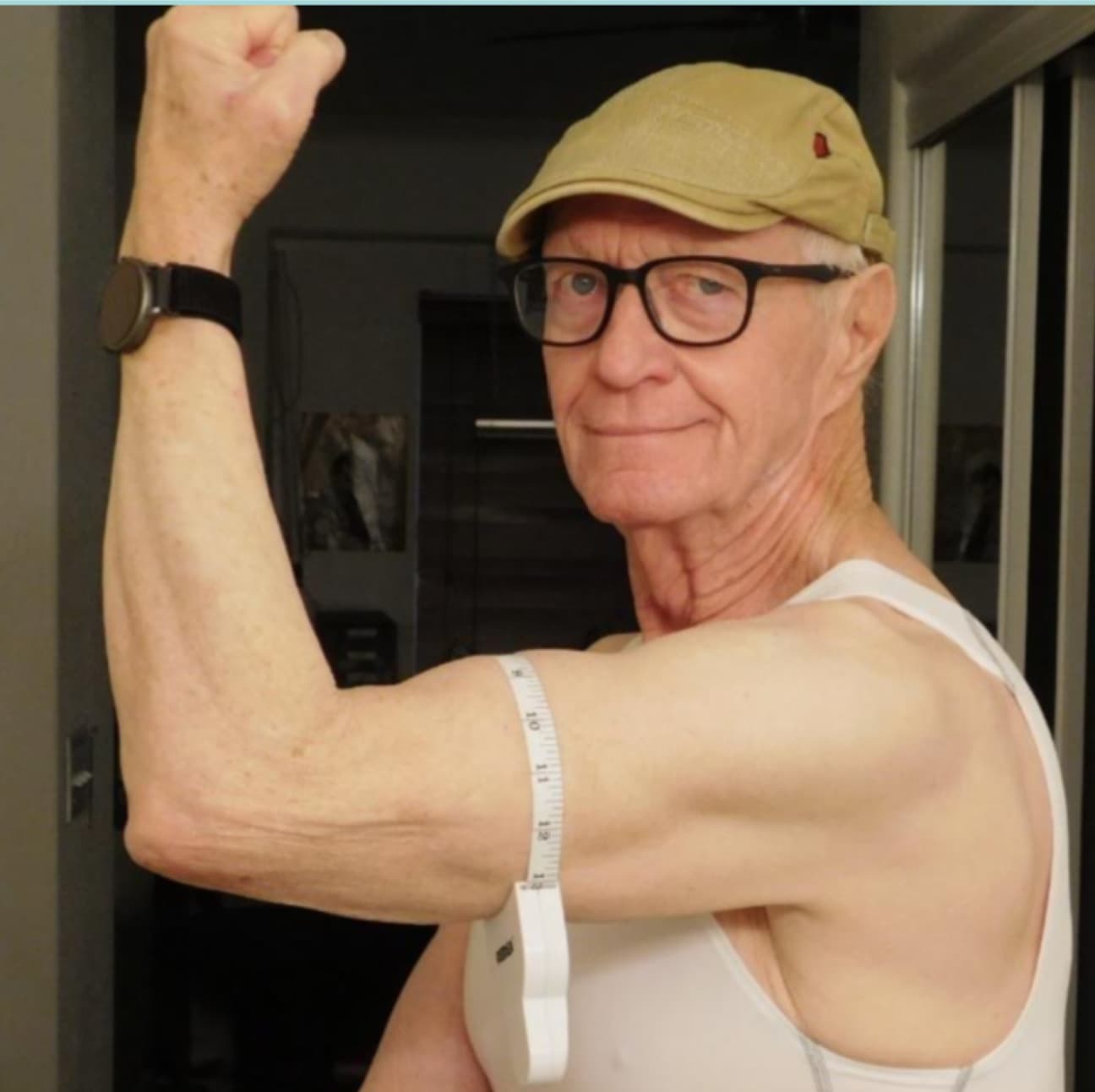
I am 85 years old and have been taking higher weekly doses than you for five years. I am no longer gaining muscle mass, probably because I don’t workout at the gym as hard as I used to. Rapamycin may make it a little harder, and by that I just mean longer, to gain muscle mass. I have no doubt that rapamycin slows down the progression of sarcopenia.
This is me at age 83 after approximately 3 years of high weekly doses of rapamycin.
I have posted this pic before and apologize to those that have already seen it. I’m certainly not Charles Atlas, but it looks ok for an 83-year-old.
12 Likes
What razor brand do you use? The shave is so clean there’s not even a shadow of stubble.