“Absorbed in the small intestine…”. Yes you remember correctly. And that is a very good question. I think that bioavailability is likely better if you can get it past the stomach acid to the small intestine. However that being said, when I got the powder from Alibaba (my first experience with Rapamycin as a newbie), I cut it with granulated sugar and put it in regular gelatin capsules to take 6mg per week. That’s assuming the powder I got was relatively pure.
I got an oral ulcer in the first week. And my swollen prostate that had been getting me up to pee several times a night shrunk so that I got a good stream and slept well. The ulcer resolved in about 2 weeks. I am very satisfied that I was getting the effects of Rapamycin. Unfortunately, since I live in a situation in Japan now that does not allow me to pull blood and have assays run, I have no quantitative results to back that up.
After a few months of taking the Rapamycin from Alibaba, I joined this group and so I decided that getting Rapamycin tablets from Indian sources (Kachela Medical) was more of a sure bet as far as purity and efficacy.
My opinion, from these personal experiences and from my reading, is that some of the Rapamycin makes it past the stomach acid, but I don’t know how much, especially in a horse. The Rapamycin powder in the link I sent is soo…… dirt cheap (1000Rupies/kg=$11.50/kg + whatever the shipping is). Jeez!, can that even be right? I think you could afford to give whatever the calculated dosage comes out to be. And then have blood levels run. The concern is underdosing, so you’ll do no harm. When you have blood level results in hand, then you can adjust the dose to account for how much is lost in passing through the stomach.
By the way, Merry Christmas and a HAPPY New Year!!
The last time I ordered from India, just before Trump took office, my$400 order of sirolimus snd acarbose was seized and destroyed by Customs, so I am a little gun shy of that route now. But the powder does look dirt cheap so not much loss there if that happens again. I need to reread those articles you sent me researching rapamycin for hyperinsulinemia in horses
and wrap my head around it more–the ertugliflozin has been incredible for her
and I am wondering about using both and possible interactions. Glad it’s been so helpful for you and that you took that step.
If I go that route, I will definitely ask you for help calculating dosages.
well, you responded to the wrong Paul but I have gotten 6 shipments from India this year of various pharmaceuticals like rapa, ivermectin, doxy. Never an issue. Just got one today in fact
It seems from talking to my Racetrack veterinarian friend (actually my classmate) that the whole hyperinsulinemia/cushings/endocrine system out of whack syndrome is a rather peculiar thing that horses do. Reading the things from the link to Equine Endocrinology Group, https://equineendocrinologygroup.org/ . Would be very useful, I think.
Have a very Happy New Year Susanne.
Sorry guys, I am kicking up this topic as it’s one of the few topics of rapamycin and horses.
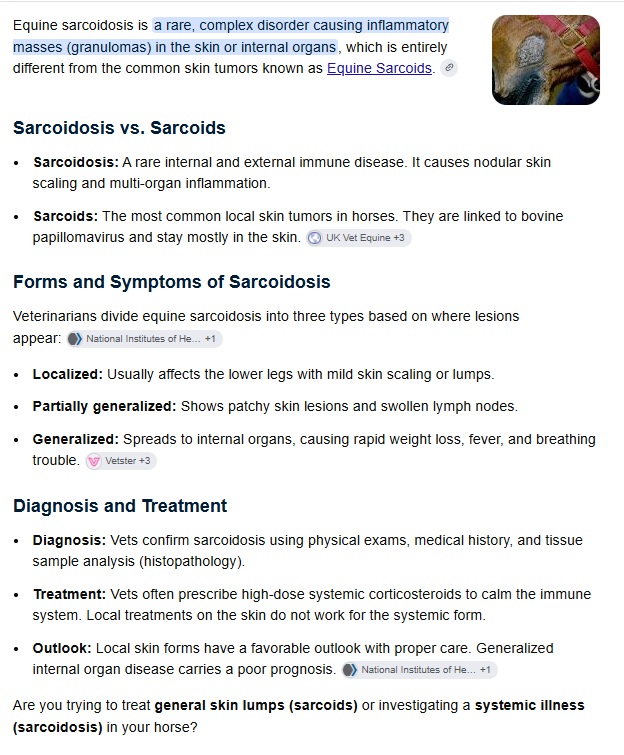
Long story short, I have a horse diagnosed with Sarcoidosis. An autoimmune disease. Gives her a swollen leg and skin problems, all on 1 leg.
After reading a study with humans on mdedge, unfortunately can’t post a link? (google: sirolumus sarcoidosis skin)
Which looked promising. Showed it to my vet and he is now also looking into it and getting more feedback.
So reading back this topic. You would suggest a start does of 60-65mg? Is that than daily for a week or every other day or? Not sure now what is the halftime/life is in horses?
Is this something you would use longterm lower dose, or like only short boost periods like 1-2 weeks, than off for a while?
I am a retired small animal veterinarian living in Japan and I have not been involved in equine practice. But, I will weigh in with my two cents, for what it is worth. Sarcoidosis treatment with sirolimus in humans appears to be very promising new thing. However, sarcoidosis in humans is a very different thing from sarcoidosis in horses. Unfortunately, the suspected causes and tumor behavior are quite different. I was unable to find a reference for treating equine sarcoidosis on a google search but here is a link to an overview: Sarcoids in Horses | Equine Skin Conditions.
I suspect that sirolimus will not be helpful. On the other hand the immunomodulatory effects of sirolimis do raise interesting questions.
The equine terminal half life of sirolimus ranges from 54-79 hours (average 59 hours). Oral bioavailibility is around 9.5%.
If you ask me (small animal vet with limited experience), of the treatments listed in the link I provided, the treatments using laser or cryosurgery are the most conventional. Treatment with BCG vaccine or Autologous Implantation are things you can try if the first two fail. My experience with BCG vaccine in small animals is approximately 33% cure rate in otherwise inoperable malignancies that would otherwise die.
Good luck. Please be sure to let me know what you decide re treatment. I would love to know thw outcome.
Paul