I was in the Ageless RX Pearl trial that ended last year. To be considered for a candidate you had to be within a certain age group. I’m 77 so was maybe 75 when I first took part in the trial. The idea of taking low dose Rapamycin is to keep a person healthier as they age. Someone at your age wouldn’t have been allowed in the trial. I was taking 15MG of the compounded form of Rapa and was just offered a chance to increase it to 20MG starting next month. I bike ride, and hit Planet Fitness at least five times a week. I do have Arthritis but overall my health is good.
Video of the trial results. It appears to have benefited women a little more then men.
Hi! I believe 6mg/week of Rapamune is a very substantial dose. Late Dr Green recommended only 2mg/week to people around the age of 40. You might be better off with 1-2 mg every 2-4 weeks in my opinion. At this low dose, you’ll still experience rejuvenation, but won’t necessarily get permanently supressed cell division.
As rapa has ~3-4 day half life, 6mg/week results in very sigificant growth supression. According to a study conducted in Iran, people who’ve had organ transplant only use 8.4mg/week of Rapa on average (spread out daily – Sirolimus Dose Requirement in Kidney Transplant Recipients in Iran - PubMed). People are fooling themselves when they call 6mg/week enteric coated tablets “low dose” – it is not.
We have studies that suggest Rapamycin can interfere with testicular function; naturally it should! But only at high doses.
Same with Brian Johsonson’s experience, he used too high a dose, and stacked too many mTor inhibiting interventions on top of each other (intermetting fasting, vegan diet, CR, Rapa, numerous supplements…). In the end he was looking like a sick cancer patient for the longest time!
So, 1) don’t stack 2) go low dose if you decide to take it at all. Best of luck!!
Based on your AMH, I understand that you were not in “menopausal transition stage -3a” which was the criterion to be allowed to the ovarian aging trial.
ChatGPT is quite useful at summarising things, but it tends to provide the conventional wisdom. It is probably worth investing some time to find using ChatGPT or a more traditional search engine or another LLM a list of the papers that study this and analyse those.
Just heard from AgelessRX. I didn’t realize at the time how little Rapamycin I was taking. 15MG compounded was maybe 3 to 5 mg. They finally said I can move to 20mg compounded formula which should put me up to about 6mg a week, which is about what the average user is taking. At such a low dose during the trial, I wonder if that was part of the reason there was little movement or results especially for men.
The trial basically proved that if you don’t take that much rapamycin not a lot happens. The low dosing is almost certainly why not much of an effect was seen.
Hey @LilyD, so nice of you to share this information with us - thank you.
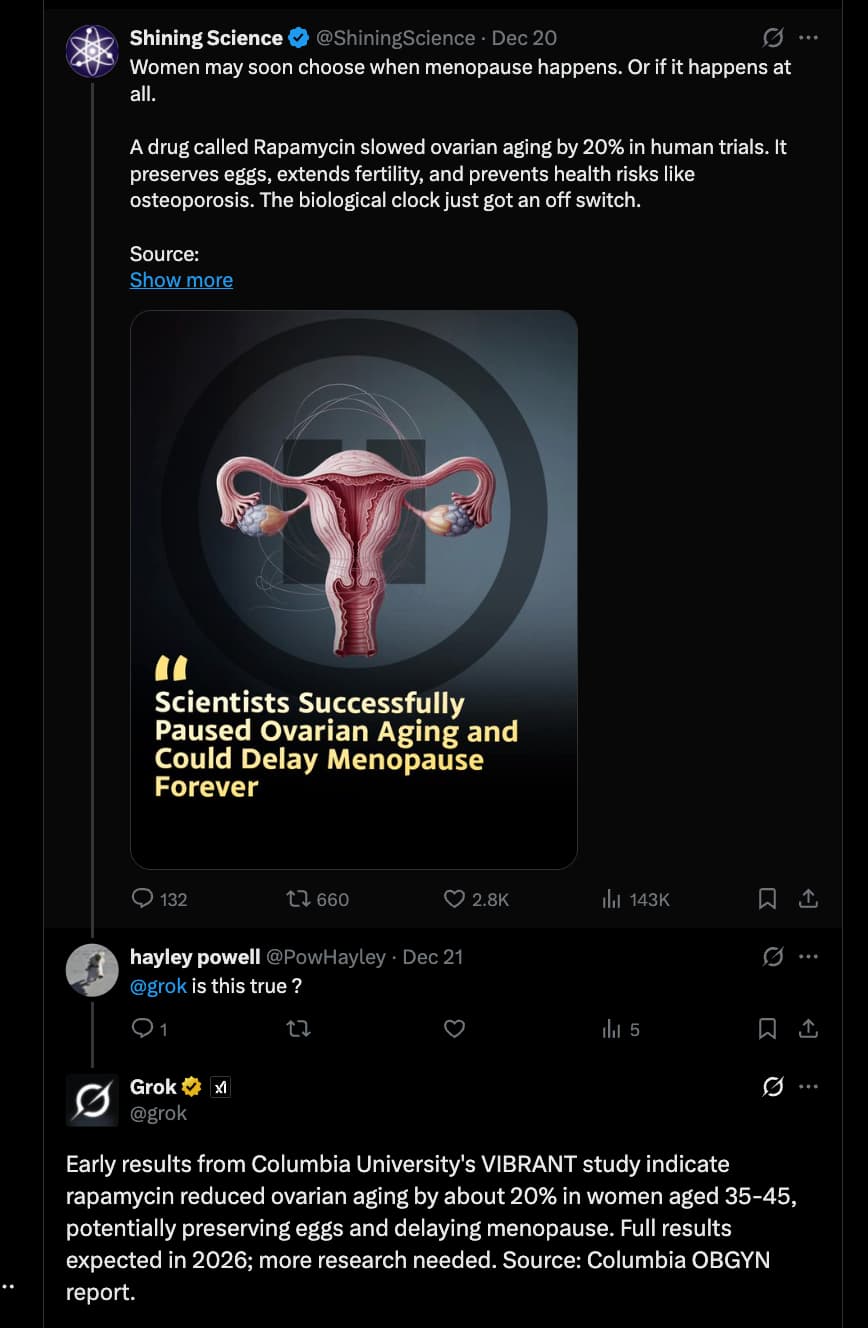
I’ve been mimicking the Vibrant study protocol and my AMH has increased, which I’m concerned about because this could indicate higher rates of folliculogenesis / more rapid depletion. But my cycle has lengthened which is cool. Did you get any info from the researchers about whether AMH going up or down would be a good thing?
Wild how little (accessible) information there is on the internet about how our bodies work.
Unfortunately, no - they didn’t discuss any aspect of the bloodwork or ultrasounds. Most of what I found out I learned by googling things I overheard the techs saying to each other, lol. I hadn’t really considered the possibility that AMH increasing might be unwanted, so thanks for that perspective. I’ll see when they unblind whether the debrief includes any additional thoughts from the research team on how they’re interpreting movement in those measures.
I have been doing a bit more reading up on the process by which mammals particularly have babies and have written up a blog post on Follicular Atresia, which I think is relevant
The core of this, however, is that within the process there is a need where possible to improve the mitochondrial quality of the eggs themselves. The eggs are kept in a dormant state with complex 1 being inhibited which will reduce the effect of ROS, but although dormant they are not inactive. Hence to get eggs which will be viable needs where possible to improve mitochondria in the eggs. I don’t know what can do this. Rapamycin obviously is a candidate, but I don’t know if it would work.
Fascinating thread, can’t stop reading… the rapa may be protecting my ovaries but the sleep loss from staying up late reading this Forum is probably aging them …
The really interesting and important question about Rapamycin is whether it encourages mitophagy in the oocytes. This is not only important from the perspective of fertility, but also important as to the health of any baby as the baby gets older.
Hi I am on rapamycin now. I have had 8 egg retrievals and almost none have resulted in a blastocyst. My doctor is hoping this will help with my egg quality. This thread is making me very very anxious though as my period has been late since we started. Can you tell me if this study was unbound? I have heard great things about this medication but am now having doubts. I’m running out of time.
We’ve had many people reporting positive results and I spoke with Dr. Aimee recently and she’s going to publish a paper (group case study) on the success she’s having with her patients: Rapamycin for Fertility and Menopause; Clinical Results
Results from Columbia university are coming out in 2026 I believe, and Matt Kaeberlein was mentioning to me recently that he’s trying to get a podcast soon with Yousin Suh of the VIBRANT Columbia study soon, so you may get more positive information soon: