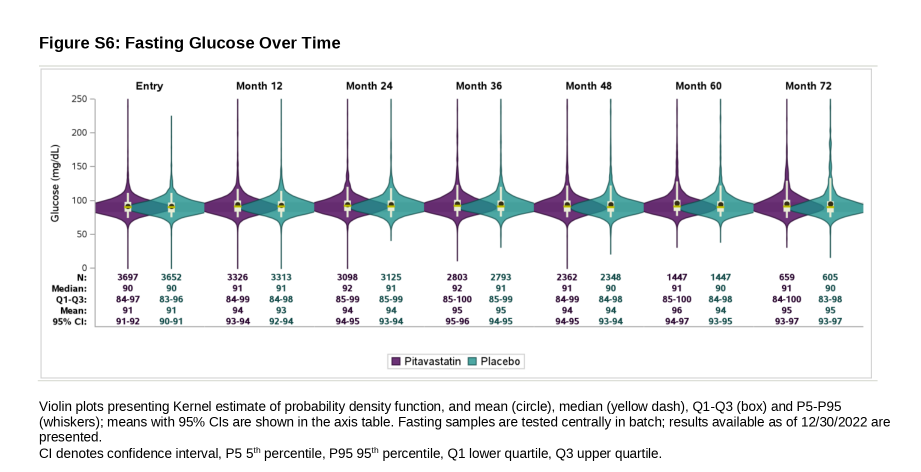
For pitavastatin and T2D risk, there was a 35% increase in the reprieve trial: https://www.nejm.org/doi/full/10.1056/NEJMoa2304146 but overall both groups was not different than the U.S population at large for this age group:
Pitavastatin: 1.13 and Placebo 0.84.
In our trial, the frequencies of diabetes mellitus in both the pitavastatin and placebo groups were similar to those in the general U.S. population for persons between the ages of 45 and 64 years: 1.01 per 100 person-years (95% CI, 0.81 to 1.25)
And this is the MR study I based my LDL-C → T2D risk link:
Variants in these two genes were also associated with very similar effects on the risk of diabetes: odds ratio for each 10 mg per deciliter decrease in LDL cholesterol, 1.11 (95% CI, 1.04 to 1.19) for PCSK9 and 1.13 (95% CI, 1.06 to 1.20) for HMGCR. The increased risk of diabetes was limited to persons with impaired fasting glucose levels for both scores and was lower in magnitude than the protective effect against cardiovascular events.
But I noted now there was no effect detected with a fasting glucose < 100 mg/dl:
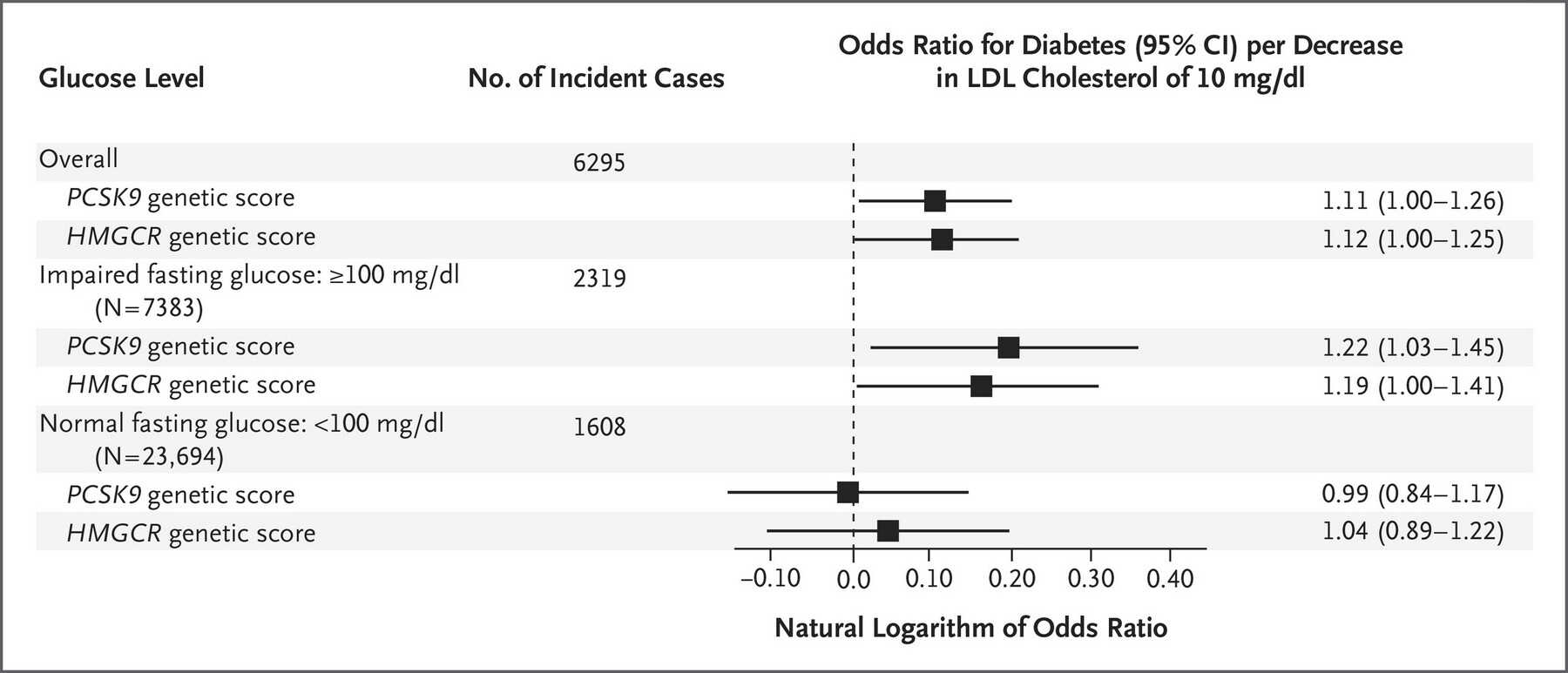
The proposed mechanism is an increase of LDL receptors on the liver decreasing glucose tolerance increasing T2D incidence among those “who have impaired fasting glucose levels” (but isn’t this an inaccurate measure of T2D risk?), and similarly found in JUPITER trial (didn’t know this).
The mechanism by which PCSK9 and HMGCR variants increase the risk of diabetes is unclear. However, it is unlikely to be mediated by weight gain because unlike HMGCR variants, PCSK9 variants are not associated with obesity or its subphenotypes, such as weight, body-mass index, or waist circumference. Instead, the mechanism may involve an LDL receptor–mediated pathway. We found that each set of gene-specific variants in PCSK9, HMGCR, and LDLR had a very similar effect as the other sets on the risk of diabetes per unit decrease in the LDL cholesterol level. This finding is consistent with the fact that both PCSK9 and HMGCR inhibitors ultimately reduce plasma LDL cholesterol levels by increasing the density of LDL receptors.31 It is also consistent with the observation that persons with familial hypercholesterolemia appear to have a lower prevalence of diabetes than unaffected relatives.32
The genetic evidence suggests that PCSK9 and HMGCR inhibition, possibly acting through an LDL receptor–mediated pathway, may cause mildly impaired glucose tolerance (as suggested by higher plasma glucose levels 2 hours after an oral glucose challenge) without materially increasing fasting glucose levels, which may then lead to an increased likelihood of incident diabetes among persons who have impaired fasting glucose levels. This conclusion is consistent with data from the Justification for the Use of Statins in Prevention: an Intervention Trial Evaluating Rosuvastatin (JUPITER), in which treatment with rosuvastatin was associated with an increased risk of diabetes but not an increase in fasting plasma glucose levels, and virtually all of the increased risk of diabetes occurred among persons with impaired fasting glucose levels
https://www.nejm.org/doi/10.1056/NEJMoa1604304
Has there been an increase in diabetes risk in ezetimibe/pcsk9i trials?
Didn’t read it was mentioned in IMPROVE-IT (ezetimibe), but ODYSSEY outcomes (alirocumab) detected no effect – basically 9.6% in alirocumab and 10.1% in placebo of new incidence of diabetes: https://www.nejm.org/doi/full/10.1056/NEJMoa1801174
And FOURIER trial (evolocumab): 8.1% evolocumab and 7.7% in placebo: https://www.nejm.org/doi/pdf/10.1056/nejmoa1615664
Anyway my conclusion from all of this, and I looked over the JUPITER trial again, is that the effect of LDL lowering on diabetes risk is minor. I don’t know what it means to have NODM – if a statin increase HbA1C by 0.1% points, is simply the increase in NODM the people that reach the “diabetes” threshold because of that increase?
That’s the key, if so, it’s more of a nothing burger IMO. It’s different if it’s because of a “sudden” increase in A1C or similar that gets someone from the lower range to the diabetic range, but still the rate is low. Of course worth monitoring regardless – as one should for diabetes risk.
But I’m convinced that pitavastatin does have improved glucose handling effects etc than other statins. So lowering the A1C from switching to it from other statins – as have been shown in studies – and by many here and elsewhere is worth it.