Am I remembering this right?: nuns tend to live longer than average. Could it be because they are insulated from many of the stressors of life outside the convent, including the demands of men?
2 Likes
I won’t go into the many studies. People can look it up for themselves, but the evidence is strong that men benefit more from marriage than women.
But, I don’t blame it on the men. Women seem to be much harder to satisfy in marriage.
The multitudes of young women marrying a skunk with the expectation that they can change him is one of the problems. I have never heard of a man marrying a woman with the expectation that he could change her.
3 Likes
Quite the contrary. Probably most men go into the married state expecting / hoping she never changes, then wind up disappointed 
5 Likes
My Fair Lady.
1 Like
@desertshores @medaura I think you’re both right. Fun fact: women initiate 69% of divorces.
Personally, I’m one of those people that doesn’t think a relationship needs a marriage contract attached to it in all cases. You could still refer to each other as husband/wife and even have a ceremony, but not sign marriage papers. I wish this were to become more normalized.
Back to the topic of sex, I can definitely say I’m happier when I am having a lot more of it.
3 Likes
Well if you have joint assets and joint offspring you can see that the papers end up meaning something.
1 Like
I don’t really know what all the facts are, but I’ve heard it’s related to women being the cook/housekeeper etc… granted, things might be very different these days.
Along those lines, I’ve heard men typically remarry much sooner.
(I have not looked anything up but this is just what I’ve always heard)
@LukeMV in the olden days, I think women needed marriage to have some financial security, but now that they are also earners, as long as they are not staying home with the kids (putting themselves at financial risk), I think it’s perfectly fine to keep the state out of it if that is what two people choose.
1 Like
Women tend to have better friends and social networks, men tend to have fewer friends and rely on their wives for social interaction. My understanding is that this is thought to be the main reason why men tend to benefit more from marriage.
4 Likes
For men: higher frequency of orgasm associated with lower prostate cancer….20’s and 40’s studied. (60’s?). 21+ x/month = lower cancer than 4-7x/month. Once a week isn’t enough…for lots of reasons (even if not causal of prostate cancer).
A 2016
Harvard T.H. Chan School of Public Health study of 31,925 men confirmed that higher ejaculation frequency (21+ times per month) is associated with a ~20–31% lower risk of prostate cancer compared to 4–7 times per month. This protective effect was consistent across different age groups (20s and 40s) and is believed to work by clearing potential carcinogens from the prostate.
Key Study Findings:
- Reduced Risk: Men ejaculating 21 or more times per month had a 19–22% lower risk of prostate cancer diagnosis, and in some analyses, up to 31%.
- Age Factor: The protective effect was observed in both younger (20–29) and older (40–49) men.
- Mechanism: Researchers hypothesize that frequent ejaculation helps flush out potentially cancer-causing substances from the prostate gland.
- Consistency: The results held true even after controlling for factors such as diet, lifestyle, and BMI.
3 Likes

I. Executive Summary
The provided transcript details behavioral and circadian interventions for sleep optimization, featuring clinical psychologist Dr. Michael Breus. The core thesis posits that sleep architecture is the foundational pillar of metabolic health, cognitive preservation, and longevity. The speaker emphasizes circadian entrainment through consistent wake times, strategic light exposure, and the management of autonomic tone to combat sleep maintenance insomnia (SMI).
While the behavioral protocols—such as light-induced suprachiasmatic nucleus (SCN) entrainment and early time-restricted caffeine/alcohol consumption—are supported by robust clinical data, the transcript occasionally strays into biological oversimplification and minor biohacking hype. Claims regarding the precise mathematical equivalents of Non-Sleep Deep Rest (NSDR) or the physiological efficacy of “grounding” lack rigorous Level A or B validation. However, the foundational advice regarding the glymphatic clearance of neurotoxic proteins during slow-wave sleep (SWS) and the underdiagnosis of obstructive sleep apnea (OSA) in post-menopausal women represents highly actionable, lifespan-extending intelligence.
For clinical longevity optimization, the signal in this transcript is clear: prioritize sleep regularity over absolute duration, aggressively screen for sleep-disordered breathing, and utilize targeted environmental cues (light, temperature, and autonomic breathing) to manipulate endocrine and neurochemical cascades.
II. Insight Bullets
- Circadian Entrainment: Waking at the exact same time daily is the primary driver of circadian alignment, as morning light hits melanopsin-containing intrinsically photosensitive retinal ganglion cells (ipRGCs), suppressing daytime melatonin and anchoring the nighttime phase response curve.
- Glymphatic Clearance: Stage 3 and 4 (Slow-Wave Sleep) are critical for the activation of the glymphatic system, which clears metabolic waste products, including beta-amyloid and tau proteins, mitigating neurodegenerative risk.
- Sleep Maintenance Insomnia (SMI): The common 1:00 AM to 3:00 AM awakening coincides with the nadir of core body temperature. The body slightly elevates temperature to prevent hypothermia, which can inadvertently trigger wakefulness in hyper-aroused individuals.
- Autonomic Down-regulation: The 4-7-8 breathing protocol is designed to manually increase vagal tone, shifting the autonomic nervous system from sympathetic to parasympathetic dominance to lower the heart rate for sleep re-initiation.
- Post-Menopausal OSA Risk: The loss of estrogen and progesterone tone directly reduces pharyngeal dilator muscle integrity, exponentially increasing the risk of undiagnosed Obstructive Sleep Apnea in aging women regardless of BMI.
- Alcohol’s Sleep Disruption: Alcohol acts as a potent REM and SWS suppressant. Due to average metabolic clearance rates (~1 drink per hour), alcohol must be ceased at least 3 hours prior to sleep to prevent architectural disruption.
- Caffeine Half-Life: Caffeine exhibits a half-life of 6–8 hours, necessitating a cessation window of at least 8–10 hours prior to sleep to prevent adenosine receptor blockade during sleep onset.
- Chronobiology: Genetic polymorphisms (e.g., CLOCK, PER2 genes) dictate chronotypes (morning vs. evening preference), heavily influencing the optimal diurnal timing for exercise, cognition, and metabolic processing.
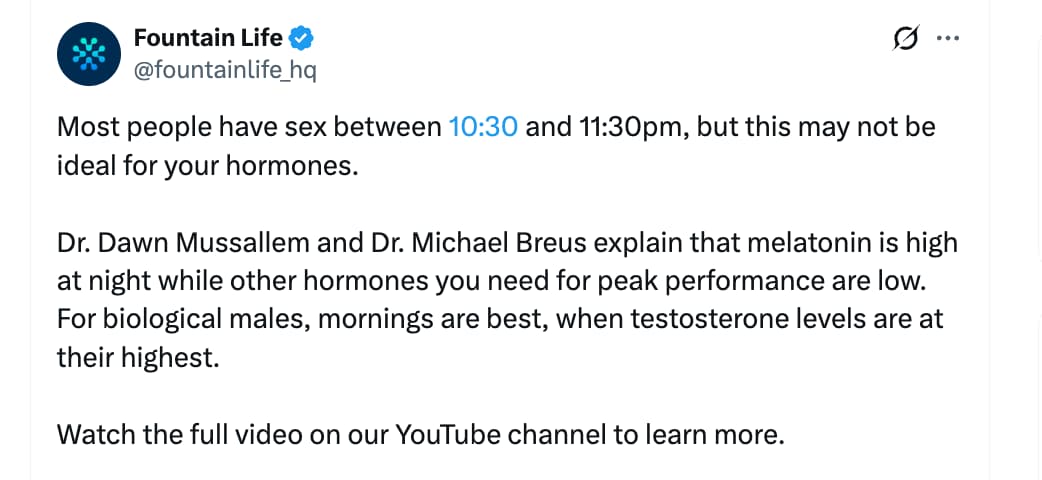
- Endocrine Timing for Intimacy: Morning sexual activity aligns with peak diurnal circulating levels of testosterone, cortisol, and adrenaline, alongside nadir levels of melatonin, making it biologically optimal compared to late-evening.
- Hydration Deficits: Sleep is a dehydrative event resulting in the loss of up to 1 liter of water via respiration; immediate morning hydration is critical prior to introducing diuretics like caffeine.
III. Adversarial Claims & Evidence Table
| Claim from Video | Speaker’s Evidence | Scientific Reality (Current Data) | Evidence Grade (A-E) | Verdict |
|---|---|---|---|---|
| Glymphatic system scoops out excess proteins during Stage 3/4 sleep. | Biological explanation. | Verified. SWS expands the interstitial space, allowing aquaporin-4 (AQP4) mediated CSF-ISF exchange to clear beta-amyloid and tau. Reddy et al., 2023 | Level A (Systematic Review) | Strong Support |
| Morning sunlight (15 mins) synthesizes Vitamin D to act as a circadian pacemaker. | Expert statement. | Conflated mechanism. UV-B synthesizes Vitamin D, but visible spectrum light (blue light) hitting melanopsin is the actual circadian pacemaker via the retino-hypothalamic tract. Vitamin D plays a secondary endocrine role. Panda, 2023 | Level B (RCTs) | Plausible (Mechanistically flawed in transcript) |
| 1 hour of Non-Sleep Deep Rest (NSDR) equals 20 minutes of sleep. | Stated as factual data. | Source unverified in live search. Yoga Nidra/NSDR improves subjective fatigue and alters dopaminergic tone, but polysomnography does not support an exact physiological 3:1 sleep replacement ratio. | Level D/E (Expert Opinion) | Speculative |
| 4-7-8 breathing lowers heart rate to 60 BPM to induce sleep. | Clinical observation. | Verified mechanism. Slow-paced breathing (<10 breaths/min) strongly stimulates the baroreflex and increases heart rate variability (HRV), safely inducing parasympathetic tone. The “exact 60 BPM” rule is an arbitrary clinical heuristic, but the pathway is sound. Russo et al., 2022 | Level B (Clinical Trials) | Strong Support |
| Grounding/Earthing provides health benefits. | Anecdotal (“feels good”). | Source unverified in modern rigorous trials. Studies on “earthing” suffer from profound methodological flaws, lack of blinding, and extreme bias. | Level E (Anecdote) | Unsupported |
IV. Actionable Protocol (Prioritized)
High Confidence Tier (Protocols backed by Level A/B evidence)
- SCN Anchoring: Establish an uncompromising, fixed wake-up time 7 days a week. Seek direct outdoor light exposure (minimum 10,000 lux) within 30 minutes of waking for 10-15 minutes to halt melatonin secretion and start the circadian clock.
- OSA Screening Protocol: Mandate high-resolution home sleep apnea testing (HSAT) measuring Apnea-Hypopnea Index (AHI) and Oxygen Desaturation Index (ODI) for any patient presenting with refractory hypertension, daytime somnolence, or post-menopausal status.
- Pharmacokinetic Curfews: Terminate caffeine ingestion a minimum of 8 hours before target sleep onset. Terminate alcohol consumption a minimum of 3 hours prior to sleep onset, matching consumption 1:1 with water to mitigate diuretic effects.
Experimental Tier (Level C/D evidence with high safety margins)
- Autonomic Reset (SMI): If awakened between 1:00 AM and 3:00 AM, remain in the supine position to prevent orthostatic tachycardia. Execute 20 cycles of 4-7-8 breathing (inhale 4s, hold 7s, exhale 8s) to stimulate the vagus nerve and down-regulate sympathetic arousal. Do not view digital clocks.
- Chronotype-Matched Training: Shift high-intensity cardiovascular or resistance training to align with genetic chronotype peaks to prevent cortisol mismanagement and orthopedic injury (e.g., morning for early chronotypes, late afternoon for evening chronotypes).
Red Flag Zone (Claims debunked or lacking safety data)
- Sleep Debt Replacement via NSDR: Relying on meditative rest protocols to physically replace lost slow-wave or REM sleep architecture is physiologically invalid and will result in accumulated neurotoxic burden over time.
- Forcing the 8-Hour Rule: Enforcing an arbitrary 8-hour sleep duration on an individual with a high sleep efficiency requirement for 6.5 hours can induce sleep maintenance insomnia and sleep-related anxiety. Optimize for sleep efficiency (>85%) over gross duration.
V. Technical Mechanism Breakdown
- Melanopsin-Mediated Photic Entrainment: Intrinsically photosensitive retinal ganglion cells (ipRGCs) contain the photopigment melanopsin, which is highly sensitive to short-wavelength visible light (~480 nm). Upon activation, these cells transmit action potentials via the retinohypothalamic tract directly to the suprachiasmatic nucleus (SCN) of the anterior hypothalamus. The SCN then signals the pineal gland via a multisynaptic sympathetic pathway to inhibit the conversion of serotonin to melatonin, effectively setting the circadian phase.
- Glymphatic System Dynamics: During NREM Stage 3/4 sleep (Slow-Wave Sleep), the cortical interstitial space expands by up to 60%. This expansion facilitates the bulk flow of cerebrospinal fluid (CSF) into the brain parenchyma along perivascular spaces, driven by arterial pulsation and polarized aquaporin-4 (AQP4) water channels situated on astrocyte endfeet. This convective flow washes neurotoxic interstitial solutes, including beta-amyloid and hyperphosphorylated tau, into the venous and lymphatic drainage systems.
- Parasympathetic Induction via Paced Breathing: The 4-7-8 breathing protocol functions through respiratory sinus arrhythmia and baroreceptor reflex modulation. Prolonged exhalation relative to inhalation decreases venous return to the heart, slightly lowering blood pressure. Aortic arch baroreceptors detect this and signal the nucleus tractus solitarii (NTS) in the medulla, which responds by increasing efferent vagal nerve activity. This releases acetylcholine at the sinoatrial node, slowing the heart rate and initiating systemic parasympathetic dominance.
1 Like