Did you mean 250 mg? The dosing for gallstone prophylaxis is 600 mg a day, and dissolution is 8 - 10 mg/kg/day.
I’ve been looking into TUDCA which is the same but taurine attached, and OTC, because I think I have gallstones and I would guess it’s good to try and dissolve them (because my ALP is high - higher ALP associated with higher ACM). 1 in 7 have asymptomatic gallstones.
I have small, asymptomatic gallstones, diagnosed with US imaging. What do you consider high ALP? Mine has been steadily climbing through the years, and now stands at 73 U/L (range at UCLA labs: 37 - 113 U/L), tested a couple of weeks ago (age 66).
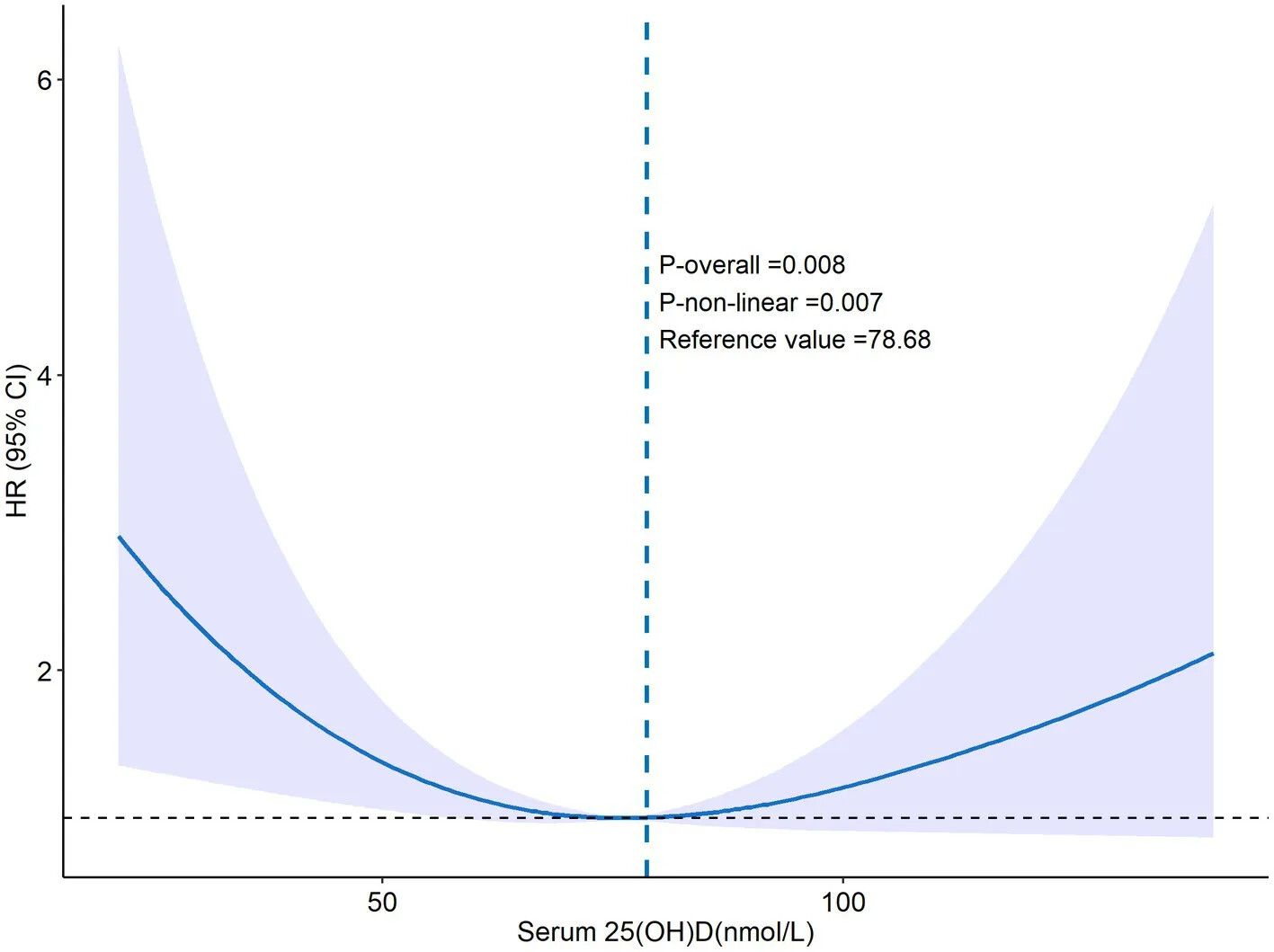
The analysis showed a U-shaped curve between 25(OH)D levels and mortality risk, with the lowest risk at 78.68 nmol/L (p-non-linear = 0.007, p-overall = 0.008). Kaplan–Meier analysis found the highest survival rates in patients with 25(OH)D levels between 75–100 nmol/L (p = 0.039). Compared to this group, patients with levels below 50 nmol/L had a 3.52-fold increased mortality risk (95% CI = 1.58–7.86, p = 0.002), and those above 100 nmol/L had a 2.92-fold increase (95% CI = 1.06–8.05, p = 0.038). Age-specific subgroup analysis (p = 0.009) revealed that both very low (<50 nmol/L) and high (>100 nmol/L) levels increased mortality risk in patients under 65, while levels below 75 nmol/L raised mortality risk in older patients.
Maybe I’m missing something here, but genetic factors that predict a high Vitamin D level … do we have actual data on subjects on what their level was? I could have genetic factors that favor a higher level, but get no sun and consume no vitamin D. I could have genetic factors that predict low, but I supplement.
I’m much more interested in actual serum levels over the long term and outcomes.
I’d like to know how this properly gets controlled for as it isn’t quite the same thing as saying no relationship between vitamin D levels and PD.
You’re right but here we have both the MR and the long-term association study showing that vitamin D is not essential in PD: you just don’t want to be below 75 nmol/L. Parkinson’s patients supplementing with vitamin D also don’t do better than non-users: Parkinson Symptom Severity and Use of Nutraceuticals (whereas those supplementing with glutathione, lithium, curcumin, omega 3 or vitamin B12 do for instance). So it’s good to be able to focus on what moves the needle most.
Yes, that is a fair call, but I’d still measure and treat low Vitamin D, but not necessarily for PD, but probably for AD.
Luckily I regularly advise all the items that are protective for PD as they also seem to be items protective for AD and vascular disease to some extent.
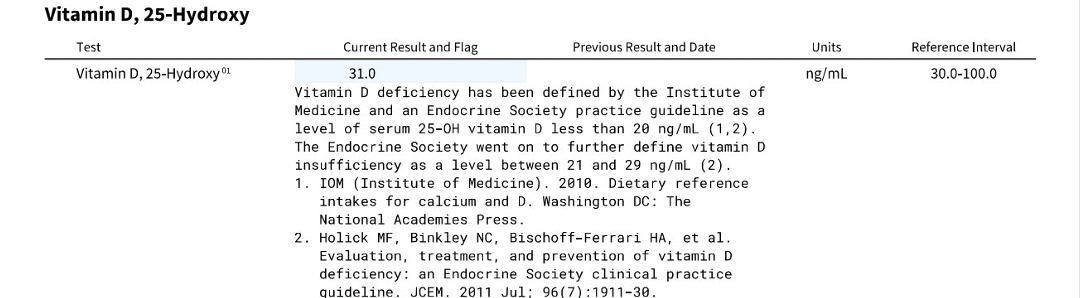
It actually takes some work for most people to be at 75 nmoL/L as I think the normal is typically 30-100, and so many of my patients before supplementation, including many who have lots of time outside end up being in the high 20’s through low 40’s. So worth measuring.
It takes 3-6 months of dosing to get a steady state as is fat soluble. I’d recommend you read the Target D Trial as that will give some context. But I’d stick with 10,000 IU/day, test at 3 month intervals and it will likely climb up nicely over time. There are a segment of the population that seems to require more than 10,000 IU. Also with Vitamin D, make sure to take it with Vitamin K2 (I prefer MK7 over MK4) of at least 200 mcg/day.
It’s my best assessment right now, that 10,000 IU/day will get people to 50-70 almost always, but it might take 6-12 months, and as that point if not optimal, then go up in dose, but that would be really rare.
I use dedrogyl (which is 25OHD) to increase the level. I take 3,000 iu a day which does not maintain the level and dedrotyl once a week either to maintain or increase the level. There are probably foods with a high level of 25OHD.
It seems that the body does not metabolise cholecalciferol that well.
Yeah, I did think there must be a unit confusion, but wasn’t sure, good catch. It’s funny, because my latest reading is 38ng, and looking at the literature I really don’t see why I should go higher. It may be the case that depending on what you are trying to address (ACM, PD, bone health etc.), the ideal level will be different. You can’t just pick ACM, because as individuals, we die from our specific weakest link, which will be different for everyone - we are not “population”, we’re n=1. Therefore ACM for a populace or cohort may not be the optimal outcome to look at, instead it should be the outcome for the specific issue you’re trying to address.
Treatment with the bile acid, UDCA, has been reported to have a wide variety of effects that are compatible with extended lifespan in mammals, including protecting against metabolic derangements such as diabetes, and suppression of tumor formation (Oyama et al., 2002; Lukivskaya et al., 2004). Nevertheless, no previous lifespan studies have been reported for UDCA. At the dose used in this study, there were significant reductions in body weight across the lifespan in both male and female mice, suggesting that UDCA treatment had biological or physiological effects. However, there was no effect of UDCA on median or maximal lifespan in either sex. Given the wide range of positive effects reported for UDCA on measures of healthspan, it is unclear why it had no effect on lifespan. It is possible that higher or lower doses of UDCA may be effective. On the other hand, as we observed with NDGA in the present study, the effects of specific interventions on lifespan may be distinct from effects on age-sensitive physiological changes in specific organ systems.
They used 5,000 ppm = 833 mg/kg (mice) => ~67 mg/kg in humans (HED). So, about 5 g/day for the average adult. That’s twice the dose used in the upcoming PD trial (2.5 g/day). The normal dose for gallstones is about 10 mg/kg, typically 750 mg/day (DDD, according to the WHO).
Hopefully, I’ll soon receive Ora Biomedical’s results for UDCA. In any case, if one has elevated AST, ALT, ALP, GGT, UDCA seems like a safe bet.