ALL studies of epitalon and other khavinson’s peptids are published exclusively in russian magazines, and moreover - very specific magazines)) Thay are all connected to the Saint-Petersburg institution, led by this “scientists”. Moreover, all authors of this articles - are from Khavinson’s team. Same fake “doctors” as he is. A lot of this articles are printed in 90s-00s - years, when everything was possible in Russia for no more that 100$. Ok, lets say 1000$. I mean - EVERYTHING AT ALL.
Khavinson was in editor’s board of several magazines those days, where they all printed all theirs studies. With less then ZERO scientific credibility. All it is for selling water for 500$.
I don’t even believe that there are any peptides it theirs bottles. There is water inside. Maybe not even distilled - gotten right from a sink in the institution’s cellar.
For example, I saw some TV(!!) programme, with Khavinson and his colleague Svetlana Trofimova spoke some absolutely anti-scientific bs. And Trofimova was entitled like “Secretary General of the World Council of Preventive, Regenerative and Anti-Aging Medicine”
you can thoroughly serf through this freak’s site, and find Khavinson, and this Trofimova along with Philippines dictator Duarte and many more other freaks)) Crazy photos included.
Vanity fair… academics of thousands academies, and foundations.
So, is Dr Bill Lawrence a fraud? He appears on multiple youtube videos promoting epitalon.
He doesn’t look younger but makes lots of claims about trials he has done
He promotes scam? Then yes, he is.
I read his interview. He is affiliated with Khavinson’s institute. So - he just makes money out of these peptides.
Do you know that one of his claims is “At seventy-six, my telomere length range is between those of a 35- to 45-year-old.”?
WOW! AMAZING! Hes a miracle man! Its so easy to make a blood tests in independent labs, I think Kaeberlain or Johnson or whateva eagerly waiting him to cooperate, don’t they?
Just for you know, another claim, but from late Khavinson was that his peptides was studied in studies with…20 000 000 (yes, 20 millions) of participants.
Ofcourse, even in Russia nobody hear about these enormous studies.
When I will meet any study of these peptides, or any peptides, from any independent researchers (especially chinese), with proven lengthening of telomers, or, even better, health- and lifespan of even mice, not to say humans - I seriously will think of getting them even on black markets.
Epitalon is Called the Most Promising Longevity Peptide, But Here’s the Problem…
I. Executive Summary
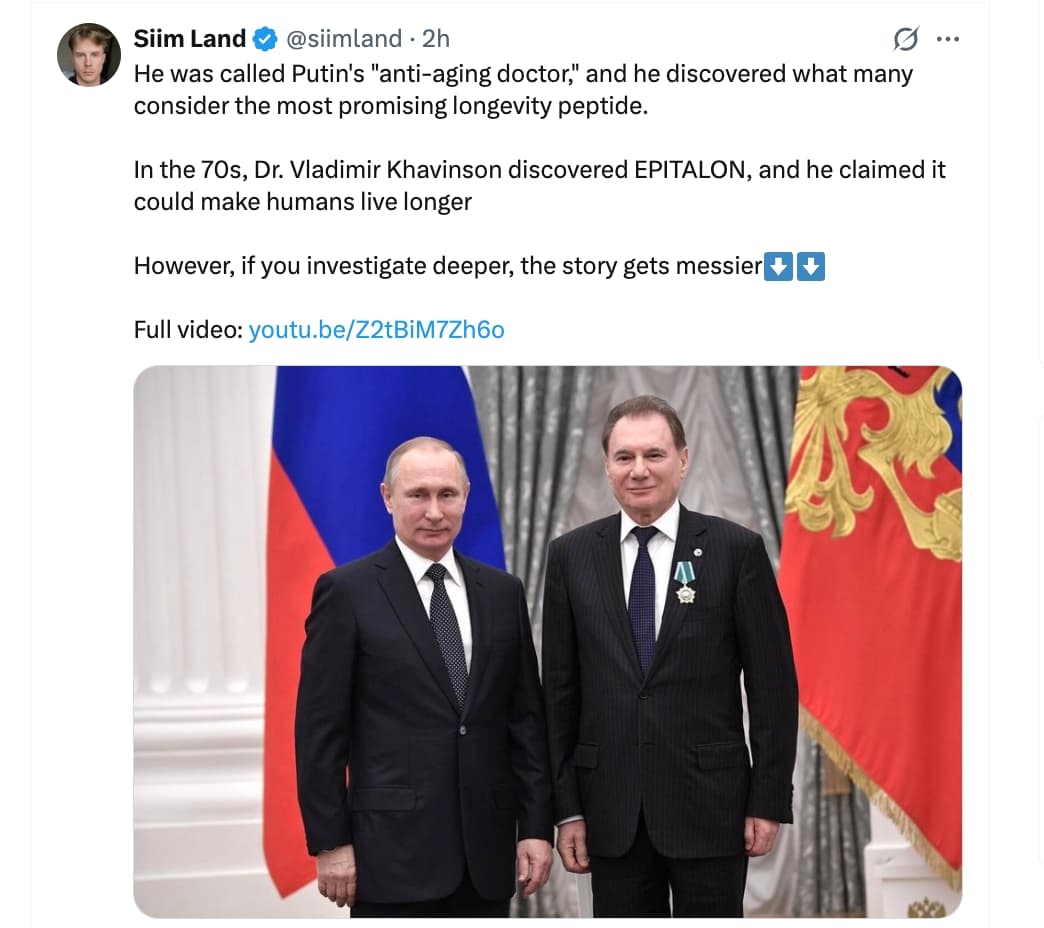
Epitalon (Ala-Glu-Asp-Gly) is a synthetic tetrapeptide derived from epithalamin, a bovine pineal gland extract. In longevity and biohacking communities, it is heavily promoted as a multi-pathway geroprotector capable of extending telomeres, restoring circadian rhythms, and significantly expanding maximum human lifespan. The primary source material for these claims originates almost exclusively from the late Dr. Vladimir Khavinson and the St. Petersburg Institute of Bioregulation and Gerontology. The provided transcript critically evaluates these claims, identifying severe methodological flaws, lack of independent randomized controlled trials (RCTs), and massive financial conflicts of interest surrounding Khavinson’s proprietary patents.
A rigorous review of the current scientific literature (2022–2026) confirms that Epitalon is a biologically active molecule with genuine mechanistic plausibility, but the translational gap between in vitro models and human clinical application remains vast. Laboratory data demonstrates that Epitalon reliably upregulates human telomerase reverse transcriptase (hTERT) mRNA expression, extending telomeres in human fibroblasts and epithelial cells. However, recent in vitro oncology data reveals a critical safety caveat: Epitalon also elongates telomeres in cancer cell lines via the Alternative Lengthening of Telomeres (ALT) pathway, raising significant theoretical oncogenic risks if used systemically without medical oversight.
Clinically, the narrative that Epitalon slashes human mortality rates by up to 4.1x or extends lifespan is entirely unsubstantiated by modern Level A or Level B evidence. Khavinson’s original cohort studies lack basic hallmarks of modern clinical design, such as verifiable randomization, double-blinding, and independent replication. Furthermore, Khavinson’s death at age 77—despite claiming his peptide protocols would ensure a lifespan of 120 years—underscores the discrepancy between marketing hype and biological reality. While Epitalon shows experimental promise as a circadian modulator and epigenetic regulator of the pineal gland, it cannot currently be classified as a verified lifespan-extending therapeutic in humans. The field desperately requires large-scale, independent, double-blind RCTs to validate its safety and efficacy profiles before mainstream adoption.
II. Insight Bullets
Epitalon is a synthetic tetrapeptide (Ala-Glu-Asp-Gly) designed to mimic the biological activity of epithalamin, a bovine pineal gland extract.
The overwhelming majority of foundational human data on Epitalon was generated by Dr. Vladimir Khavinson in Russia, creating an isolated evidence base highly susceptible to bias.
Khavinson held lucrative patents for these peptides, generating significant revenue and establishing a massive financial conflict of interest that compromises the objectivity of his published cohort studies.
Claims of 15-year “randomized” clinical trials utilizing Epitalon exhibit critical methodological flaws, including unclear randomization methods, lack of double-blinding, and profound socioeconomic confounders.
Despite claiming his peptide regimens would allow him to live to 120, Khavinson died at 77, matching standard male life expectancy in developed nations.
In basic science models, Epitalon demonstrates robust in vitro capability to upregulate hTERT and increase telomerase enzyme activity in normal mammalian cells.
A major safety signal exists: 2025 in vitro data confirms Epitalon extends telomeres in breast cancer cell lines by activating the Alternative Lengthening of Telomeres (ALT) pathway.
Animal models show highly variable lifespan results; while some fruit fly and murine models indicate a 10-16% lifespan extension, other studies show no impact on mean lifespan.
Epitalon exhibits epigenetic activity, specifically binding to H1/3 and H1/6 histones, leading to the decondensation of heterochromatin and the reactivation of repressed genes.
The peptide promotes neurogenic differentiation in human gingival mesenchymal stem cells by increasing the synthesis of Nestin, GAP43, and Doublecortin.
Pre-clinical data suggests Epitalon easily crosses the blood-brain barrier, making intranasal or sublingual administration theoretically viable for central nervous system targeting.
Epitalon directly influences pineal gland function, restoring age-depleted melatonin synthesis and re-entraining circadian clock systems in animal models.
Recent in vitro models of diabetic retinopathy (2025) indicate Epitalon accelerates retinal wound healing by decreasing reactive oxygen species (ROS) and inhibiting hyperglycemia-induced fibrosis.
There are zero modern (2022-2026), independent, Level A or Level B human clinical trials confirming the mortality-reducing claims of Epitalon.
Placebo effects and survivor bias heavily skew anecdotal reports of cognitive or physical enhancement from Epitalon within the biohacking community.
The overarching scientific reality is that Epitalon’s status as a precision gene-expression modulator is biologically plausible, but its classification as a proven human life-extension drug is currently unsupported.
III. Adversarial Claims & Evidence Table
Claim from Video
Speaker’s Evidence
Scientific Reality (Current Data)
Evidence Grade (A-E)
Verdict
Epitalon extends telomeres in both normal and cancer cells.
Cited unspecified in vitro studies showing 1.45-fold normal cell extension and 4-8 kb cancer cell extension.
Verified in vitro. A 2025 study confirmed dose-dependent telomere extension in normal fibroblasts via hTERT upregulation, and in breast cancer lines (21NT, BT474) via the ALT pathway. PubMed ID: 40908429
Level D (Pre-clinical)
Plausible (Translational Gap)
Epitalon drastically reduces human mortality and cardiovascular disease.
Source unverified in modern live search. No independent RCTs or Meta-analyses validate these mortality reductions. The cited studies lack verifiable blinding and randomization.
Level C (Highly Biased Observational)
Unsupported
Epitalon increases animal lifespan by 11-16%.
Cited a 2000 fruit fly study and a mouse study showing 12.3% maximum lifespan extension.
Verified in select models, but results are highly heterogeneous. Some modern reviews note specific mouse strains showed no increase in mean lifespan despite reductions in spontaneous tumors. PubMed ID: 12937682
Level D (Pre-clinical)
Speculative (Translational Gap)
Epitalon regulates circadian rhythms and increases melatonin.
Cited a 2020 study using 0.5 mg sublingual Epitalon for 20 days in elderly women.
Mechanistically supported. Epitalon is confirmed to stimulate the pineal gland and restore melatonin synthesis in aging animal models and early human cohorts. PMC11943447
Level C / D
Plausible
Improves visual acuity in Retinitis Pigmentosa.
Cited a 2002 Russian clinical trial on 162 patients showing broadened visual fields.
A 2025 in vitro study shows Epitalon reduces ROS and improves wound healing in diabetic retinopathy models (ARPE-19 cells), but no modern human RCTs confirm the 2002 RP clinical claims. ResearchGate: Epitalon & Retinopathy
Level D (Pre-clinical)
Speculative
IV. Actionable Protocol (Prioritized)
High Confidence Tier (Protocols backed by Level A/B evidence)
Data Absent. There are currently no protocols involving Epitalon that meet the criteria for Level A (Meta-analyses) or Level B (RCTs) evidence. Epitalon should not be prescribed or utilized as a primary therapeutic for any verified medical condition.
Experimental Tier (Level C/D evidence with acceptable safety margins)
Circadian Rhythm & Pineal Restoration: For experimental investigation into age-related circadian dysfunction, literature frequently cites a protocol of 0.5 mg to 1.0 mg of Epitalon administered subcutaneously or sublingually daily for 10 to 20 days. This cycle is typically halted for 4 to 6 months before repeating. The objective is to trigger endogenous melatonin synthesis and re-entrain clock genes.
Safety Monitoring: If utilized in an experimental or biohacking context, comprehensive baseline blood panels (including tumor markers, systemic inflammation markers like hs-CRP, and hormone panels) must be conducted prior to and following the cycle.
Red Flag Zone (Claims debunked or lacking safety data)
Lifespan Extension Therapies: Relying on Epitalon as a primary modality to prevent cardiovascular mortality or extend absolute lifespan is scientifically unsupported and dangerous if it replaces proven clinical interventions (e.g., ApoB management, VO2 max optimization).
Oncology Risk (Safety Data Absent): Due to confirmed 2025 data showing Epitalon activates the Alternative Lengthening of Telomeres (ALT) pathway in specific cancer cell lines, this peptide is strictly contraindicated in individuals with active malignancies, a history of cancer, or a high genetic predisposition to oncology syndromes. Telomerase activation in unverified cellular environments remains a profound safety risk.
V. Technical Mechanism Breakdown
Telomerase Reverse Transcriptase (hTERT) Upregulation: Epitalon acts at the genomic level to promote the transcription of the hTERT gene. This leads to the assembly of the active telomerase holoenzyme, which subsequently adds species-specific tandem repeats (TTAGGG in humans) to the 3’ ends of telomeric DNA, thereby mitigating replicative senescence and pushing human somatic cells beyond the Hayflick limit in vitro.
Epigenetic Remodeling and Chromatin Decondensation: Epitalon binds specifically to the H1/3 and H1/6 linker histones. This interaction alters nucleosome spacing and promotes the decondensation of pericentromeric heterochromatin. This localized shift from heterochromatin to euchromatin allows for the reactivation of previously silenced ribosomal genes and neurogenic differentiation markers (such as Nestin and GAP43).
Alternative Lengthening of Telomeres (ALT) Activation: In telomerase-negative or specific oncogenic environments, Epitalon has been shown to induce the ALT pathway. This is a homologous recombination-mediated mechanism where cancer cells utilize template DNA from other chromosomes to synthesize new telomeric DNA, ensuring their continued immortalization.
Pineal Gland Modulation: The peptide closely mimics the endogenous sequences found within the epithalamus. It exhibits a direct neuromodulatory effect on the pinealocytes, stimulating the enzymatic cascade responsible for converting serotonin to melatonin (via aralkylamine N-acetyltransferase and hydroxyindole-O-methyltransferase), thereby recalibrating disrupted circadian oscillator networks.
Or poly-peptide. I went from thinking I loved peptides to really hating them in a relatively short period of time LOL. Not touching any peptide for the rest of my life, including GLP’1 LOL
You shouldn’t like or hate something because it is a peptide, the same as you shouldn’t like or hate something because it is a small molecule. Peptide is a hype, but there are good peptides like GLP1s, HCG, HMG, HGH (though there are arguments against its use this is a significant peptide) and more.
Once the hype dies down I think we will focus back on the results.
The microgram hypothesis: a translational dosing error in Epitalon peptide research and its implications for human aging application
Chang-Hun Jung
Abstract
Epitalon (Ala-Glu-Asp-Gly), a synthetic tetrapeptide derived from the pineal gland, has attracted considerable attention in anti-aging research for its capacity to activate telomerase, restore circadian melatonin secretion, and extend lifespan across multiple species. The standard dosing convention in the longevity community, typically 5 to 10 mg per day administered subcutaneously, has persisted for over two decades without rigorous translational justification. This paper presents a hypothesis-generating translational re-examination of the preclinical and clinical evidence and identifies a fundamental translational error underlying current dosing practices. Through comparative potency analysis, we demonstrate that the 5 to 10 mg human dosing paradigm originates from studies conducted with Epithalamin, a crude polypeptide extract of bovine pineal glands, rather than with Epitalon itself. Primate data comparing both compounds reveal a model- and endpoint-specific potency differential of approximately 500-fold, while Drosophila models suggest a comparable, model-specific 1,000-fold differential in antioxidant efficacy. Allometric scaling of the effective murine treatment-day dose (1.0 μg per mouse, administered subcutaneously on 5 consecutive days each month) yields a per-treatment-day Human Equivalent dose of approximately 190 to 230 μg for a 70-kg individual. Furthermore, recent in vitro data demonstrate a non-monotonic concentration-response pattern in the BT474 breast cancer cell line, with peak telomere elongation at 0.2 μg/mL and declining effects at higher concentrations. Taken together, these findings support the testable translational hypothesis that Epitalon should be evaluated in the low microgram range, approximately 100 to 300 μg per treatment day, with treatment schedule and frequency to be defined in formal dose-finding studies, rather than the milligram range currently employed. The current practice may represent systematic overdosing rooted in the historical conflation of a crude extract with a purified synthetic peptide.