Nick1
December 17, 2025, 4:08am
#143
I think you should get basic diagnsotics such as Urinalysis, Urine Protein/creatinine etc to make sure there is nothing else brewing there.
1 Like
blsm
December 17, 2025, 10:34am
#144
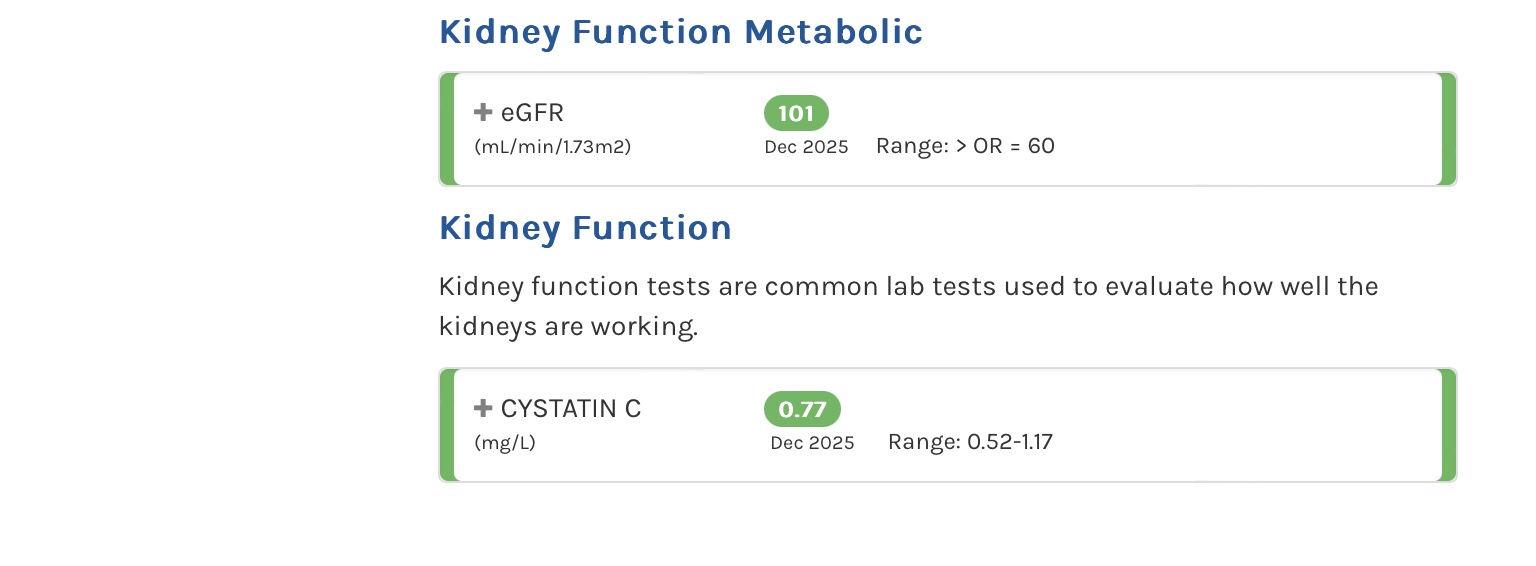
Thank you. I’m considering a kidney profile test and then taking the results to my doctor if warranted for imaging.
RapAdmin
December 17, 2025, 11:07am
#145
I recently read in a Gemini response that collagen peptides can also impact eGFR. Do you take them?
1 Like
cl-user
December 17, 2025, 12:59pm
#146
That was new to me so I also asked Gemini about that:
The short answer is: No, not directly as a measurement artifact, but potentially yes via hemodynamic modulation.
Unlike creatine supplementation—which introduces “noise” into the measurement signal by artificially raising serum creatinine—dietary collagen peptides do not directly skew the creatinine proxy. However, they do impose a metabolic load that can alter the actual “flow rate” (GFR) through vasodilation, a phenomenon known as renal functional reserve.
Here is the breakdown of the mechanism, distinguishing between the measurement signal (eGFR calculation) and the physical system (actual kidney function).
1. Signal Fidelity: The Creatinine Proxy
In physics terms, eGFR is a derived parameter, not a direct measurement. It is an inverse function of serum creatinine (Pcr):
eGFR∝Pcr1
The Creatine Artifact: You may be familiar with creatine (the monohydrate supplement) causing false positives for kidney stress. This occurs because creatine spontaneously cyclizes into creatinine, increasing the numerator (Pcr) without any change in actual renal clearance.
The Collagen Reality: Collagen peptides are comprised primarily of Glycine, Proline, and Hydroxyproline.They do not contain creatine. While collagen provides the precursor amino acids (Glycine and Arginine) for endogenous creatine synthesis, this biosynthetic pathway is tightly regulated and rate-limited by the methylation step in the liver. Consuming collagen does not create a “mass action” surge in serum creatinine. Therefore, your signal (Pcr) remains relatively clean.
2. System Dynamics: Hyperfiltration (The Hemodynamic Effect)
While the measurement isn’t skewed, the system state can change. Ingesting proteins (including collagen) induces a physiological response called glomerular hyperfiltration .
Mechanism: The liver metabolizes amino acids into urea. The renal tubule reabsorbs this urea (and sodium), which alters the tubuloglomerular feedback loop.
Outcome: The afferent arterioles (inflow pipes) vasodilate, increasing hydrostatic pressure within the glomerulus.
Magnitude: This increases the actual GFR by 10–30% acutely. In a healthy system, this is simply the kidney utilizing its “functional reserve.” In a compromised system (CKD), this sustained high pressure is akin to running an engine constantly at the red line, potentially accelerating wear (glomerulosclerosis).
3. Metabolic “Exhaust”: The Hydroxyproline-Oxalate Axis
Collagen is unique because it is roughly 12% hydroxyproline , an amino acid rarely found in other proteins.
Metabolic Pathway: Hydroxyproline is not re-incorporated into new protein translation (tRNA does not code for it; it is created post-translationally). It must be catabolized.
The Pathway: Hydroxyproline→Glyoxylate→Oxalate.
The Risk: Oxalate must be excreted by the kidneys. If urinary volume is low or calcium is high, calcium-oxalate precipitates (kidney stones). While this doesn’t immediately change eGFR, chronic micro-crystal deposition (nephrocalcinosis) can physically obstruct the filtration matrix over time, eventually reducing eGFR.
4. Important Distinction: Exogenous vs. Endogenous
In literature, you may see papers linking “collagen fragments” to low eGFR. Do not confuse these.
Exogenous (Dietary): What you put in. Absorbed as di/tri-peptides. Safe for healthy kidneys.
Endogenous (Fibrosis): Urinary collagen fragments (like endotrophin) are often biomarkers of the kidney’s extracellular matrix breaking down or remodeling during fibrosis. These are a result of kidney disease, not a cause from diet. The short answer is: No, not directly as a measurement artifact, but potentially yes via hemodynamic modulation.
1 Like
Nick1
December 17, 2025, 1:44pm
#147
I remain skeptical of its inherent risk. The only exceptions (other than contaminamts or adulterated product) would be high risk individuals e.g., hyperoxaluria(which is genetic), high oxalate absorption suchnas Roux enY Gastric bypass or underlying preexisiting kidney condition.
1 Like
cl-user
December 17, 2025, 1:54pm
#148
There is no increased risk for healthy kidneys. I do take collagen peptides but it’s interesting to know.
1 Like
blsm
December 17, 2025, 4:04pm
#149
I don’t currently. I did for about 5 years between 2014-2019 through.
1 Like