Stanfield recommends Vitamin B3 because that’s how he can shill his own supplement. That’s the only reasons why he makes Youtube videos, is to sell his supplement.
Which is completely fine but you still have to take what he says with a grain of salt.
1 Like
This is an obviously false statement.
2 Likes
I just took Niacin B3 reduced flush for the first time, and it is horrible! I am so flushed it feels like my body is on fire. It’s like the worst sunburn I have ever had in my life. The bottle is going right to the bin.
2 Likes
This is an obviously false statement.
Why do you think he would put in all this effort to make these videos?
He gets paid in ad revenue and he is also selling his supplement. It’s a business model, which is fine, but people need to be aware of it.
1 Like
I have been watching Dr. Stanfield from the beginning. Young doctor with a family. I don’t know how the educational system works where he lives. But even if he didn’t have student loans to worry about, there’s the cost of setting up a medical practice or just the expenses of starting out. He probably did start the YouTube video with the intent of making money; I certainly don’t begrudge him for that. I think he is genuinely interested in helping others and making some money on the side.
I became a little skeptical when he started using affiliate links and making his own vitamin supplement. But overall, I believe he is a good source of information on drugs, supplements, and increasing healthspan and lifespan. As you said, take everything he says with a grain of salt, but I do that with every YouTube video.
The evolution of Dr. Stanfield. I actually think he looks better than five years ago. I think he has slowed down his aging process.

3 Likes
If you consider the facts of the issue. He was publishing the videos for a number of years before he decided to produce his own supplement. Causality generally runs on the basis of event A occurring before event B and hence B does not cause A.
I accept that causality can be complex. However, arguing that he produced the videos years before he produced the supplement in order to sell the supplement is something that does not persuade me.
3 Likes
Dr Stanfield sold the supplement to fund the Rapamycin trial he did. He had tried other ways of raising money, such as donations and sponsorships, but they didn’t work well for him (went against his conscience for schlepping expensive supplements). So he created his own supplement to fund the Rapamycin trials, as well as taking out a mortgage on his own home to help fund it. He is pursuing a PhD in Rapamycin.
To call this man anything other than a stellar example would be a dishonor. Those who criticize without researching the circumstances around an individual should think carefully about their own credibility.
1 Like
There is zero reason, other than monetary. Why would you put in all this effort, reading studies, making and editing videos for absolutely no return? Why would someone do that?
Even if he funds Rapamycin studies (which is great), in the end it is something that uplifts his own brand.
He has multiple income streams:
- youtube ad revenue
- affiliate links to Amazon
- his own supplement e-commerce
- personal health plans
- email marketing flow where he sends you information and upsells
Youtube is a business model, that’s how it is. Anyone who believes Stanfield does this for the good of humanity must be naive.
I’m not saying he is a bad guy, but he is definitely an entrepreneur. Also he’s not some ultimate longevity expert, he is a General Practitioner in New Zealand.
I start with the assumption that causality is such that event follows cause. He has been monetising his youtube account in various ways for some time, but the supplement sales are quite a recent exercise.
What you said was:
Stanfield recommends Vitamin B3 because that’s how he can shill his own supplement. That’s the only reasons why he makes Youtube videos, is to sell his supplement.
I said that was an “obviously false” statement.
I continue to be of the view that it was an “obviously false” statement.
When you are in a hole you are well advised to stop digging.
1 Like
Lots of people jab NAD, and also there’s NMNH now too (I’m using NMNH complex from California Gold).
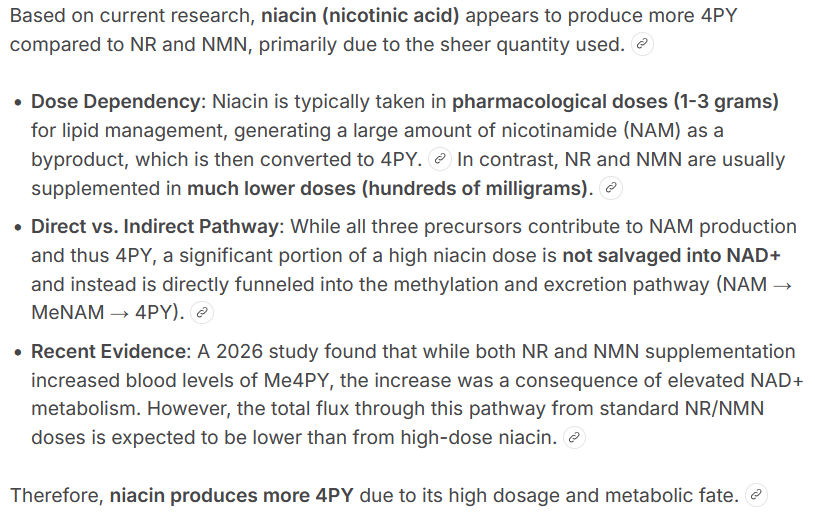
The niacin flush it goes away after u use it for a while, but i think there’s a paper claiming this is bad for you … edit: correction, the flush is actually good for you, the excess 4PY is what’s bad.
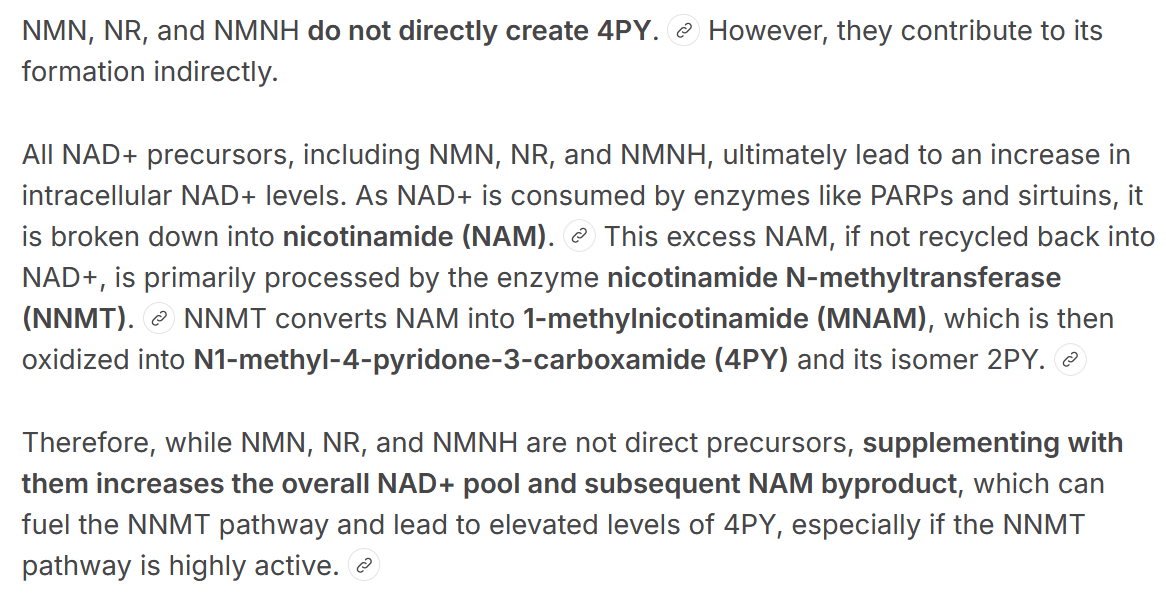
Regarding the link between excess niacin and increased cardiovascular risk, research led by Dr. Stanley Hazen at the Cleveland Clinic has identified that high levels of a terminal metabolite of niacin, N1-methyl-4-pyridone-3-carboxamide (4PY) , are strongly associated with an increased risk of major adverse cardiovascular events (MACE) like heart attack and stroke
Couple immediate questions for the AI:
lastly, on research and money making; I do research, I am not paid, I am not making money, I share what I find, I am wrong sometimes but not always. Money isn’t always the driver. Good for that guy. Wish I had more money 
1 Like
yes dude just take NR/NMN
been there, taken the b3, got the flush
NAD Commentary by Eric Verdin, president of the Buck Institute for Research on Ageing, and other scientists…
The problem, however, is how best to increase NAD+ levels, and how to do so safely. So far, most approaches have focused on artificially adding NAD+ to the bloodstream, for example through so-called NAD+ “precursor supplements”. The two most commonly sold are nicotinamide riboside (NR) and nicotinamide mononucleotide (NMN).
This has yielded impressive results in lab rodents and fungi. “In yeast, boosting NAD+ levels helped cells live longer by allowing them to divide more times before dying,” says Sophia Quigley, a specialist in the biology of ageing. “In mice, long-term increases in NAD+ led to better energy levels, improved metabolism, greater physical activity and signs of slower ageing.”
When researchers have manipulated mice so their brains carry degenerative features that resemble Alzheimer’s disease, treatment with NAD+ precursors has successfully reduced neuroinflammation and improved the rodents’ learning and memory capabilities. Human studies are now planned.
“The mouse studies on Alzheimer’s have really been amazing and promising, and I hope that the results from the first clinical trials will be beneficial for patients as well,” says Sofie Lautrup, a researcher at the University of Oslo.
However, as Eric Verdin, president of the Buck Institute for Research on Ageing, points out, humans are, of course, infinitely more complex than mice, and while there are numerous clinical trials under way in different disease types, there is still a distinct sparsity of evidence when it comes to the benefits.
Over the last four years, Norwegian researchers have led various early-stage trials of high-dose NR supplements in a small group of patients with Parkinson’s disease, but while there have been some small indications of improvement, not all patients have responded.
“In animals, these supplements do really very spectacular things, but so far almost all of the clinical trials in humans have failed to show anything,” says Verdin.
Do NAD supplements actually work – and are there risks?
While there’s a stronger case for experimenting with NAD+ supplements in people with debilitating health conditions such as long Covid, or diseases such as Alzheimer’s and Parkinson’s, there is much less evidence for artificially boosting NAD+ in relatively healthy midlifers, even those who are feeling more easily fatigued.
Both Verdin and Quigley are particularly sceptical about the idea of receiving direct NAD+ infusions, as Verdin says that most of it will simply be digested quickly by the liver.
“There is limited evidence that elevating NAD+ levels in this way is effective,” says Quigley. “The reason is that NAD+ is a large, unstable molecule, and while you can boost levels in the bloodstream, the molecule degrades quickly.”
Verdin is also not convinced that anyone in their 40s, 50s or 60s will be staving off the ageing process and increasing their lifespan by taking NAD+ precursors. One reason is that the doses being sold by most supplement companies are relatively small.
“What people don’t realise is that the doses that have been used in mice are typically 10 times higher than what you can buy in a supplement, and frankly, those doses don’t do anything in most cases,” Verdin says. “The reason is that the supplement companies don’t want to take a chance [in case of risks].”
Read the full article: The costly supplement promising to restore energy in midlife (Telegraph Newspaper)
1 Like