Unveiling the Emerging Role of Klotho: A Comprehensive Narrative Review of an Anti-aging Factor in Human Fertility
Klotho, an anti-aging protein, plays a vital role in diverse biological functions, such as regulating calcium and vitamin D levels, preventing chronic fibrosis, acting as an antioxidant and anti-inflammatory agent, safeguarding against cardiovascular and neurodegenerative conditions, as well as exerting anti-apoptotic, anti-senescence effects. Additionally, it contributes to metabolic processes associated with diabetes and exhibits anti-cancer properties. This protein is commonly expressed in organs, such as kidneys, brain, pancreas, parathyroid glands, ovaries, and testes. Recent research has highlighted its significance in human fertility. This narrative review provides insight into the involvement of Klotho protein in male and female fertility, as well as its potential role in managing human infertility in the future.
In this study, a search was conducted on literature spanning from November 1997 to June 2024 across multiple databases, including PUBMED, SCOPUS, and Google Scholar, focusing on Klotho proteins. The search utilized keywords, such as “discovery of Klotho proteins,” “Biological functions of Klotho,” “Klotho in female fertility,” “Klotho and PCOS,” “Klotho and cryopreservation,” and “Klotho in male infertility.” Inclusion criteria comprised full-length original or review articles, as well as abstracts, discussing the role of Klotho protein in human fertility, published in English in various peer-reviewed journals. Exclusion criteria involved articles published in languages other than English. Hence, due to its anti-aging characteristics, Klotho protein presents potential roles in male and female fertility and holds promising prospects for reproductive medicine. Further, it holds the potential to become a valuable asset in addressing infertility concerns for both males and females.
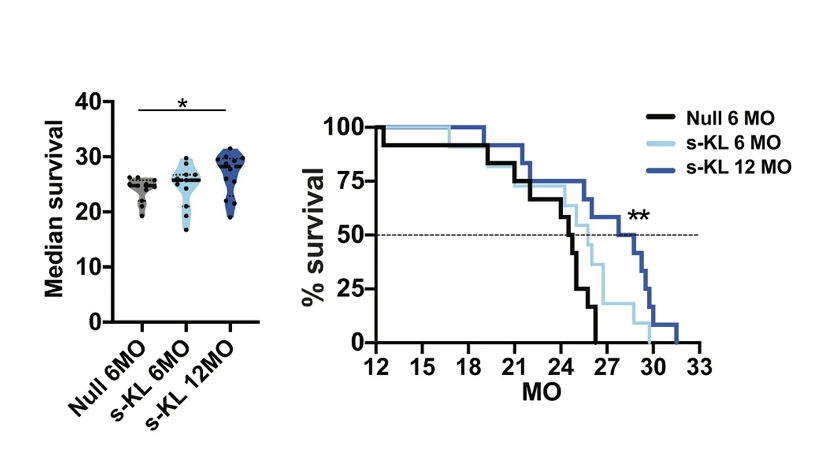
A study published in Molecular Therapy reveals that upregulation of secreted Klotho (s-KL) using adeno-associated virus (AAV) gene therapy significantly extends the lifespan of male mice, marking a major advancement in anti-aging science. This research highlights the potential of targeting specific proteins to mitigate age-related decline and improve longevity.
Key Points:
Male mice treated with the s-KL AAV at 12 months demonstrated substantial lifespan extension without adverse health effects
Enhanced muscle regeneration and structural improvement in treated males were accompanied by reduced fibrosis and better grip strength
The therapy also improved neuronal markers and reduced age-related changes in gene expression in the hippocampus
Why It Matters: This research opens up new possibilities for developing anti-aging therapies that could potentially extend human healthspan and lifespan.
C57Bl6 but interesting nonetheless. Apparently their vector expressed more s-KL in males than in females so this doesn’t mean it won’t work in females.
Liz Parrish has done the Klotho gene therapy. As well as Telomere, PGC-1α and myostatin gene therapies.
She “looks” pretty darned healthy to me from the many videos she is in. I think she is 54 or 55 now so about 10 years of data should be available from her experience.
Boosting Klotho Protein Slows Aging and Enhances Health
Summary: Increasing levels of the Klotho protein can slow aging and improve health across multiple systems. Scientists showed that mice treated to produce more secreted Klotho (s-KL) had better muscle strength, bone density, cognitive function, and even lived 15–20% longer.
The treatment promoted neuron growth, reduced muscle fibrosis, and protected bones, especially in females, suggesting widespread benefits. While human applications are still being developed, the findings point to s-KL as a promising future therapy to enhance healthy aging.
Key Facts:
Longer Lifespan: Mice producing more Klotho lived 15–20% longer.
Since the KL protective effect was needed systemically but also in the nervous system, and KL seems to not cross the blood-brain barrier, we performed both IV and ICV injections.33,34,35 In this regard, the double injection approach could be avoided in future studies using AAV serotypes with enhanced capacity to cross the blood-brain barrier following IV injection, increasing translatability to the clinic.
A cohort study on the correlation between serum Klotho levels and all-cause mortality in American diabetic populations
Conclusions: Low levels of Klotho were found to be strongly associated with an increased risk of all-cause mortality in individuals with diabetes (Klotho levels < 829.138 pg/ml), and a nonlinear relationship was observed between these two variables. These associations were largely mediated by age.
The first-ever Klotho Conference will be held in California, in September. Among the invited speakers are Dr. Markoto Kuro-o, who first identified klotho, and the redoubtable researcher Dena Dubal.
Interesting. Sounds slightly cultish in a Southern California Kooky way, which occasionally results in spectacular success (e.g. Jobs/Apple) . Let’s hope it’s one of those, lol.
3 trillionths of a gram isn’t going to do anything, you have hundreds of thousands of times more than that already circulating in your bloodstream.
I can get 5 ug for $97 from Thermo Fisher, which is 1.5 million times more material. Recombinant proteins aren’t cheap but $21 for 3.5 pg is highway robbery.
Several drugs enhance circulating Klotho levels, and some cross the blood-brain barrier to potentially act in the brain. In clinical trials, increased Klotho was noted with renin-angiotensin system inhibitors (losartan, valsartan), a statin (fluvastatin), mTOR inhibitors (rapamycin, everolimus), vitamin D and pentoxifylline. In preclinical work, antidiabetic drugs (metformin, GLP-1-based, GABA, PPAR-γ agonists) also enhanced Klotho. Several traditional medicines and/or nutraceuticals increased Klotho in rodents, including astaxanthin, curcumin, ginseng, ligustilide and resveratrol. Notably, exercise and sport activity increased Klotho. This review addresses molecular, physiological and therapeutic aspects of Klotho.
I’ve prescribed it once or twice for a condition called lipodermatosclerosis (scarring of the deep layers of skin and subcutaneous fat of the lower legs), but after checking out this review and perusing some more studies, I’m incredibly intrigued by its potential. Newer studies are showing potential as an adjunct treatment for dementia, chronic kidney disease, cancer and depression in addition to vascular disease. I just wish they had a form that could be taken once or twice daily instead of TID.
I’m curious if anyone here has personally noticed cognitive enhancement from Klotho or Klotho-related compounds — especially things like working memory, focus, mental clarity, processing speed, motivation, or ADHD-like symptoms.
I know there was the primate study where Klotho seemed to improve working-memory-type performance, and I’ve also heard claims from Liz Parrish / BioViva about Klotho gene therapy potentially increasing cognition quite significantly — even numbers like 10–15 IQ points or around one standard deviation. I’m not sure how realistic that is, so I’m trying to separate actual user reports from hype.
Has anyone here used Klotho-1, Klotho-6, Klotho peptides, gene therapy approaches, or related compounds like SS-31 and noticed anything clearly cognitive? Or do most people not feel much subjectively?
I’m especially interested in real-world effects on working memory, executive function, ADHD-type issues, and general cognitive performance.

 . Let’s hope it’s one of those, lol.