Collagen and elastin are part of the extracellular matrix, something from my view is not focused on enough in the longevity space.
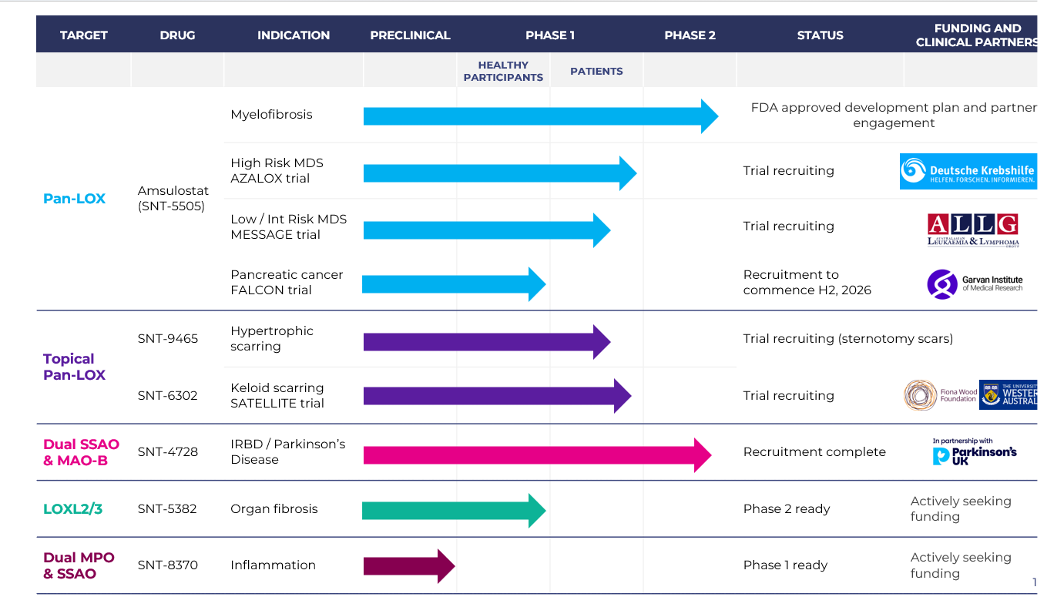
An Australian biotech company that is particularly focused on the extracellular matrix was brought to my attention: Pipeline – Syntara
“Currently, our clinical development efforts are primarily focused on evaluating novel drugs targeting a subset of oxidase enzymes known as lysyl oxidases. This family of enzymes are uniquely responsible for the development of fibrosis by cross-linking collagen and elastin, resulting in hardened, poorly-degradable scar-like tissue.”
While their interventions are currently targeted at scar tissue and various other specific conditions I get a feeling that something in this collection of drugs they are developing are going to have beneficial off-target effects for elastin/collagen for skin aging, as well as overall vascular/systemic aging.
After three months, patients receiving SNT-6302 treatment showed significant improvements in scar vascularisation and extracellular matrix remodelling compared to placebo-treated patients. Advanced imaging analysis provides compelling evidence that scars appeared structurally and biologically closer to normal, uninjured skin. Source: BCAL Diagnostics and Sonic Healthcare advance validation of BreastestPlus Version 2 for US market - Biotech
"In 2023, Professor Wood led clinical trials conducted at the University of Western Australia, identifying a drug developed by biotech company Syntara (ASX: SNT) as one that could reinvigorate elasticity of the skin in scar tissue.
Syntara’s pan LOX (lysyl oxidase) inhibitors caught her attention, with potential to inhibit the enzymes that create scar tissue. Research was put into clinical trials in 2023 with 42 patients volunteering to apply the topical cream to their scars in a 3-month study.
The results were highly encouraging, showing 66% reduction in LOX enzyme activity which is responsible for the cross linking of collagen fibres implicated in adverse scarring. Collagen was reduced by 30%, a result Professor Wood described as “an unprecedented change to the scar composition that we have not seen with any other form of treatment.”…
…Syntara’s pan LOX inhibitors, however, have shown the potential to permanently modify the scar by reducing the cross linking of collagen fibres and collagen, holding out the potential to revert scars back to their pre-burn elasticity and prevent bad scars forming."
https://thesentiment.com.au/syntara-prepares-for-new-clinical-trials-led-by-professor-fiona-wood-to-reinvigorate-elasticity-into-burn-scars/
From their website:
Syntara using pan-LOX inhibitors for skin scarring
Lysyl oxidases are a family of enzymes that play a critical role in scar formation and maintenance. Lysyl oxidases stabilize the main component of scar tissue, by the cross linking of collagen and elastin fibres, and drive scar stiffness and appearance. The process by which the inhibition of LOX enzymes can improve scars is:
- Inhibition of lysyl oxidases in the skin reduces cross-linking of extracellular matrix proteins (collagen and elastin).
- Collagen stability is reduced and remodeling is
- Consequently, scar tissue will be reduced and of diminished stiffness, with improved mechanical properties and appearance.
Syntara is developing topical and oral drugs inhibiting all lysyl oxidase family members with potential anti-fibrotic application in severe fibrotic related skin scarring indications
The company’s drug discovery, known as SNT-6302, has shown promising clinical results in inhibiting the LOX enzymes that play a critical role in the development of scar tissue. SNT-6302 was discovered by the company’s research team at the company’s Frenchs Forest laboratories. The project was awarded initial National Health and Medical Research Council (NHMRC) funding for some of the pre-clinical development work done in collaboration with researchers at the University of Western Australia, led by distinguished surgeon Professor Fiona Wood.
UWA researchers published the pre-clinical studies performed in collaboration with Syntara in Nature Communications showing the topically applied pan-LOX inhibitors reduced collagen deposition and cross-linking and improved scar appearance without reducing tissue strength.
In 2023 the phase 1c trial of SNT-6302 reported it had met its primary safety objective and two secondary biomarker endpoints in patients with established scars. 42 Australian patients with any type of scar older than 1 year and at least 10cm2 in size were recruited in the double‐blind three‐month study and applied either SNT‐6302 or placebo cream three times a week.
Applications of SNT‐6302 cream resulted in a mean 66% reduction in LOX activity when measured 2 days after the last dose (p<0.001) compared to baseline and to placebo group. LOX is responsible for the cross linking of collagen fibres implicated in adverse scarring. Professor Wood commented, “This exploratory clinical study has significantly enhanced our understanding of the role of LOX enzymes in scarring and the scar process itself. SNT‐6302 safely inhibits these key enzymes to a significant degree and leads directly to an unprecedented change to the scar composition that we have not seen with any other form of treatment. We estimate that up to 50% of the excess collagen in these patients’ scars has been removed and while the length of this Phase 1c safety study was not sufficient to change the appearance of an established scar the remodelling process will be ongoing and I’m confident we would see an improvement in scar appearance and physical characteristics if we observed them for longer.
Skin Scarring – Syntara