Air pollution is a much larger killer than I thought! I have noticed a big impact of my indoor HEPA air purifiers.
It’s also good to ‘burp’ your house by opening up windows and doors to let fresh air in.
Air pollution is a much larger killer than I thought! I have noticed a big impact of my indoor HEPA air purifiers.
It’s also good to ‘burp’ your house by opening up windows and doors to let fresh air in.
Causes and extent of avoidable mortality across the european union: insights for advancing healthy aging
Yes, this is becoming quite a bit one. I was at a cardiac conference last year where the presenter made a convincing case that air pollution was also a driver of cardiovascular disease. Plus lots of spillover - lung diseases, persistent low-level inflammation etc.
My family also runs air purifiers in our main living room and our bedrooms. (We use the Dyson ones which have a sensor to tell you PM2.5, PM10, formaldehyde, volatile oxygen compounds etc). So together that basically covers at least 1/3 of the day. I also have one in my office, which covers another 1/3 or so. I think we can’t be “perfect” on this, but running a purifier in the room you sleep in seems like a no-brainer.
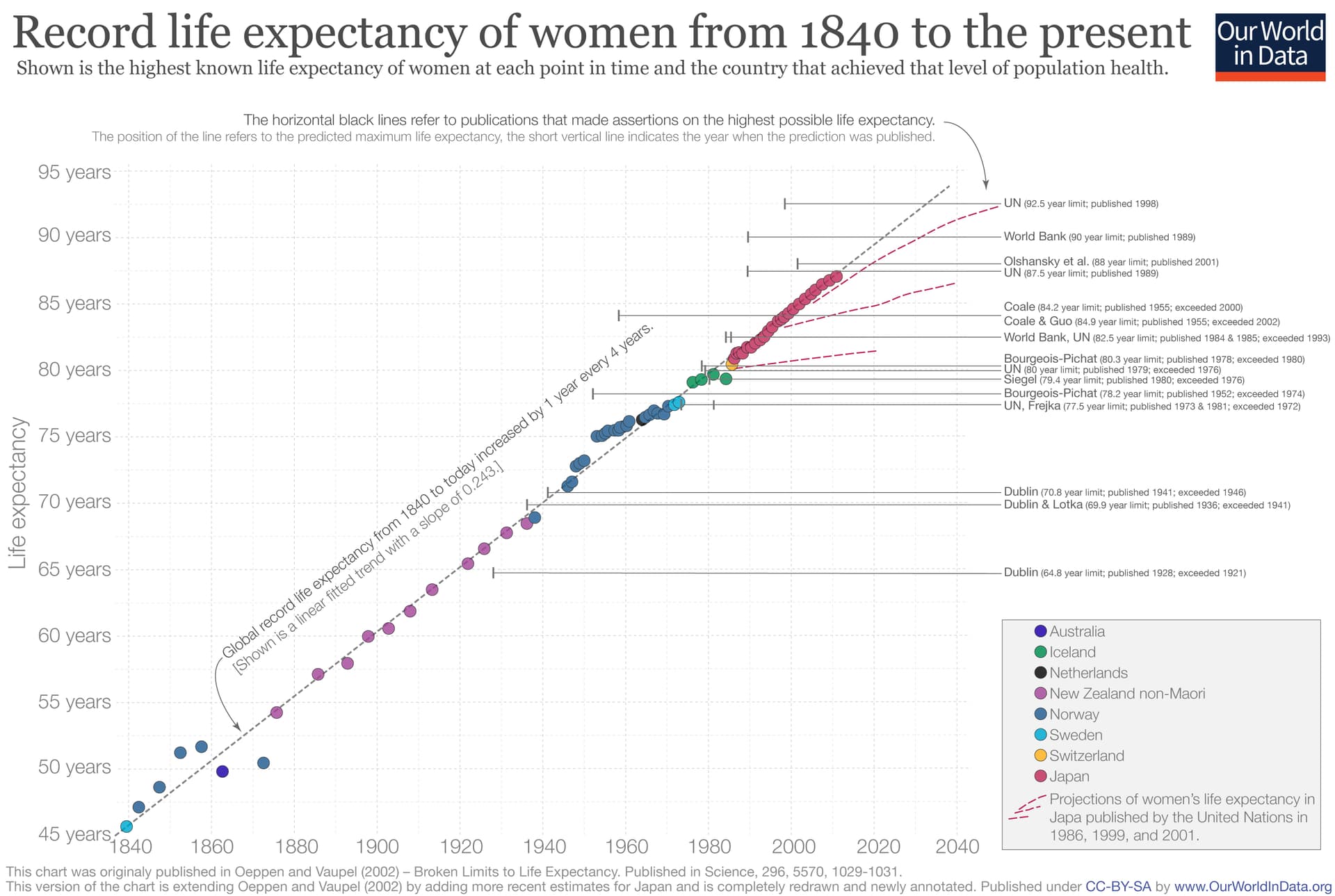
A story here in The Guardian about “healthy life expectancy” being in decline.
a child born this morning in Britain can expect to be in good health only until they are 61. The last 20 years of their life will be blighted by illness: dodgy hearts, painful joints, an inability to get about. Our healthy life expectancy has been dropping for years; it is now the lowest since 2011, when records began.
It seems that a huge part of it is economic. Poor living conditions, high stress.
The working-class suburb where I was raised, Edmonton, ranks among the most deprived in the country; the middle-class suburb where I currently live is among the least deprived. I could see them on her map, along with figures suggesting my two small daughters can expect almost a decade more of good health than girls living in my old home, just three miles away.
And the thing that (selfishly) worries me the most:
Scientists increasingly worry about “midlife mortality” in Britain: people in the prime of their lives dropping dead.
In Donald Trump’s America, where life expectancy is plunging, more women are dying between the ages of 25 and 44 than did in 1990.
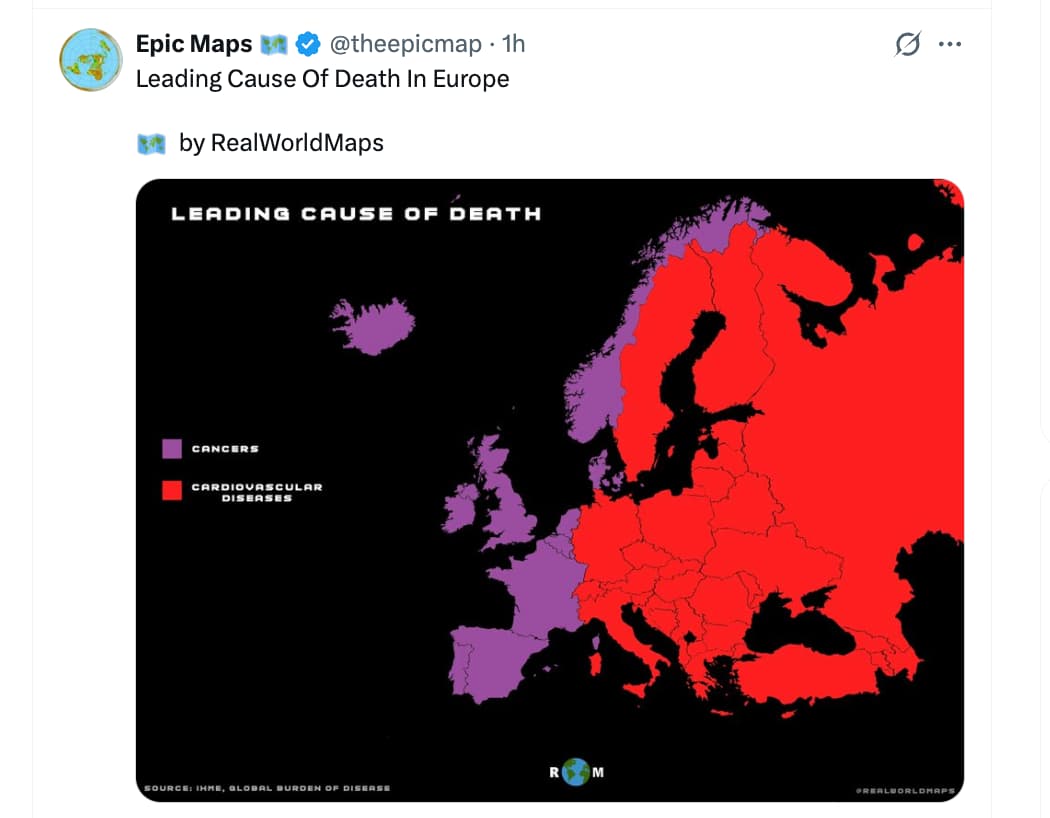
So the red countries need to take statins and the purple need to take Rapamycin.
Or you could just be smart and take both. 
Ha, I think it’s more that we’ve made really good progress in preventing CVD. Statins and blood pressure medications work wonders. So if you deal with early deaths from CVD, you’ll end up with more deaths from other causes. And we aren’t anywhere near as good at preventing or curing cancers.
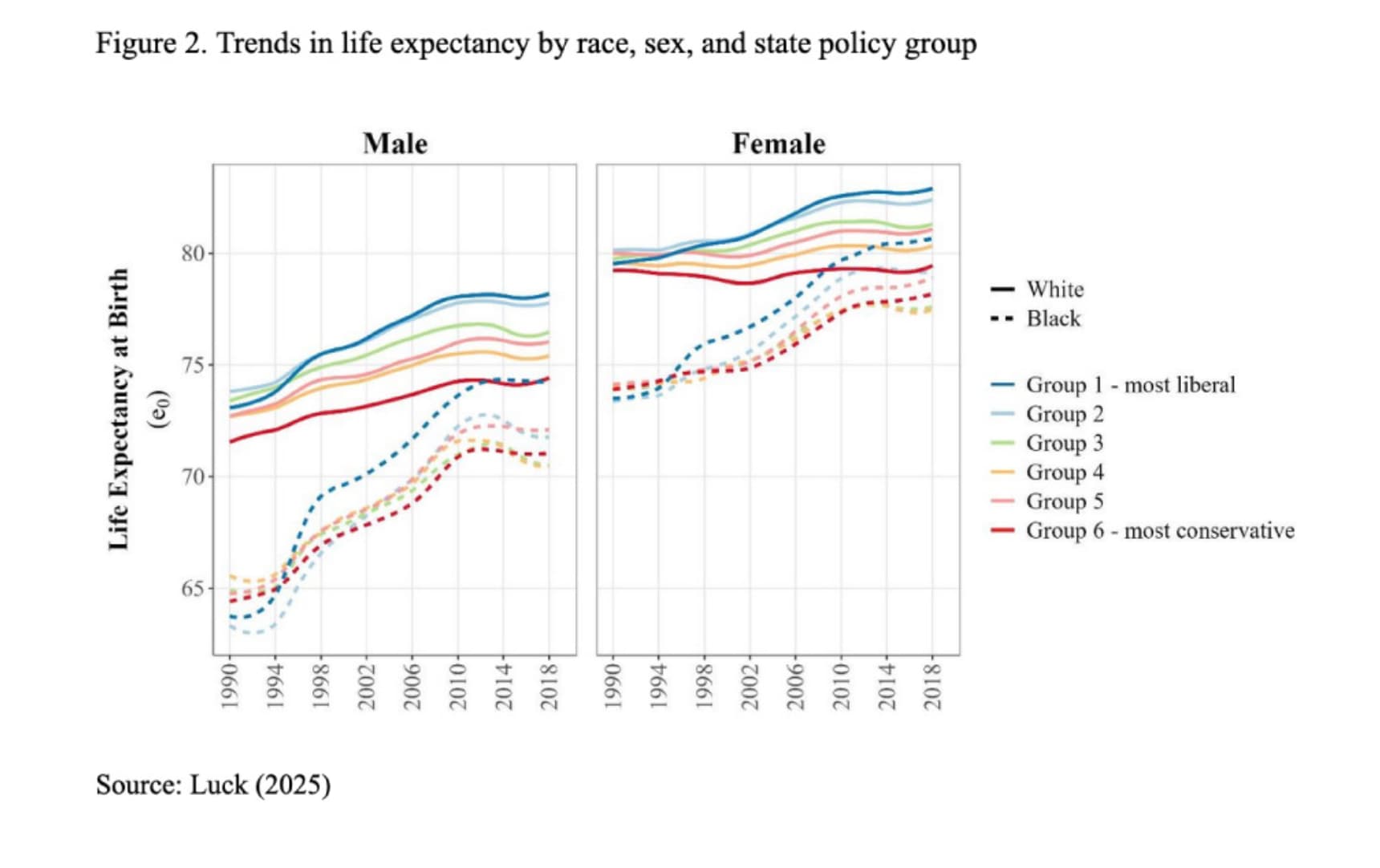
Policy polarization is rewriting the American geography of longevity
“Figure 2 shows how Black and White life expectancy has changed between 1990 and 2019 across these state policy clusters. Across all race-sex groups, more liberal states achieved far larger gains in life expectancy between 1990 and 2019 than their conservative counterparts. In the most liberal states, life expectancy rose by 3.4 years for White women and an extraordinary 10.7 years for Black men. Meanwhile, the most conservative states registered modest improvements at best, and for White women, there was essentially no progress at all.”
Cost of healthcare also causing many to delay pursuing milestones and life-enhancing goals
Amid a landscape of elevated prices and a rising cost of living, Americans are feeling financial strain from both a range of daily expenses, such as groceries and utilities, and healthcare expenses.
The West Health-Gallup Affordability Index indicates that Americans’ ability to afford healthcare has deteriorated in recent years. In 2026, millions are expected to face higher insurance premiums and rising out-of-pocket costs as the expiration of some Affordable Care Act subsidies and upcoming cuts to Medicaid enrollment threaten coverage. Collectively, these shifts could leave millions of Americans without health insurance at a time when financial stress is already running high.
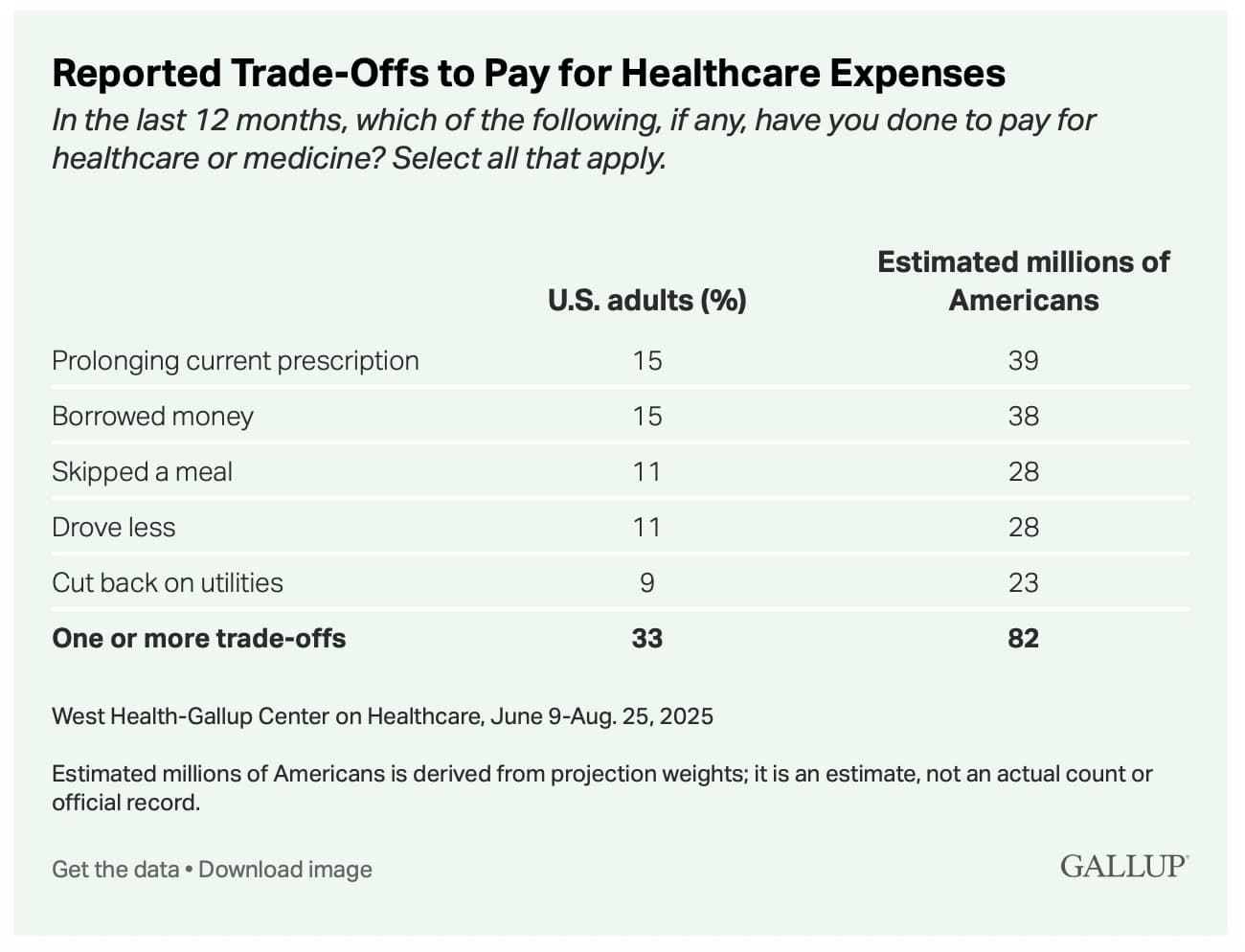
New findings from the West Health-Gallup Center on Healthcare in America reveal that some Americans are cutting back on a wide range of other expenses, including utilities, driving less to save gas money to pay for healthcare, and stretching out doses of prescription drugs or borrowing money.
Americans also report that healthcare expenses are influencing long-term planning and major life decisions. Even middle-income households are feeling the strain.
Healthcare Costs Impact Daily Life
In a nationally and state-representative survey of nearly 20,000 U.S. adults conducted from June through August 2025, roughly one-third of respondents — the equivalent of more than 82 million Americans — said they have made at least one trade-off with daily living expenses to afford healthcare.
One problem with these statistics is that deaths from drug addition and shootings are not separated from those such as aging diseases. The main improvement in life expectancy came from a reduction in infant mortality. Hence it is hard to read things into this.
I think you can read that conservative states have higher infant mortality, shootings and durg overdoses.
Conservative states tend to have more poverty which contributes to the above. There is also smoking, obesity and typical lifestyle drivers.
But there is also education and government programs and that is very effected by politics.
The infant mortality rates and the variations around the US are shocking. They correlate very well to political affiliation. Utah as a relatively rich red state has low infant mortality but quite high black infant mortality. Also has relatively high life expectancy so it is hard to make generalizations.
But overall, being poor in the US is pretty bad all around relative to more advanced countries.
This makes sense as many countries have strong safety nets such as socialized healthcare for all, whereas the US does not. Believe it or not, but free healthcare positively impacts lifespan.
A new study using better data and more rigorous methods finds that every US state saw cohort life expectancy gains of at least 5 years between the generations born in 1941 and 2000 — directly contradicting previous estimates that showed losses in some states. The real story of American longevity may be far more optimistic than the headlines suggest. Full text
Pifarré i Arolas H, Andrade J, Fletcher J
Life expectancy gains across US states between 1941 and 2000: a cohort study
BMJ Open Access 2026;16:e109623. doi: 10.1136/bmjopen-2025-109623
The obesity of high income nations is also interesting. Puerto Rick, of course is a US protectorate.
| Rank | Country | Obesity Rate (%) | Region |
|---|---|---|---|
| 1 | Kuwait | 45.0 | Middle East |
| 2 | Qatar | 44.0 | Middle East |
| 3 | United States | 43.0 | North America |
| 4 | Saudi Arabia | 43.0 | Middle East |
| 5 | Puerto Rico | 42.0 | Caribbean |
| 6 | Chile | 40.0 | South America |
| 7 | Bahrain | 38.0 | Middle East |
| 8 | Panama | 37.0 | Central America |
| 9 | Romania | 35.0 | Europe |
| 10 | New Zealand | 34.0 | Asia-Pacific |