Life Expectancy in the USA and Around the world

Safety - few traffic fatalities, low crime (no guns), a feeling of safety (low crime), healthy food, low obesity levels, etc…

Lots of reasons. But to be honest, what we have in Hong Kong should be what the world has.

The amazing thing is.the number for men and women both went up by about 7 months. I like living a year and getting 7 months back!

3 Likes

Now, a solution has been found through the work of Dr Michael Ni Yuxuan, Clinical Associate Professor in the School of Public Health and colleagues. Dr Ni conducted the largest and most comprehensive assessment of Hong Kong’s longevity to date, which has been published in The Lancet Public Health.

“Explanations for longevity in Hong Kong have included economic prosperity, our universal health coverage, and our very low maternal and infant mortality. But these things are true for many high-income regions, including in Asia. What really distinguishes us is that we have attained a low smoking prevalence for both men and women,” he said. “For the first time, we showed that successful tobacco control was the reason why Hong Kong’s life expectancy has surpassed all other populations.”

This is the real reason.

3 Likes

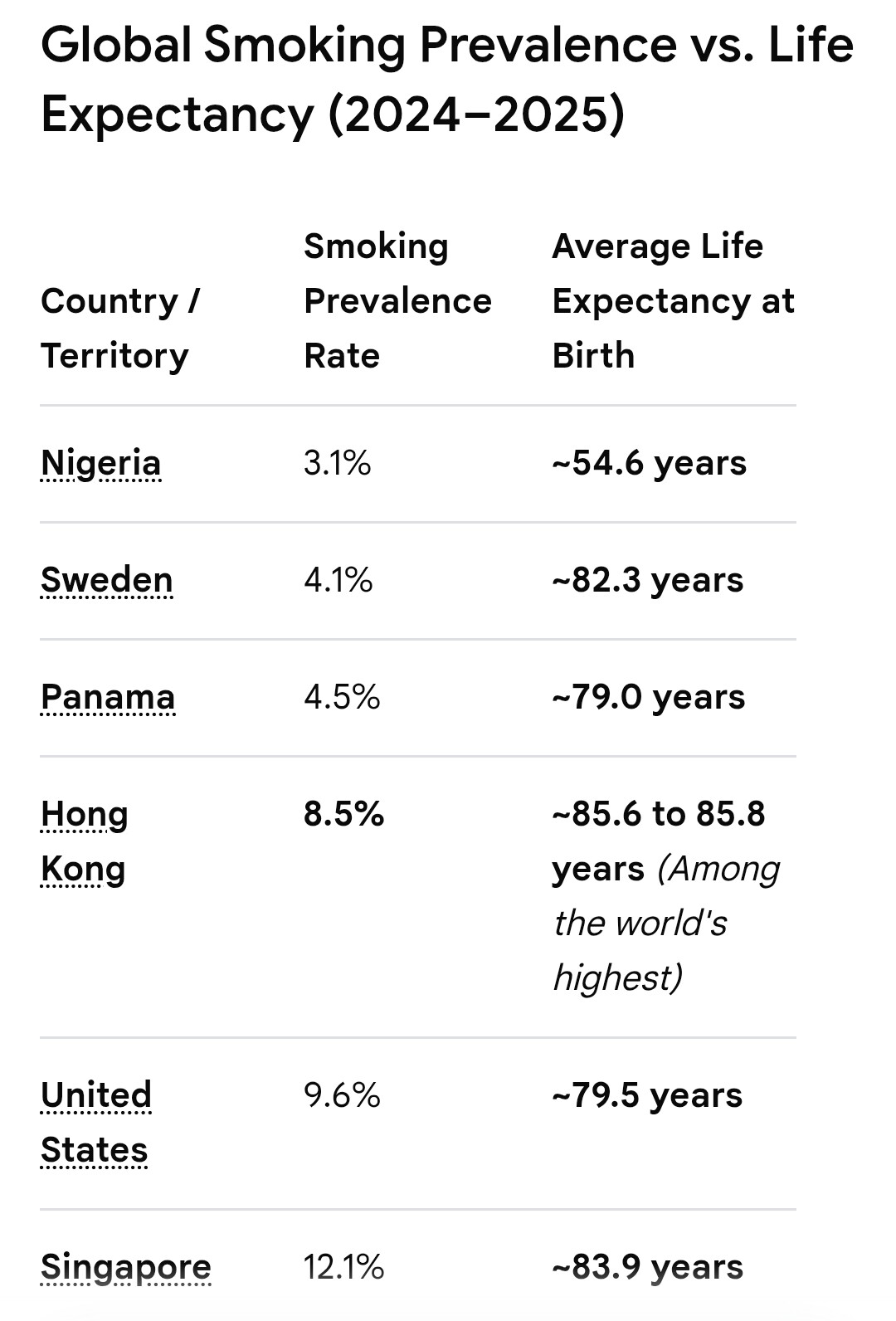
Well if that were the case, then why don’t the other countries who have even lower smoking prevalence have higher life expectancy?

And then there’s this gem of an outlier.

No. It doesn’t seem to be smoking that does it. The authors wanted a silver bullet.

However I do believe smoking is egregiously bad and a factor. It’s just not the whole story.

2 Likes

It seems to suggest that in Honk Kong deaths related to smoking are lower than in say USA even though the prevalence rate is similar. I wonder if they smoke different brands of cigarettes in Hong Kong meaning they are less harmful? I was watching a documentary on cigarette industry a while back and the tabaco leaves would be treated with plenty of chemicals before they were processed, which I believe makes them way more dangerous/cancerous and the documentary itself seemed to suggest same in addition to making cigarettes more addictive.

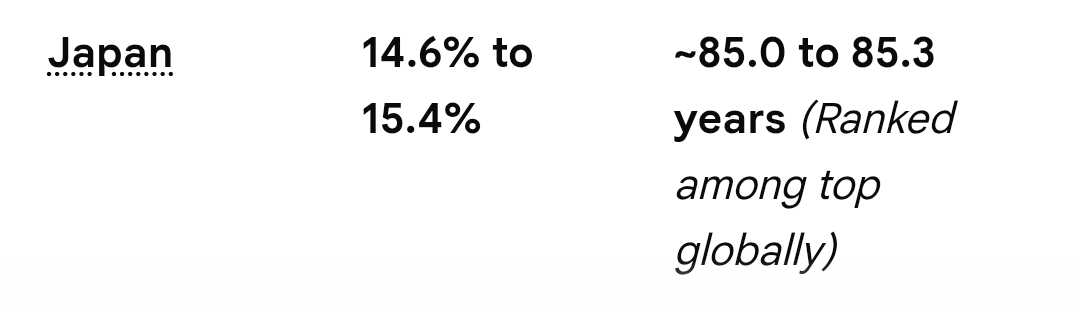
While there’s no doubt inhaling smoke (of any kind, let alone cigarettes) is bad I was raised in a farm, and I recall few people in town making their own tabaco/cigarettes and they would smoke it. None of the 5-6 of the ones who did it died young, one actually became the oldest in town, died at 97, Clearly too small a sample to mean anything but thought I’d throw it out there, and from the above table/data (alone) smoking seems to have no connection whatsoever to life acceptancy as Japan’s % of smokers is almost double that of USA, yet they have second highest life acceptancy.

AI:

DeStrider’s skepticism is a fair reminder that no single factor can explain everything. But the rigor of Dr Ni’s study lies in its comparison: it restricts the analysis to high-income regions that already share universal health coverage and very low maternal and infant mortality. Within that group, tobacco control is precisely what separates Hong Kong from the rest.

2 Likes

3 things would seem to matter

  • high income
  • low smoking
  • Not US (ie - proper functioning social and health care systems)

I think if you just look at the 2 winners - Japan and HK, smoking explains the difference. Same for Singapore.

If you compare to the US, it isn’t smoking. There are 1000 reasons why the US is bad but smoking isn’t the reason.

I’m sure no one in HK really compares to the US. They compare to Japan and Singapore.

2 Likes

Ok, if you are comparing only Asian countries, smoking can be the determining factor as all those countries share almost all of the other factors that I listed above - no guns, lowest crime in the world, low obesity, excellent public transport, etc…

I guess it depends on the groups you are comparing. As the article itself states:

Hong Kong’s record is best understood as a population pattern with several interacting causes, not a recipe that can be copied one ingredient at a time.

1 Like

Does it really matter? Everybody agrees that smoking is bad, and I am sure that no members of a longevity forum smoke :rofl:

It’s also well known that you can’t just “transplant” findings from one country into another. The culture, habits, genetics, and behaviours of the people are also important. You’re not going to get Americans to behave like Hong Kongers or Swedes, no matter what government policy you manage to implement.

I don’t see anything special in any of these data. The biggest factors are increasing wealth, not being obese, and having access to healthcare. You can see clear examples of that within countries, such as the clear, large, life expectancy gap between poor and rich people across the USA, UK and most of Europe.

Look at the UK data (for men):

Bottom socioeconomic 10%; life expectancy 73.2y, healthy life years 49.8y
Top socioeconomic 10%; life expectancy 83.6y, healthy life years 69.2y

That is almost 20 YEARS more healthy life years, and 10 extra total years of life. So if you can raise up the poorest people in society, you make absolutely massive gains on average.

It isn’t simply a matter of universal health care. The UK system is pretty bad nowadays. But as I said earlier, culture and lifestyle have a lot to do with it. Even when the bottom 10% have just as much right to see a doctor as the top 10%, their jobs are probably shittier, worse workplaces, worse housing, worse childhood experiences and upbringing, higher psychological stresses (job insecurity, bills, debts, crime), poorer health literacy etc etc.

A much more obvious explanation IMO could simply be genetics. Hong Kong population is 92% ethnic Chinese. Japan and Korea are also highly genetically homogenous. All of those countries seem to be somewhat “protected” from negative effects of smoking compared to western populations. For lung cancer, typically smoking is a 3-5x risk enhancer in East Asia, but a 9-23x risk enhancer in the West. (pubmed.ncbi.nlm.nih.gov)

There are other situations where things like this are a major factor. For a 10mmHg increase in systolic blood pressure, a white person has a 8% higher risk of stroke, but a black person has a 24% higher risk. (https://jamanetwork.com/journals/jamainternalmedicine/fullarticle/1485077)

There are also clear differences in how populations respond to certain classes of drug. Clopidogrel is an anti-coagulant given to people often after a stent placement. It needs an enzyme (CYP2C19) to activate it. Around 60% of East Asians are poor metabolisers of the drug, and so compared to a European, East Asians taking this drug have a 2x higher risk of MACE, and a 5x higher risk of stent thrombosis. If you treat with a different drug (ticagrelor) then the risk is equal between East Asians and Europeans, showing that it’s the difference in drug metabolism which is the factor.

Long story short, IMO it’s likely that genetics explain a huge amount of the difference.
4 Likes