@dajs
I strongly disagree with your post, especially posting it in the Lest We Off Ourselves thread.
What target? I am not sure what you are implying. Yes, some people experience things such as mouth sores, but they are in the minority, as Dr. Green’s evaluation of 333 adults shows.
There are no known deaths or any other irreversible side effects even from massive doses of rapamycin. If you know of any, please post the citations or papers.
(All bold type are mine):
I understand where you are coming from, as Dr. Mikail Blagosklonny said:
“But the fear of nonexistent side effects is not the only reason the use of mTOR inhibitors for life extension has been questioned. The second reason is that there is rightful skepticism about any claims made about anti-aging drugs because thousands of anti-aging remedies have already failed. What then makes rapamycin different?”
“However, numerous studies in mice show that late-life treatment extends lifespan. For example, when started at the age of 20 months, transient (for 90 days) treatment with high-dose rapamycin was sufficient to increase life expectancy by 60%.”
Brian Kennedy (Buck Insitute for Research on Aging, USA) " Rapamycin, a specific mTOR inhibitor confers robust extension of lifespan and healthspan in mice"
Mikhail V. Blagosklonny (Roswell Park Cancer Institute, Buffalo, USA): “In a number of experiments, rapamycin suppressed and slowed down cellular senescence of human cells. The mTOR inhibitor rapamycin prevents age-related weight gain, decreases rate of aging, increases life span and decreases carcinogenesis in mice.”
Vladimir Anisimov (N.N. Petrov Research Institute of Oncology, Russia):
"The mTOR inhibitor rapamycin prevents age-related weight gain, decreases rate of aging, increases life span and decreases carcinogenesis in transgenic HER-2/neu cancer-prone mice. Rapamycin dramatically delayed tumors onset, decreased a number of tumors per animal and tumor size. Lifelong administration of rapamycin extends lifespan in female 129/Sv mice.
“Importantly, rapamycin was administrated inter-mittently (every other 2 weeks) starting from the age of 2 months.”
Rapamycin inhibited age-related weight gain, decreased aging rate, increased lifespan (especially in the last survivors), and delayed spontaneous cancer."
"We envision that mTOR inhibitors may potentially be used to prevent sunlight-caused tumors as well as skin photo-aging.
Elimination of Proliferating Cells Unmasks the Shift from Senescence to Quiescence Caused by Rapamycin: Olga V Leontieva 1, Zoya N Demidenko 1, Andrei V Gudkov 1, Mikhail V Blagosklonny 1,*
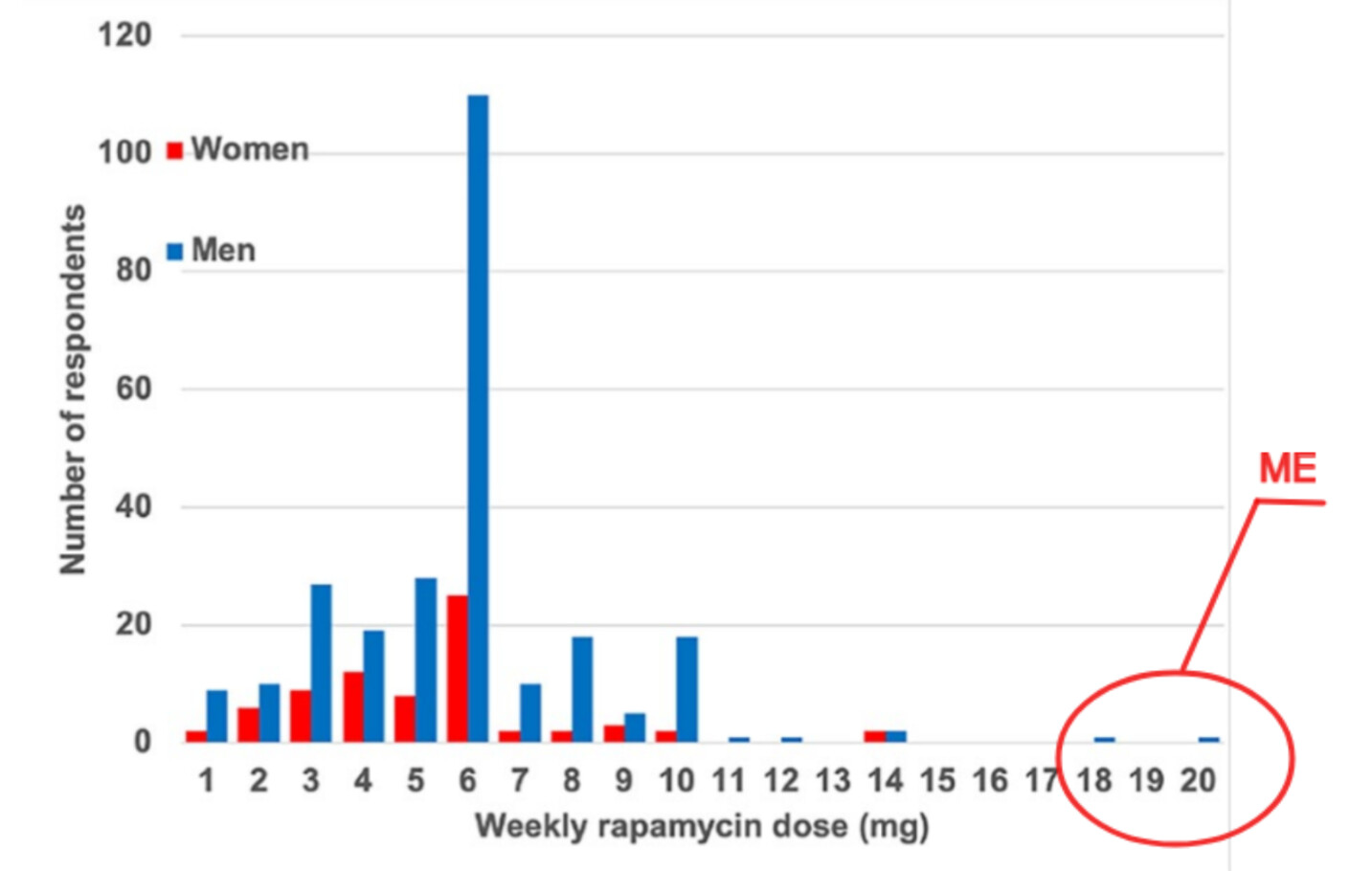
Evaluation of off-label rapamycin use to promote healthspan in 333 adults
Green, Kaeberlein et al.
I didn’t participate in the study, but this is where I would fall, 18 mg or more equivalent once-weekly doses for 5 years.
Despite these limitations, we find no evidence for significant increases in health risks, other than mouth sores, from off-label rapamycin use. A trend toward increased risk of bacterial and fungal infection was associated with rapamycin use, but did not reach statistical significance and appear to be small in magnitude. Overall, the risk of side effects from off-label use of rapamycin may compare favorably with other drugs commonly used off-label, such as statins [63] and metformin
A similar conclusion was reached by a study of rapamycin use in obesity [112]. It was suggested in 2008 that a pulse (intermittent) schedule of rapamycin administration would improve regeneration of stem cells [114] while avoiding mTORC2 inhibition [54,115].
This is what I follow and have had excellent results. Complete elimination of chronic actinic keratosis and no squamous or basal cell carcinomas since I started rapamycin.
This is my mantra. Not suggesting it for anyone else, especially young people:
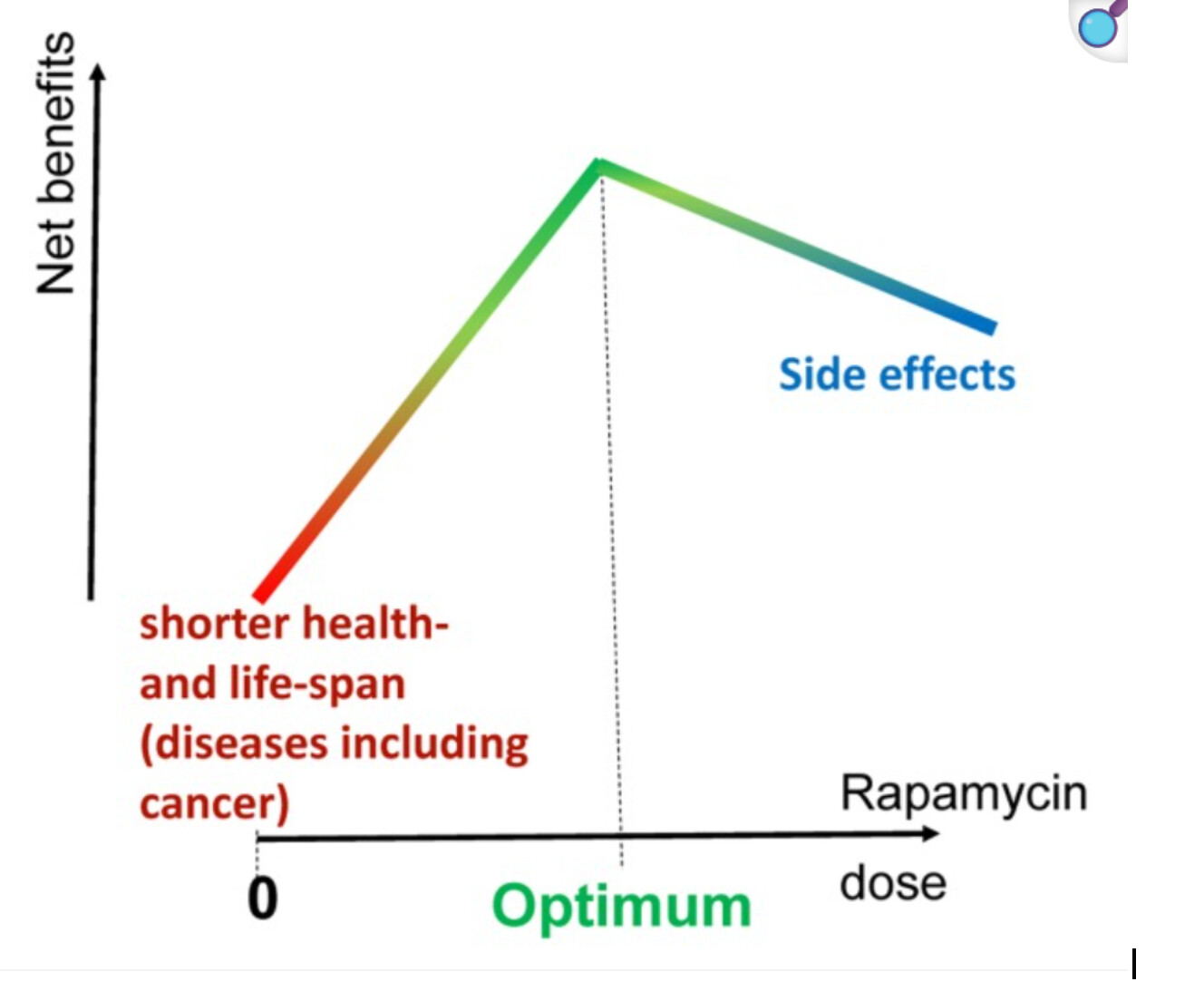
Optimal dose of rapamycin for maximal net benefits. Life extension by rapamycin is dose-dependent in rodents. The higher the dose, the higher the anti-aging benefits, including cancer prevention and life extension. In humans, side effects are dose-dependent and net benefits could potentially decrease at very high doses. This point of the highest net benefit is the optimal dose. The optimal dose varies in different individuals due to the variability of potential side effects. Thus, the optimal dose in a particular individual is determined by the emergence of side effects. The treatment can be viewed as life-long phase I/II clinical trial.