Collectively, the HbA1c and weight-lowering potential of oral semaglutide (7–14 mg) appear to be nearly similar to injectable semaglutide (0.5–1.0 mg) and larger than other GLP-1RAs, currently approved in people with T2D. […] Notwithstanding, unlike injectable semaglutide which has shown a significant reduction in MACE (SUSTAIN 6) and has an additional label for cardiovascular (CV) risk reduction, oral semaglutide is yet to show CV superiority over placebo (PIONEER 6). Since PIONEER 6 was not powered to assess the CV superiority of oral semaglutide over placebo, the SOUL (Semaglutide cardiOvascular oUtcomes triaL, NCT03914326) has been specifically designed for this purpose and is estimated to be complete by July 2024.
It’s definitely different. Initially, I actually became slightly more hungry but also energetic, both of which are not unusual reports. After the 2nd or third dose I sometimes had to remind myself to eat because I had no appetite whatsoever. That’s also pretty common especially as it builds up in the system. It seems to take up to a month to be felt for a lot of folks, though my wife got appetite suppression on 1mg immediately.
Unlike tirzepatide, which caused me a feeling of almost-nausea (very faint, hard to describe), reta felt great. If I wanted to eat, I could eat, but I didn’t need to eat and I’d feel full quickly. It didn’t cause side effects except for an elevated heart rate for the first couple weeks (also common). The reason I went on it was that I had stalled on tirzepatide.
I went back to tirz for maintenance because I have a large stockpile, and I want to reserve the reta for future cuts since it’s so powerful.
A 2mg dose goes a very long way, so it’s actually quite inexpensive if sourced from overseas.
Hi @AgentSmith - do you have any sense of what happens with insulin levels in healthy individuals when on these different GLP/GIP drugs?
From a longevity perspective that is one of my main questionmarks - are they (a) raising fasting insulin levels and (b) making insulin levels constantly revved up and not cyclically up around and then decreases, down after meals/when sleeping.
Insulin up is of course one way to lower blood glucose, but insulin up also has negative longevity effects. So in someone with good glucose control may not be net good to increase insulin.
Do you have any data from your N=1 experiments and/or see what people on your other forums and groups have experienced?
It’s true that I have done some experimentation, but I actually started tirzepatide under the supervision of a doctor, and did the semaglutide also under her supervision. When I began this process I was obese and was unable to lose more than 12 lb, even with rather significant caloric reduction and exercise. My metabolism was in bad shape because of massive weight gain after a hospitalization that significantly reduced my muscle mass and destroyed my gut microbiome. I was not yet diabetic, but the trend was troubling.
After a 20% weight loss from the peak, my HbA1c was 4.9 when on about 10mg/wk of tirzepatide. 3 months later, it was 5.3, still on about the same dose. The difference may have been my Acarbose use, but that’s the one medication that I don’t log for some reason and my memory of that is poor.
At the time of the 5.3 reading, my insulin was 4.7 for a HOMA-IR of 0.9 based on fasting glucose, or 1.2 based on an estimate of average glucose from the HbA1c. Not horrible . However, at the same time I got a LabCorp NMR Lipoprofile that put my insulin resistance score (LP-IR) so low that they couldn’t measure it (<25). Truly excellent.
Not long after those tests I began lowering my tirzepatide dose and increasing calories dramatically. I’m now eating about 50% more an an attempt to gain weight back (muscle).
I’ll get fasting glucose, insulin, and HbA1c this coming Friday. It will be interesting to see where much higher carb intake, yet more muscle and much less tirzepatide will land me. I was using Acarbose for 2 of the 3 months that this latest HbA1c will cover, but abandoned it because the sides are horrible for me. I can report back when I get the results.
Regardless of all this, I could not lose weight before the meds, and a year later I think I’m healthier than I’ve been since my mid 20s. I get really ticked off at all the pundits and influencers who just tell obese people to eat less and move more as if many of them haven’t been trying that for years without success. Without this medication, I’m hungry all the time no matter what kind of diet I’m on or how much I eat. People who don’t have that problem cannot comprehend it but should be humble enough to consider that the phenomenon is real.
From last week, while I’m now lean and on a maintenance dose of tirzepatide, my fasting glucose was 77, fasting insulin 2.8 → HOMA-IR of 0.5.
HbA1c was 5.2.
I was taking Acarbose for probably 1/2 to 2/3 of the time period that that HbA1c covered, but hadn’t taken it for about a month to 6 weeks prior to the test because of gas of the untrustworthy variety.
I have been eating a lot more than when I was dieting (2700-3000 cals vs less than 2000), much higher carb intake at an average of 221-248g/day (past 12 weeks, past 8 weeks, respectively; I track everything).
I did start taking 5mg of dapagliflozin (half dose) 7 days before the labs, but not that morning. I don’t know how much the dapa influenced my results.
I switched my strength training from low rep/heavy over to high volume/moderate for a hypertrophy emphasis. My weekly hours spent lifting went from 2.5-3.5 to 4.5-6.5. I’ve been trying to gain weight. So far I’ve been gaining a bit more than half a pound a week - about perfect. I think it’s mostly muscle but I’ll get a DEXA mid-June to see. My creatinine has gone up since increasing the lifting volume.
I do not have a fasting insulin result before Tirzepatide - no doctor ever bothered to check until recently. Actually, the result from a few months ago was my lab order.
My doctor answered that question about how an SGLT2i (or anything actually) will affect HBA1C. HBA1C is a composite of roughly the past 3 months. So, if you took it for 1 out of the 12 weeks that your HBA1C measurement covered, I’d assume it had about 8% of the full effect that you’ll see during your next test.
It’s (approximately) the past 3 months but probably more weighted towards recent weeks. So if you had one week of dapagliflozin ending today I think it’ll influence your HbA1c more than 1 week but 3 months ago.
Effects of Semaglutide on Chronic Kidney Disease in Patients with Type 2 Diabetes (2024)
Among the 3533 participants who underwent randomization (1767 in the semaglutide group and 1766 in the placebo group), median follow-up was 3.4 years, after early trial cessation was recommended at a prespecified interim analysis. The risk of a primary-outcome event was 24% lower in the semaglutide group than in the placebo group (331 vs. 410 first events; hazard ratio, 0.76; 95% confidence interval [CI], 0.66 to 0.88; P=0.0003).Results were similar for a composite of the kidney-specific components of the primary outcome (hazard ratio, 0.79; 95% CI, 0.66 to 0.94) and for death from cardiovascular causes (hazard ratio, 0.71; 95% CI, 0.56 to 0.89). The results for all confirmatory secondary outcomes favored semaglutide: the mean annual eGFR slope was less steep (indicating a slower decrease) by 1.16 ml per minute per 1.73 m2 in the semaglutide group (P<0.001), the risk of major cardiovascular events 18% lower (hazard ratio, 0.82; 95% CI, 0.68 to 0.98; P=0.029), and the risk of death from any cause 20% lower (hazard ratio, 0.80; 95% CI, 0.67 to 0.95, P=0.01). Serious adverse events were reported in a lower percentage of participants in the semaglutide group than in the placebo group (49.6% vs. 53.8%).
“The four pillars are now a renin-angiotensin-aldosterone system (RAAS) blocker, sodium-glucose cotransporter-2 (SGLT2) inhibitors, finerenone, and semaglutide,” said study co-author Katherine R. Tuttle, MD, who is a professor of medicine, Nephrology Division and Kidney Research Institute, at the University of Washington, Seattle, while presenting the findings.
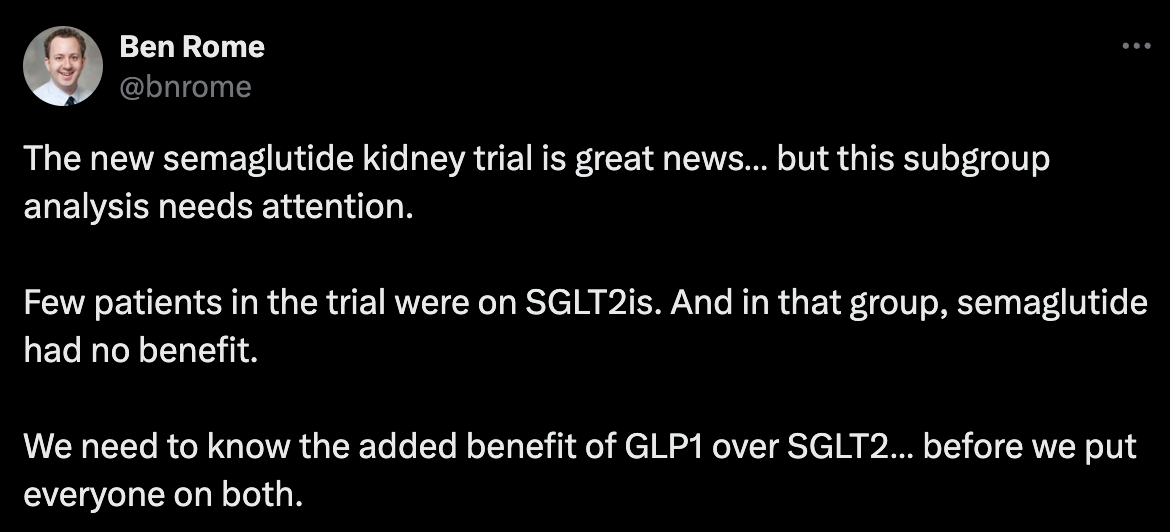
About 15% were receiving an SGLT2 inhibitor, reflecting the time period when enrollment occurred (before increased use of the drugs).
Also providing comment for Medscape Medical News, Alberto Ortiz, MD, PhD, chief of nephrology and Hypertension Renal Unit, Health Research Institute of the Jiménez Díaz Foundation, Madrid, Spain, noted caveats, including the early termination of the trial and that few patients were taking an SGLT2 inhibitor.
“The number of participants on SGLT2 inhibitors was low and results were nonconclusive for this reason,” he said. Therefore, “this trial does not answer the question of whether semaglutide adds benefit for the primary endpoint for patients who are already on the standard of care, ie, SGLT2 inhibitors.”
The issue was also the first to be raised during the question and answer session, with one audience member asserting that regulatory authorities will argue that SGLT2 inhibitors should be the comparative treatment for GLP-1 receptor agonists.
Perkovic agreed that because of the trial’s timing, the proportion of patients taking an SGLT2 inhibitor was “relatively modest.” However, he added, “I think one of the assumptions is that we have to either choose SGLT2 inhibitors or GLP-1 receptor agonists, and I would challenge that.”
“I think the question is: What benefit do we get when we prescribe [the treatments] in combination? [Ongoing research] is looking at that issue of whether the effects are additive, and we believe they are,” he said.
The semaglutide weight-loss miracle has a dark side: As desperate patients contend with shortages and sky-high prices, a world of criminals and con artists are filling the void with life-threatening fakes. Katherine Eban investigates our alarmingly active pharmaceutical underground.
The plot of the South Park special episode about Ozempic is partly about ordering the powder from India and creating their own injectables. Something similar is happening here it seems, with some fraud in the mix.
Counterfeit pen with insulin is extremely dangerous, these criminals are extremely immoral.
European investigators tracing the origin of the counterfeit pens sold by the plastic surgeon followed the chain of custody through a web of distributors in Austria, Germany, and the UK and back to an all-too-familiar home base: Turkey. Specifically, an exporter in Ankara named AUB Healthcare was identified as being a conduit for the counterfeits.
Turkish Ozempic not good (in fact any black market ozempic)?
The glucose-dependent insulinotropic polypeptide (GIP)/GLP-1 dual agonist showed significant differences in LDL-C (range of mean differences: −11.61 to −6.77%p), triglycerides (−19.94 to −13.31%p), and T-CHO (−7.94 to −5.09%p) levels compared to placebo, insulin, and sodium-glucose co-transporter 2 (SGLT2) inhibitors.
The GLP-1 agonist significantly reduced T-CHO (−5.20%p; −6.39%p) and LDL-C (−4.32%p; −8.17%p) levels compared to placebo and SGLT2 inhibitors, respectively.