You can get a prescription for tret on Amazon pharmacy in about an hour without having to actually see a doctor - just answer a few questions online. It costs about $20
5 Likes
Scarless healing?
Students and dermatologists at Penn set out to discover how rosemary and its extract could heal damaged skin without leaving scars.
The growing social media craze promoting rosemary and rosemary extract in skincare routines now has scientific evidence to support it. Researchers from the Perelman School of Medicine at the University of Pennsylvania report in JCI Insight that a natural compound found in rosemary leaves could play a key role in improving wound healing and reducing the formation of scars.
“Many skin injuries end in scars, and in some people, it can lead to long-term cosmetic and even functional issues,” said senior author Thomas Leung, MD, PhD, an associate professor of Dermatology at Penn. “Our findings suggest that rosemary extract, and specifically the antioxidant, carnosic acid, can shift the healing process from scarring to healthy skin regeneration. We don’t have proven ways to consistently do that in humans.”
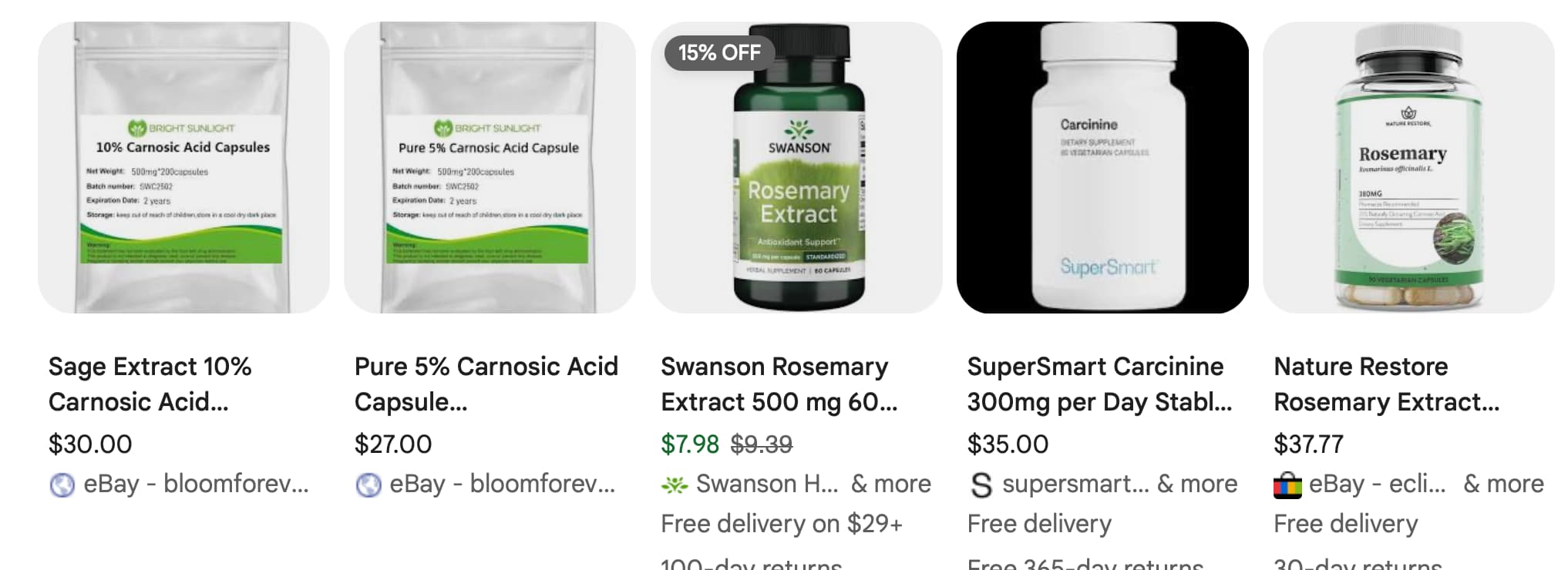
Conducting the research in mice, the researchers made cream with carnosic acid, a naturally occurring antioxidant mostly existing in rosemary, to accelerate wound closure and restore hair follicles, oil glands, and cartilage. They also found that a particular nerve sensor in the skin previously identified as essential to scarless healing, TRPA1, was critical for stimulating the healing in this instance, too. When tested in mice without the TRPA1 sensor, which previous research from Leung showed is responsible for scarless healing, carnosic cream lost its impact.
The researchers also found a localized effect from rosemary; scarless healing only occurred when carnosic acid cream was applied to the site of the injury, but not when it was applied to skin far from the wound.
Story:
https://scitechdaily.com/according-to-scientists-this-viral-skincare-trend-actually-works/
Research Paper:
Reference: “Carnosic acid in topical rosemary extract enhances skin repair via TRPA1 activation” by Emmanuel Rapp, Jiayi Pang, Borna Saeednia, Stephen Marsh Prouty, Christopher A. Reilly and Thomas H. Leung, 23 October 2025, JCI Insight.
DOI: 10.1172/jci.insight.196267
5 Likes
Rosmarinic acid is an HDACi
2 Likes
The title says it all.
Full open access article here: The Best Skin-Care Trick Is Being Rich
5 Likes
Reminds me of this story on “Mar-a-Lago Face”: https://www.axios.com/local/washington-dc/2025/11/10/plastic-surgeons-dc-mar-a-lago-face-trump-insiders
4 Likes
The Silicon Valley Skin-Care Brand Biohackers Are Obsessed With
OneSkin, all over TikTok, merges the beauty industry’s fixation with antiaging and tech’s fantasy of halting death.
Amid snail slime serums, pulsed-light hair removal gadgets and Korean sunscreens on TikTok, a new kind of skin-care product is making the rounds. In one video, a white-coated scientist pipettes pink liquid into vials. In another, on Instagram, a woman with glittery ombre nails unboxes black-and-white bottles filled with futuristic youth serum. “Welcome to your skin-health and longevity journey,” the packaging reads.
If the pitch sounds more Palo Alto than Paris, that’s because it is. OneSkin, begun by four Ph.D.s in a San Francisco biotech accelerator, is now a skin-care brand sitting at the intersection of beauty’s obsession with antiaging and Silicon Valley’s fixation with outfoxing death. The company’s lotions and serums, “proven to target a root cause of aging,” have attracted a fan base that includes a who’s who of tech, biohacking and wellness types.
Full story: The Silicon Valley Skin-Care Brand Biohackers Are Obsessed With (Bloomberg)
Related:
6 Likes
One thing is for sure, the mentioned Silicon Valley category can certainly afford that expensive product.
1 Like
The OneSkin thing is pretty interesting. I ordered 3 bottles, so I’ll test it myself. But if you look at the paper, and if you believe it, you basically have efficacy similar to over-the-counter retinol products. That’s not bad, and it seems to work through a different mechanism, where they can likely be stacked. However, it’s not a game-changer, and would still be easily out-performed by basic Adapalene or tretinoin.
However, it’s still a peptide and they don’t cross the skin very well. In their newsletter, the OneSkin company basically strongly allude to using micro needling to enhance permeability, but they can’t outright advise it, so they say “many people are doing it this way” and similar statements.
7 Likes
It would be good to use on microneedling days since you can’t use retinoids or BHA/AHA on top of microneedled skin.
2 Likes
I’m looking forward to hearing about your experience with it. I’ve seen they have a body lotion which is tempting, but I keep assuming it must be a gimmick and no better than the other million peptide lotions out there.
In the meantime, I just bought a red light panel and am HOPING this was not a big fat waste of time/money and really does work on our skin/hair
The OS-01 peptide is a senolytic, very different from retinol products in function.
I plan to order some FOX04-DRI next month to do a skin experiment with micro needling. This is a “universal” senolytic and acts on all types of senescent cells. I’ve used it before for a systemic cycle but I’m interested to see if a targeted delivery to the epidermis and dermis layers.
It looks like it’s a derivitive of another peptide called OS-01 and is a proprietray version that seems to be protected by “secrecy” kind of like the Colonels secret recipe.
OS-01 peptide structure and cas#.pdf (300.1 KB)

3 Likes
Yes I know. But in the NPJ Aging study (which they use in their marketing material) the overall effects on skin were compared to retinol, and were comparable. But in theory they could stack together since they work in different ways.
I’m just saying not to expect miracles because the product was not out-performing a simple OTC low dose of retinol.
IMO, I would still also be a bit hesitant about injecting peptides into my face - especially when they are only cosmetic grade and come bundled with all the other ingredients in the cream.
4 Likes
Because I’m a peptide hound, I’ve been looking at all aspects of these amazing molecules, from how they are made, how our body generates and uses these coded instruction sheets and the amazing benefits we get when we “supplement” our age related decline in peptide production.
Cosmetic grade peptides are manufactured to pretty much the same standard (>98% purity, endotoxin and TFA free) as pharma grade. I agree about the other “stuff” and that is why I’m going to make my own skin care product so I have control over what goes in my skin for micro needling and the Electroporation machine I ordered (thanks to all who have pointed us in the right direction on that interesting device) ,
Every legit peptide mfg I know of lists their peptides in 2 tiers >95% and >98%. Even companies making them to be used at the standard to compare to any tested product. I’ve purchased standardized compounds for a testing lab I used 5 years ago, at their request, so they would be able to compare what I had purchased to a known standard.
We see re-sellers touting the 3rd party test in the 99% plus range but that is to be expected from a product that is manufactured with a >98% threshold. That shows that the peptide mfg process is significantly better than most people think it is.
What people miss with that 99% “purity” is the more important :“assay” i.e. how much of this pure peptide is in the powder, it can be a low as 60% active ingredient in raw powder with the rest being harmless by-product of the mfg process. We have found with our raw peptide powders it runs about 90% to 95% so we take that into consideration when we fill vials
Prompt - List research grade peptide sources, direct manufacturing only, no resellers, provide the typical percent purity of peptides from these companies.
Pepride Manufactures for Reseach and Custom mfg.pdf (122.8 KB)
4 Likes
The bigger issue, for me, is that there is such limited amounts of research on peptides from unbiased sources. It still seems like the Wild West…
4 Likes
Just to chime in a bit on peptide synthesis since I’ve done it in the past. It’s a very well developed field where one can now buy automated synthesizers to do the whole reaction for you. At least for linear and basic branched peptides using the basic 20 amino acids, it’s very straightforward and “easy” to make in the gram to kg scale nowadays. Any impurities as Steve said are likely just unreacted amino acids or other relatively harmless reactants.
As RapAdmin said, though, tox studies are very limited and some of these peptides are quite potent in their effects. My primary concern with some of these are their potential off-target effects, eg I took it to target a specfic receptor but it also targets another receptor in a different tissue.
3 Likes
I don’t disagree on that
With skin care, there are well over 80 peptides used in a lot of high end skin care products. One of the great things about peptides is that they are very targeted and typically have short half lives if not modified to increase that. The risk of spill over effects are quite low and adverse reactions don’t last. I think the higher risk is the complexity of many skin care products with 30 to 40 ingredients that are not peptides. The lower the compound count for highly penetrating methods, the better, in my opinion.
With injectables for purposes other than skin care, I’m not terribly concerned about those as they are 1 thing, not a bunch of things like skin care products and the highly targeted aspect remains, as an injectable is generally 1 thing.
Peptides are instruction sheets that only specific receptors can read. Not every cell can read every peptide instruction.
I get questions on this all the time and I explain it like this. Say your body was a building, first under construction, and then being maintained.
Under construction you have multiple trades at work. The master plan requires instructions that are comprehendible to the trade in question and we don’t care if any other trade can read it.
Digging the foundation requires instructions that the plumbing trade can’t read
Framing the building requires instructions the electrician can’t read
Siding the building requires instructions the roofers can’t read
Only the trade that needs to do it’s specific job can read it’s own instructions and all the other trades ignore that.
Same thing happens when the building is finished, sanitary, maintenance, security, IT infrastructure, all get their instructions that are incomprehensible to the other maintainers, so they do not respond.
Our cells are like this, only specific cells can read insulin (a peptide)
only specific cells can read GLP1 (a peptide)
etc.
IMHO, Peptides in general are one of the safest interventions we can do as humans.
So why are there not more RCT studies on the peptide we know and love?
If you can’t make money off the end result, why waste money proving anything about it?
The main problem is how to monetize peptides and the pharma companies have figured out some of that but not all due to the nature of peptide synthesis. If the peptide is bio-identical (humans are a peptide factory making over 7,000) , that is a real problem for getting IP, so it has to be modified to improve it’s performance, as GLP1-RA’s have been created. Even then, because of how peptides are made, they are more easily knocked off.
2 Likes
That is a good caveat to be aware of. Would this apply to creating a new peptide vs an existing one with known performance?
In my building example above it would be like the plumber reading a new, never before seen instruction meant for the electrician and acting on that with unknown consequences.
Thanks for your posts Steve. I think if I could buy the actual peptide, I would be much more willing to self-experiment. But when I look at the skincare/cosmetic industry as a whole, with all the dodgy claims, misleading studies etc, I just don’t feel comfortable.
For example, there are lots of skincare products with exosomes from various sources, and really none of them have good evidence and they can cause horrendous side effects (including necrosis, permanent scarring etc) after injection.
https://onlinelibrary.wiley.com/doi/10.1002/der2.242
3 Likes
Not sure what you mean by “actual peptide” the structure of any peptide is perfectly mapped before production. They are easily analyzed to ensure they are what they claim to be.
Exosomes are not peptides they are tiny vesicles (sacs) with a lipid membrane that act as messengers, carrying a complex cargo of proteins, lipids, and RNA to other cells. In contrast, peptides are short chains of amino acids that act as signaling molecules, like “on/off” switches for specific biological processes
Peptides are one thing, amino acids, not a mash up of many things.
Overall bio-identical peptides are incredibly safe and predictable in function.
But it is also easy to make “new” peptides that don’t exist in humans. Modified plant peptides come to mind.
1 Like
Thanks Steve. Yeah I do understand the difference between peptides and exosomes. Sorry my post was not very clearly written.
When I say “actual peptide” I mean if I could buy the OneSkin OS-1 peptide in a pure form (like from Sigma, Peprotech etc.) that would be more appealing than bundled into a cream. According to the website, the product contains:
Water (Aqua), Glycerin, Calycophyllum Spruceanum Bark Oleic Extract (Pau Mulato), Sorbitan Olivate, Cetearyl Olivate, Squalane, Carapa Guianensis Seed (Andiroba) Oil, Vitis Vinifera (Grape) Seed Oil, Pentaclethra Macroloba (Pracaxi) Oil, Rosa Canina (Rose hips) Fruit Oil, Prunus Domestica (Plum) Seed Oil, Caprylhydroxamic Acid, Glyceryl Caprylate, Decapeptide-52*, Hyaluronic Acid, Sodium Hyaluronate, Sodium Hyaluronate Crosspolymer, Niacinamide, Allantoin, Bentonite, Tocopheryl Acetate, Tocopherol, Cellulose, Cetyl Palmitate, Sorbitan Palmitate, Xanthan Gum, Potassium Sorbate, Phenoxyethanol, Sorbic Acid, Caprylyl Glycol, Tetrasodium Glutamate Diacetate. *OS-01 Peptide.
So you’ve got a few actives in there like the niacinamide, but also some plant extracts:
Pracaxi Oil. Known for its moisturizing, anti-inflammatory, antioxidant, anti-bacterial, and anti-fungal properties.
Andiroba Oil. A seed oil that promotes healthy collagen and minimizes the effects of inflammation.
Oleic Pau Mulato Extract. An Amazonian tree extract that smooths wrinkles, minimizes skin stress and supports skin healing.
Allantoin. A skin-conditioning molecule that moisturizes and soothes irritated skin.
Hyaluronic Acid. A hydrating acid included in three molecular weights so that it can boost collagen and elastin, support epidermal regeneration, and maintain moisture in every layer of the skin.
And basically, I’m not sure I’d like to also be injecting those things through my skin barrier.
It would also be nice to be able to known, and modify, the dose of OS-1.
4 Likes