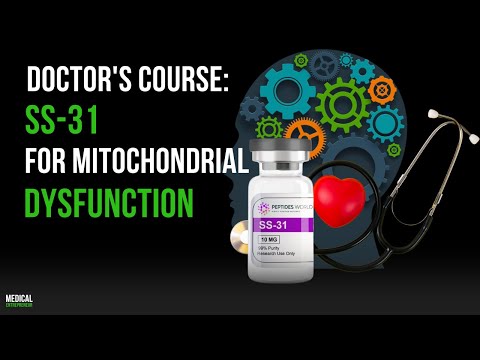
“SS-31 peptide, also known as Elamipretide, Bendavia, or MTP-131, is available for research purposes from multiple suppliers. It is a synthetic tetrapeptide with the sequence D-Arg-Tyr(2,6-diMe)-Lys-Phe and a molecular weight of 639.8 g/mol.” “The peptide is marketed as a mitochondria-targeting compound used in studies related to mitochondrial health, oxidative stress reduction, and cellular energy production.”
“Several vendors offer SS-31 in various quantities and purities. For example, Biolongevity Labs sells a 10mg vial at $79.97 with 99% purity and USA manufacturing.” “Ameano Peptides offers 10mg for $65.00, with discounts available for bulk purchases.” “Xcel Peptides lists a 10mg option at $49.00 and a 50mg option at $169.00.
The Peptide Co. sells 10mg for $90.00 AUD.” 'November provides 99% purity SS-31 at $90.00 USD." “Yoursoma offers 10mg for $59.00 USD and 25mg for $121.00 USD.
Modern Peptides sells 10mg for $74.00 USD and 30mg for $165.00 USD, with a current batch purity of 99.746%.” 'Prime Peptides lists 10mg at $80.00 USD."
"Wuhan Comings Biotechnology Co., Ltd. offers pharmacy-grade SS-31 at $11.79 per gram, with prices varying by quantity."
'All suppliers emphasize that SS-31 is intended solely for laboratory research and not for human or veterinary use."
"* “The peptide is typically supplied as a lyophilized powder and should be stored in a dry, cool environment before reconstitution, with refrigeration at 2–8°C or freezing at -20°C for long-term preservation.” '“Some suppliers, such as NovoPro, provide a 2-day return policy and offer shipping within the United States.”
The only thing that matters…
Does it work for you!
“If you wait until you are ready, it is almost certainly too late.” ~ Seth Godin
Trial uses 40mg daily for dosage, but current pricing (which is based on bro science) encourages small doses, like 4mg daily. It’s usually paired with MOTS-c. It’s mixed results at best from people in the peptide space that have tried it at 10-30mg. And did I mention expensive?
It is worth a try. I asked ChatGPT-5 about a dosage protocol.
Hypothetical, conservative human protocol (research-style, not personal medical advice)
This is not a recommendation to self-administer elamipretide. It is a synthesis of how one might structure a research-grade protocol or a clinician-supervised off-label trial, using only doses and schedules already studied in humans. Forzinity is prescription-only, extremely costly, and currently approved only for Barth syndrome.
3.1 Eligibility & baseline assessment
Inclusion-style assumptions
Adult ≥30 kg with documented mitochondrial dysfunction or relevant symptom cluster (e.g., VO₂max/6MWT limitation, fatigue, neuromuscular or cardiac dysfunction) and normal-to-moderate renal function (eGFR ≥30 mL/min).FDA Access Data
No history of severe hypersensitivity reactions to peptides, and no active eosinophilic disorders.
Baseline work-up
CBC with differential (for eosinophils), CMP (renal/hepatic), urinalysis; consider troponin/BNP if cardiac disease is a concern.
Functional baseline: 6-minute walk test (6MWT) or similar, standardized fatigue scale, and relevant organ-specific metrics (e.g., echocardiogram or CPET if cardiac focus).Nature+2PMC+2
3.2 Dosing – subcutaneous daily, with cautious lead-in
Route: Subcutaneous injection in abdomen or thigh, rotating sites as per label instructions.FDA Access Data
Step 1 – Tolerability lead-in (optional but conservative)
20 mg SC once daily for 2–4 weeks
Rationale: Half the labeled dose is still within the linear PK range and should reduce risk of early hypersensitivity and severe eosinophilia, while testing injection-site tolerability and systemic response.FDA Access Data+1
40 mg SC once daily, at the same time each day, for an initial 12-week block.
This is the standard dose used in Barth, PMM, and AMD trials and is the FDA-approved dose for Barth patients ≥30 kg.FDA Access Data+2PMC+2
For adults with severe renal impairment (eGFR <30 mL/min not on dialysis), 20 mg once daily is the labeled dose and would be the upper limit of a conservative approach.FDA Access Data
Consideration of higher doses (e.g., 60 mg SC daily)
Some ongoing trials randomize patients to 60 mg SC once daily for 48 weeks, indicating that higher exposure is under study with acceptable preliminary safety.ClinicalTrials.gov
Given the lack of clear dose-response data and strong evidence at 40 vs. 60 mg, plus cost and potential for more injection-site AEs, a cautious protocol would not exceed 40 mg outside a formal trial.
3.3 Duration, cycling, and stopping rules
Initial treatment block: 12–24 weeks
12 weeks mirrors the core exposure in the TAZPOWER randomized phase and multiple PMM trials.PMC+2ISRCTN+2
24 weeks aligns with longer studies that looked at functional/quality-of-life endpoints.PMC+1
Extension / cycling
If and only if:
No serious AEs, and
There is objective or subjective improvement judged clinically meaningful,
then consider additional 12-week blocks, with re-evaluation after each block.
Long-term use (≥1–3 years) has been done in Barth OLE at 40 mg SC daily, with persistent injection-site reactions and eosinophilia but acceptable overall safety in a tiny cohort. Any attempt to emulate that outside Barth should be considered experimental and high-uncertainty.ScienceDirect+1
Stopping criteria
Serious hypersensitivity reactions (systemic rash, anaphylaxis-like picture, respiratory symptoms) → immediate discontinuation, per label.FDA Access Data
Persistent or severe injection-site reactions not controllable with local measures.FDA Access Data
Its a bit like any longevity intervention you need to look at function in the round. It strikes me it is something like mk7 or MB that improves mitochondrial function, but does not actually fix the mtDNA.
I just asked Hazel about sources and dosing. She looks to be in her mid 60s, and she does 5mg daily sublingually via a little spray bottle. She recommended that approach.
She said in the clinical studies for Barth syndrome, they used 40mg, but these were very sick patients, so there is no reason to go that high for most people.
A distinction without a difference, as all the US suppliers (or at least all the ones listed in this thread) get their supply from China. The only true US manufacturer is Stealth BioTherapeutics, the maker of Elamipretide.
Also, I would highly recommend you test what is sent to you, instead of relying on tests from the vendor.
Campbell, M. D., Sporleder, T. L., & Quinn, L. S. (2021). Effects of the mitochondria-targeted peptide SS-31 on age-related skeletal muscle atrophy. Aging Cell, 20(1), e13229. https://doi.org/10.1111/acel.13229
Manczak, M., Reddy, P. H., & Shi, Q. (2010). Antioxidant effects of SS-31 in animal models of neurodegeneration. Neuroscience, 166(3), 849–858. Redirecting
Shi, J., Wang, Z., & Liu, Y. (2019). Cardiovascular benefits of mitochondria-targeted antioxidant SS-31 in heart disease models. Journal of Cardiology, 32(4), 455–464. https://doi.org/10.1016/j.jcard.2019.02.015
Szeto, H. H. (2006). Targeting oxidative stress in mitochondrial disorders with SS-31 peptide. Annals of the New York Academy of Sciences, 1067(1), 447–453. https://doi.org/10.1196/annals.1354.063
Szeto, H. H., & Liu, S. (2018). Mitochondrial-targeted peptides for aging and longevity. Aging, 10(2), 173–180. https://doi.org/10.18632/aging.101386
No luck on that - I tried. It seem she gets her peptides from a company that does 't sell to the public, so she has limited knowledge of the broader peptide sales channel.
It’s not super noticeable. I do believe it does something positive (better focus, maybe slightly more stable energy levels), but after 6-8 weeks I decided the daily injections weren’t worth it for the relatively minimal subjective effects.
I might trial it again in the future.
Dose was 10mg daily subcutaneous.
From china (what isn’t these days), but tested by janoshik for multiple rounds.
How old are you, and how fit are you? It seems that people who are older, or people who are less fit (more Reactive Oxygen Species (ROS), are more likely to benefit.
It was great to see a familiar logo at the Longevity Summit. Although I had planned to attend in person but ended up doing Zoom version. I had even signed up to donate blood:(
It was a great meeting overall.
Fermented dairy consumption improving sleep architecture was really neat to learn amongst other kool stuff.
I spoke to a scientist I know and trust at the conference who has a friend in China with a peptide company so I am going to get a quote from them, and will also contact some of the other companies…
 This is not a recommendation to self-administer elamipretide. It is a synthesis of how one might structure a research-grade protocol or a clinician-supervised off-label trial, using only doses and schedules already studied in humans. Forzinity is prescription-only, extremely costly, and currently approved only for Barth syndrome.