I find more than 2 hours and 20 minutes of strength training in the danger zone… a bit hard to believe. One hour 3 times a week… an hour every other day seems reasonable.
The Metabolic Middle (30-60 minutes/week)
Strength training occupies the pyramid’s middle tier—far less time than walking but essential for maintaining muscle mass, bone density, and metabolic health. The dose-response curve is remarkably precise.
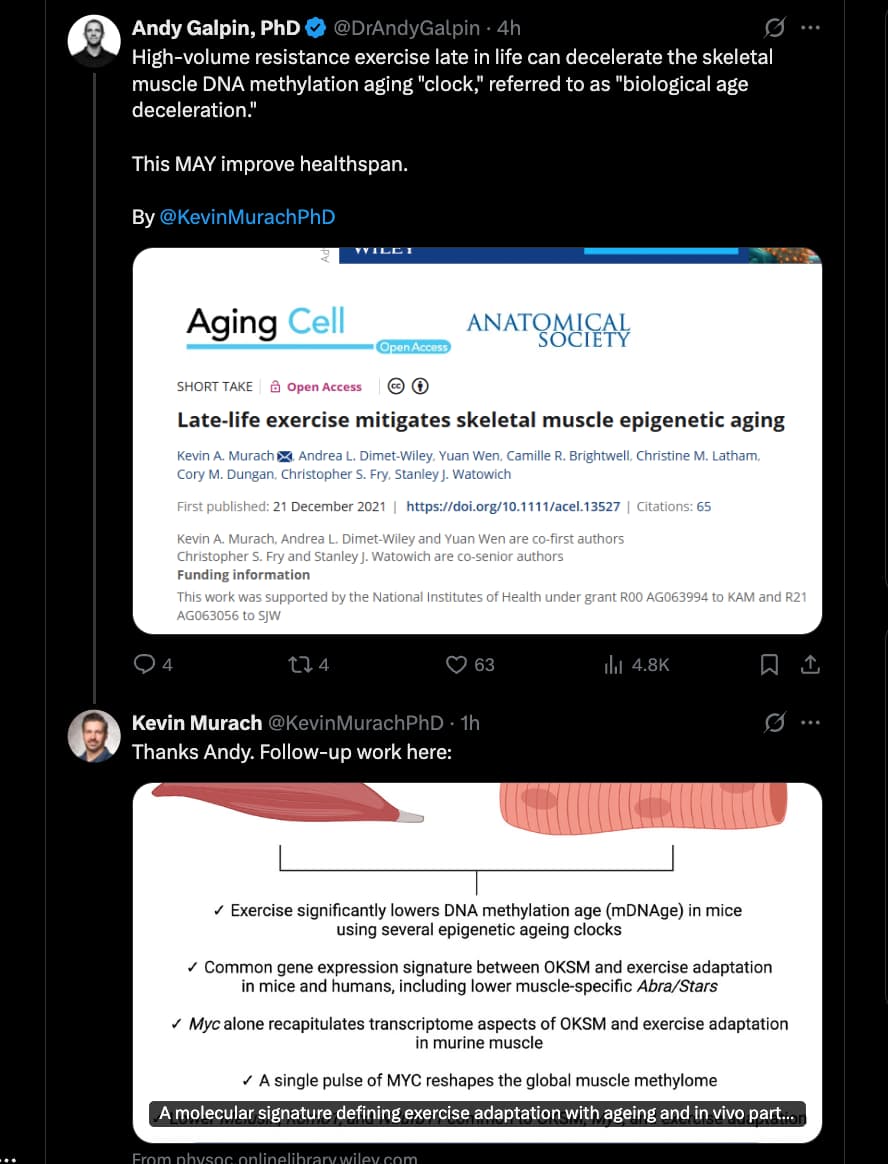
There are functional benefits to exercise in muscle, even when performed late in life, but the contributions of epigenetic factors to late-life exercise adaptation are poorly defined. Using reduced representation bisulfite sequencing (RRBS), ribosomal DNA (rDNA) and mitochondrial-specific examination of methylation, targeted high-resolution methylation analysis, and DNAge™ epigenetic aging clock analysis with a translatable model of voluntary murine endurance/resistance exercise training (progressive weighted wheel running, PoWeR), we provide evidence that exercise may mitigate epigenetic aging in skeletal muscle. Late-life PoWeR from 22–24 months of age modestly but significantly attenuates an age-associated shift toward promoter hypermethylation. The epigenetic age of muscle from old mice that PoWeR-trained for eight weeks was approximately eight weeks younger than 24-month-old sedentary counterparts, which represents ~8% of the expected murine lifespan. These data provide a molecular basis for exercise as a therapy to attenuate skeletal muscle aging.
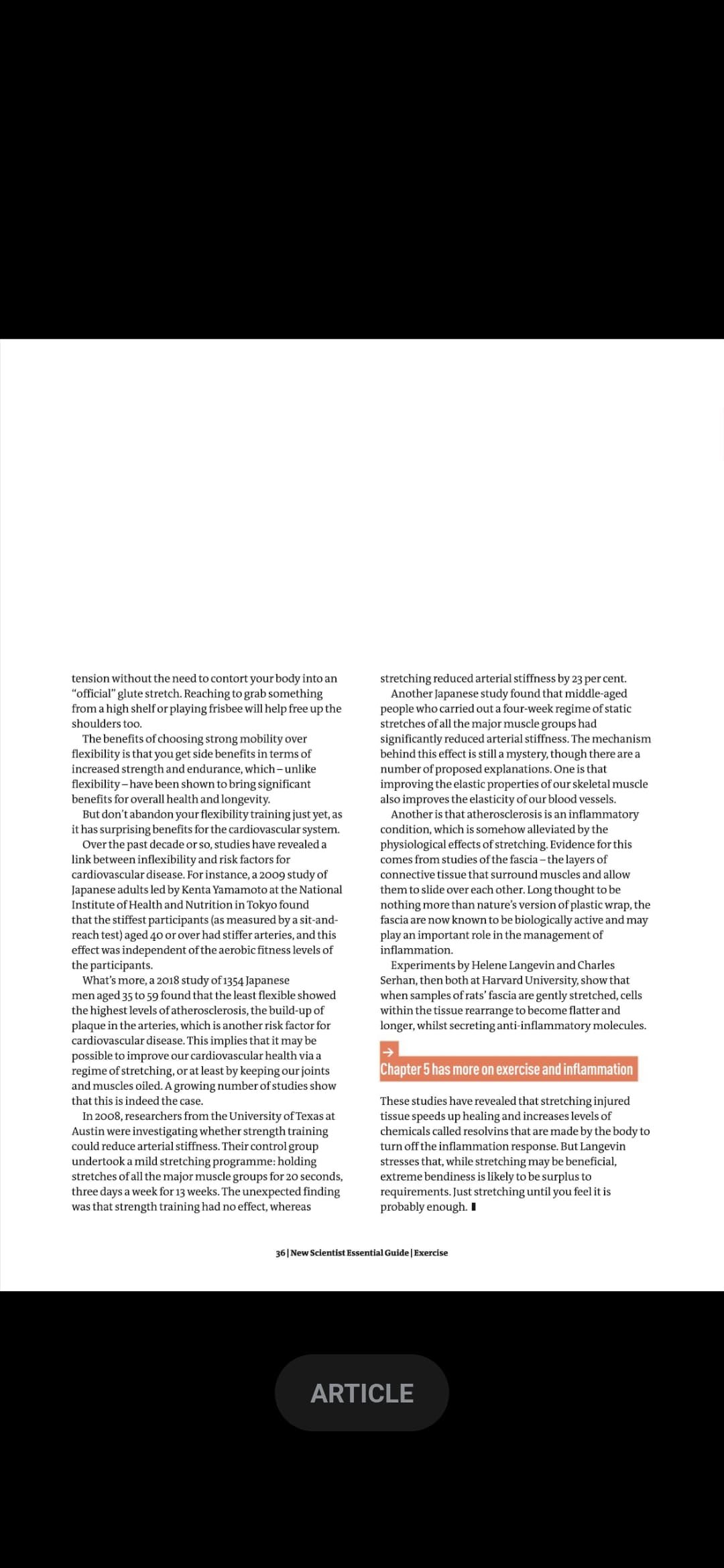
I can’t see why yoga was perceived to be useful for vascular or heart function anyway. Good for flexibility I’m sure. Maybe you can break a slight sweat holding certain positions. But it can’t be as beneficial as a cardio workout like walking on an incline treadmill or riding a bike.
To maximise gains you’d want to be hitting each body part with 20 sets or greater per week, and you’re taking sets pretty close to failure. It’s really hard work. When you do that, generally your protein requirements will be higher, but the training provides the single biggest stimulus.
@Agetron Arrgh, not yet another step to add to may exercise program… to get maximal gains
ah… but the study actually says “sexual activity” - so its a broader definition than the story above initially seemed to suggest. How to make the workout even more enjoyable…
Sexual activity before exercise influences physiological response and sports performance in high-level trained men athletes
I knew a guy who liked to get bjs while doing seated bicep curls in his home gym. He claimed it really helped get those last couple of reps in as he climaxed. I was amazed at how he could time it, but as he and his gf explained it, they had a system and by grunting he signalled the timing of those last few movements she delivered. He offered to demonstrate, but I quickly took his word for it. He claimed the whole exercise + sex thing provided a very deep release and satisfying workout session and a lot of motivation to hit the gym.
At the time, I just thought of him as a somewhat eccentric fitness fan, but now I see there was perhaps a method to his madness. Who knew!
I think it will be myopic to dismiss Yoga as as mere stretching and flexibility.
For example, when you perform a tree pose, you are a performing cerebellar stress test (fun fact: cerebellum hosts maximum population of neurons and synapses in brain).
You also engage interhemispheric circuitry: corpus callosum, basal ganglia, cerebellum
Practical implications: fall prevention, foot reactivity, neurorehab in stroke/parkinson’s.
Needless to say, one-leg standing test is a validated predictor of longevity! To take it further, one leg standing with eyes closed…is even harder! Some these are actually Yoga poses!
Somebody once said that genes are less like a switch and more like a thermostat. Your behavior and such can reset the thermostat but only within a narrow range.
Honestly thought this was a good video on a balanced health and longevity focused exercise protocol by Bryan Johnson:
The core message is that exercise is not just about aesthetics or weight loss, but about building long-term health, resilience, and lifespan through a balanced approach across multiple fitness systems.
Strength training is presented as a foundational pillar. Muscle mass and strength strongly correlate with longevity, reducing risk of premature death and supporting insulin sensitivity, bone density, joint stability, and independence in older age. Progressive overload is emphasized as essential for continued adaptation.
Low-intensity cardio (Zone 2 training) is highlighted as highly beneficial for heart and metabolic health. It improves mitochondrial efficiency, fat metabolism, and glucose control, with practical recommendations like aiming for regular steady cardio and adding short walks after meals.
High-intensity cardio (Zones 4 to 5) is also considered crucial, particularly for improving VO₂ max, which is strongly linked to reduced mortality risk. Interval protocols like the Norwegian 4x4 are suggested as efficient methods to improve cardiovascular capacity.
Mobility and flexibility work are framed as essential for maintaining functional movement with age. Regular short daily routines targeting key joints help reduce injury risk and preserve independence by countering stiffness and postural decline.
Balance training is described as an often ignored but powerful predictor of neurological health and mortality risk. Simple single-leg stability drills are recommended, as poor balance is associated with significantly higher risk of death and falls in older adults.
The overall exercise prescription is a combination model rather than specialization: strength training, Zone 2 cardio, high-intensity intervals, mobility, and balance all contribute to different aspects of longevity and should not be neglected in favor of a single modality.
Consistency matters more than perfection. A sample weekly structure includes multiple strength sessions, regular cardio, and daily small movement habits, reinforcing that sustainable exercise habits are what ultimately drive long-term health outcomes.
This is the first time I saw this Finnish study. Taking it and extant US-based research into account, my best guess is that the true causal effect of moving someone from genuinely sedentary to WHO-minimum LTPA, in a US-like population, is in the 10–20% all-cause mortality reduction range. This is not 36%, but not 7% either. The Finnish twin design is producing a methodologically clean estimate of a parameter that has limited generalizability outside Finland and outside the specific contrast available in this cohort.
The RCT literature is weak because long-duration high-compliance trials with mortality endpoints are essentially impossible to run. Projections to such effects are doomed to be fuzzy. The Mendelian randomization literature on physical activity is also mixed but generally directionally consistent with a modest protective effect.
Overall, the empirical research seems headed for a collision. We see recent research suggesting that the benefit curve does not begin to flatten nearly as soon as generally believed (I think this finding has many flaws but beyond that is practically irrelevant) and we see an emerging profile suggesting that “less is good enough.”
Mostly but not exclusively, I exercise in the mid- to lower-mid range because it feels good to do so and I like the benefits it confers. I think I would do about the same amount if research were to show there were no reductions in ACM.
From a practical standpoint, I’ve basically been regularly exercising (3X a week) since high school. It’s simply part of my lifestyle. I still have the same muscle level in my 60s as I likely did in my 20s or 30s and am often thought to be about 10 years younger by others that don’t know my age. Studies like this one aside, I clearly have seen the benefits of a lifestyle of regular exercise and don’t plan to change a thing.
This is so so true. Anybody who has done this for a long time is well aware of this.
You can go all-out, smashing every workout, perfect nutrition etc… but as soon as you have to move house, a family member gets sick etc, it all goes to hell and you fall off the wagon completely. Whereas just being consistent, not overburdening yourself with exercise goals, is more sustainable long-term.
Me too. When exercising, I feel better, look better, and life becomes easier in general. The only downside really is the time commitment.
I think there are particular genotypes where exercise is almost mandatory. Both my sister and I have been consistent exercisers for life.
Without it, mood, stress reaction and sleep are not good. Perhaps we are used to it and can’t stop or perhaps it is genetic. My father was/is the same.
But I meet people all the time who don’t exercise and they are ok. I mean not physically healthy but ok. Some are people that have exercised at some point and never really got much out of it and stopped. Not even because of time or health or anything else - they just didn’t feel like they got much out of it.
“Physical activity and biological ageing: the need for stronger causal evidence”
Nah, the authors simply have not done their homework.
“For example, healthy lifestyle factors tend to cluster within the same individuals. Furthermore, physically active individuals often differ systematically from less active individuals in ways that are difficult to fully measure or adjust for.”
I have yet to find a study without many unmeasured confounders.
But the fact remains, IMO, that the link between exercise and longevity is well established.
Oddly: “Older males who develop frailty have a significantly higher risk of mortality than their female counterparts.”
What is known. Exercise delays sarcopenia, and even if exercise is stopped, the muscle mass gained through exercise will delay frailty for more years than those who don’t exercise.
In gerontology and exercise science, this concept is often referred to as building a “functional reserve.”
“In the field of gerontology and geriatrics, clinical frailty is widely recognized as one of the most significant, independent risk factors for mortality (shortened longevity) in older adults. In fact, frailty is often a more accurate predictor of mortality than chronological age or the presence of individual chronic diseases.”