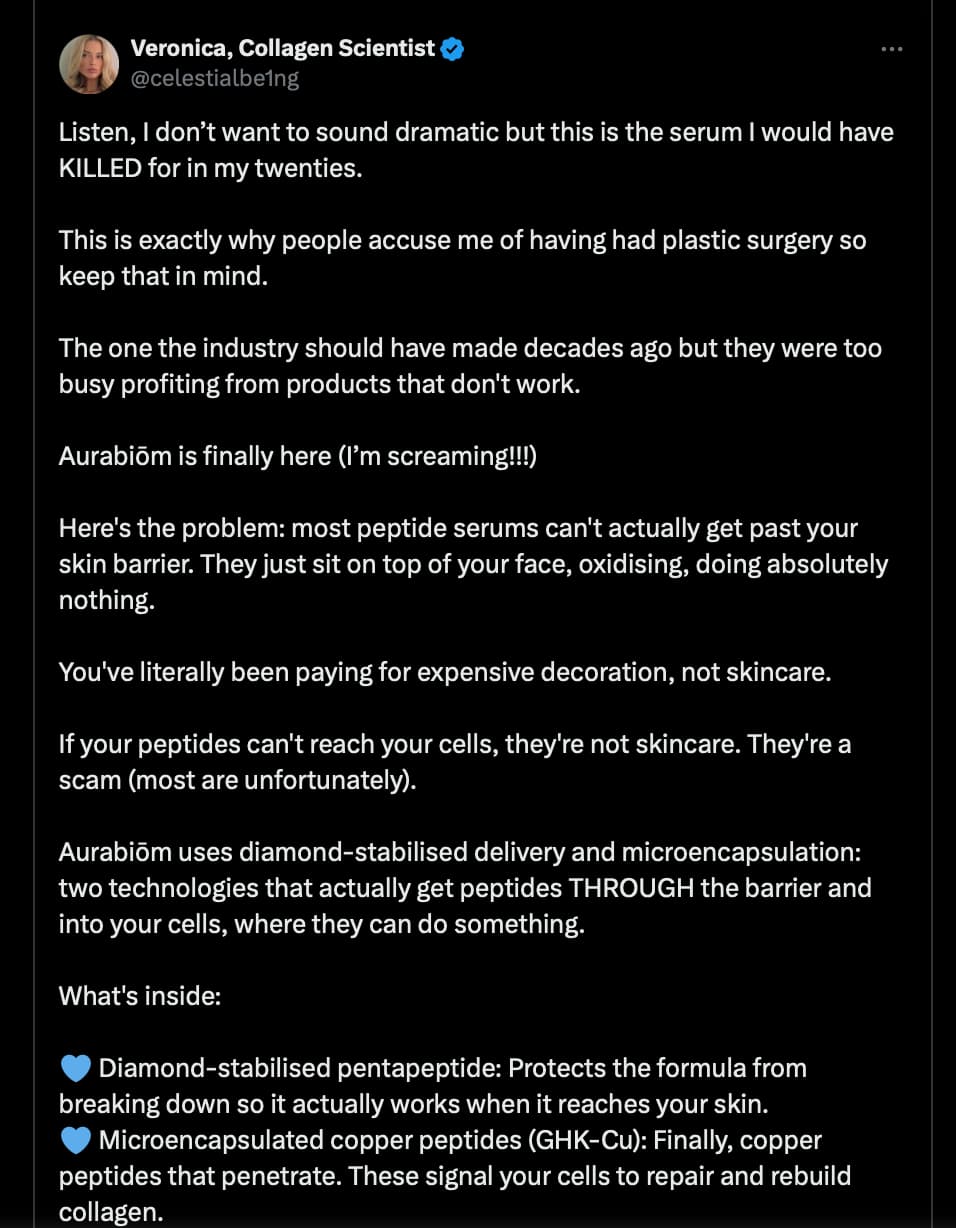
Based on the promotional text and ingredient profile provided, this is an evaluation of the scientific validity of Aurabiōm (specifically the “Legacy Youth Serum”) and a fact-check of its marketing claims.
Executive Summary
Aurabiōm appears to be a “bio-hacker” focused skincare product that prioritizes delivery systems over standard formulation. The formula relies on legitimate, high-performance compounds (GHK-Cu, PBN, Matrixyl) utilizing advanced delivery vehicles (encapsulation, conjugation).
However, the marketing copy is hyperbolic. While it correctly identifies a common failure point in skincare (penetration), it exaggerates the “scam” nature of competitors to sell its specific solution. The formula is clinically sound based on its components, but the “diamond” aspect is as much marketing theater as it is science.
Fact-Checking the Core Claims
Claim 1: “Most peptide serums… just sit on top… they’re a scam.”
- Verdict: Hyperbolic Half-Truth.
- The Science: The skin barrier (stratum corneum) effectively blocks molecules larger than 500 Daltons. Most native peptides are hydrophilic (water-loving) and large, making passive penetration difficult.
- The Nuance: It is false to call all non-encapsulated peptides a “scam.” The industry solved this decades ago by “palmitoylation” (attaching a fatty acid chain to the peptide). For example, Matrixyl (Palmitoyl Pentapeptide-4) is chemically modified specifically to penetrate the lipid barrier. It does not strictly require diamond encapsulation to work, though encapsulation can enhance stability.
- Correction: Unmodified peptides often struggle to penetrate. Modified peptides (standard in quality skincare) penetrate fine. Aurabiōm’s claim is marketing fear-mongering, though technically true for cheap, unmodified peptide serums.
Claim 2: “Diamond-stabilised delivery… protects the formula.”
- Verdict: Plausible but Performative.
- The Science: This likely refers to a technology like MVP Diamond, where peptides are conjugated to diamond powder (silica microspheres coated in diamond aggregate). The diamond particle acts as a “shield,” preventing enzymatic degradation (proteases on the skin eating the peptide before it works) and potentially acting as a sustained-release system.
- The Reality: While effective, “diamond” is chosen for its marketing allure. Silica or gold carriers often perform similarly. The clinical benefit here is stability and duration of release, not necessarily “magic” penetration that other carriers cannot achieve.
Claim 3: “Microencapsulated copper peptides (GHK-Cu): Finally, copper peptides that penetrate.”
- Verdict: High Validity (The Real Winner).
- The Science: GHK-Cu is the “holy grail” of remodeling peptides, proven to reset gene expression to a healthier state. However, it is notoriously unstable and hydrophilic. Without encapsulation (e.g., liposomes or nano-carriers), much of it oxidizes on the surface or fails to penetrate.
- Assessment: Encapsulating GHK-Cu is a legitimate, superior formulation choice. If Aurabiōm uses a verified liposomal/encapsulated GHK-Cu, this is the strongest asset of the formula.
Claim 4: “PBN Spin-Trap… catches free radicals BEFORE they damage.”
- Verdict: Scientifically Accurate.
- The Science: Phenyl-N-tert-butylnitrone (PBN) is a “spin trap.” Unlike standard antioxidants (Vitamin C) that sacrifice themselves to neutralize a free radical after it has formed, spin traps stabilize the precursor free radical species, effectively stopping the “chain reaction” before it begins.
- Assessment: This is a sophisticated, under-utilized ingredient in skincare. It is more “preventative” than “reparative.”
Ingredient Profile Analysis
| Ingredient | Mechanism of Action | Clinical Efficacy Rating |
|---|---|---|
| Microencapsulated GHK-Cu | Copper peptide that modulates gene expression, rebuilds collagen, and reduces inflammation. | High (Gold Standard for remodeling) |
| Matrixyl® Complex | Likely Matrixyl 3000 or Synthe’6. Stimulates fibroblasts to produce collagen/elastin. | High (Industry Standard, highly proven) |
| Pycnogenol® | French Maritime Pine Bark extract. Potent antioxidant; recycles Vitamin C, binds to collagen to prevent degradation. | Medium-High (Strong data on elasticity) |
| PBN Spin-Trap | Intercepts reactive oxygen species (ROS) early in the radical cascade. | High (For prevention/anti-aging) |
| Diamond Peptide | Conjugated peptide delivery system (likely Sirtuin-mimicking peptides). | Medium (Good delivery, but “diamond” is partly marketing) |
| 4D Hyaluronic Acid | Multiple molecular weights of HA (Sodium Hyaluronate, Crosspolymer, etc.) to hydrate different skin layers. | Medium (Standard in modern moisturizers) |
Scientific Conclusion
Aurabiōm is a legitimate, high-performance “clinical” serum masked in aggressive influencer marketing.
- What works: The combination of GHK-Cu and PBN is a potent “longevity” stack. GHK-Cu signals repair, while PBN prevents oxidative stress drift. This aligns well with a “biotech/longevity” approach to skin health.
- What is hype: The “Diamond” technology is largely a stability mechanism marketed as a luxury feature. The claim that all other peptides are a “scam” is demonstrably false, as palmitoylation works effectively for millions of users.
Final Verdict: If you are looking for a “tell it like it is” assessment: This is likely a very effective product, superior to 90% of generic Sephora peptides, but not because of the diamonds—because of the encapsulated Copper and the Spin Trap.
Prompt:
Do a comparison of Aurabiom and 9 similar products and rank by cost per 100ml
Gemini Pro:
Note on Aurabiōm Pricing: As Aurabiōm is a newly launched “drop” brand (indicated by the “finally here” and “waitlist” context), its retail price is not yet indexed in public shopping data. Based on its “diamond” technology and “luxury/clinical” positioning, it likely falls in the $88–$120 range, similar to NIOD or Medik8, but I have marked it as “TBD” below.
Comparative Analysis: Cost Effectiveness (Ranked by Value)
Products are listed as rows, with cost per 100ml as the primary comparison metric.
1. Asterwood Naturals Copper Peptide
- Retail Price: ~$22.00 (30ml)
- Cost per 100ml: $73.30
- Verdict: Best for budget; simple formula without advanced delivery systems.
2. Naturium Multi-Peptide Advanced
- Retail Price: $25.00 (30ml)
- Cost per 100ml: $83.33
- Verdict: Best Overall Value; contains encapsulated peptides similar to Aurabiōm’s claims but at a mass-market price.
3. The Ordinary Multi-Peptide + Copper
- Retail Price: $32.00 (30ml)
- Cost per 100ml: $106.67
- Verdict: The “Standard”; reliable, proven GHK-Cu concentration (1%).
4. Biossance Squalane + Copper Peptide
- Retail Price: $68.00 (50ml)
- Cost per 100ml: $136.00
- Verdict: Best for Dry Skin; the larger bottle size (50ml vs 30ml) makes it surprisingly cost-effective compared to other prestige brands.
5. Theramid Copper Peptide
- Retail Price: ~$49.00 (30ml)
- Cost per 100ml: $163.33
- Verdict: Highest Potency (3% Pure Copper); best for experienced users wanting maximum strength.
6. Peach & Lily Copper Peptide Pro
- Retail Price: $49.00 (30ml)
- Cost per 100ml: $163.33
- Verdict: Gentle option; focuses on hydration and barrier support alongside peptides.
7. Drunk Elephant Protini Powerpeptide
- Retail Price: $82.00 (30ml)
- Cost per 100ml: $273.33
- Verdict: Exfoliating Hybrid; combines peptides with Lactic Acid (10%), making it a different category of product (resurfacing + firming).
- Retail Price: ~$90.00 (30ml)
- Cost per 100ml: $300.00
- Verdict: The Scientist’s Choice; separates the copper activator to ensure 100% freshness. Direct competitor to Aurabiōm in terms of “tech-first” claims.
9. Medik8 Copper PCA Peptides
- Retail Price: ~$102.00 (30ml)
- Cost per 100ml: $340.00
- Verdict: Most Expensive; uses Copper PCA (an antioxidant salt) rather than pure GHK-Cu peptides, claiming 40x antioxidant power.
10. Aurabiōm Legacy Youth Serum
- Retail Price: TBD / Waitlist (Est. $90+)
- Cost per 100ml: N/A
- Verdict: The “Hype” Choice; relies on Diamond-Conjugation and Spin Traps. If priced above $90, it competes with NIOD; if below $50, it competes with Theramid.
Interactive Comparison (Columns = Products)
| ## Asterwood Naturals | ## Naturium Multi-Peptide | ## The Ordinary | ## Biossance Squalane | ## Peach & Lily | ## Theramid | ## Drunk Elephant | ## NIOD CAIS 3 | ## Medik8 | |
|---|---|---|---|---|---|---|---|---|---|
| retail_price | retail_price $21.99 / 30ml | retail_price $25.00 / 30ml | retail_price $32.00 / 30ml | retail_price $68.00 / 50ml | retail_price $49.00 / 30ml | retail_price $49.00 / 30ml | retail_price $82.00 / 30ml | retail_price $90.00 / 30ml | retail_price $102.00 / 30ml |
| cost_per_100ml | cost_per_100ml $73.30 | cost_per_100ml $83.33 | cost_per_100ml $106.67 | cost_per_100ml $136.00 | cost_per_100ml $163.33 | cost_per_100ml $163.33 | cost_per_100ml $273.33 | cost_per_100ml $300.00 | cost_per_100ml $340.00 |
| key_actives | key_actives GHK-Cu, HA | key_actives Encapsulated Copper | key_actives 1% GHK-Cu, Matrixyl | key_actives Copper + Squalane | key_actives Copper + 12 Peptides | key_actives | |||
| 3% Pure Copper | key_actives Peptides + Lactic Acid | key_actives 1% Pure GHK-Cu | key_actives Copper PCA | ||||||
| best_for | best_for Budget | best_for Value Performance | best_for Reliability | best_for Dry Skin | best_for Sensitive Skin | best_for Maximum Potency | best_for Resurfacing | best_for Bio-Hackers | best_for Antioxidant Power |
Recommendation: If you want to replicate the “Aurabiōm effect” (penetration + copper peptides) without the waitlist or mystery price, Naturium Multi-Peptide is the closest match in terms of technology (encapsulation) at a significantly better price point. If you want the raw power of copper peptides that Aurabiōm promises, Theramid offers a higher confirmed concentration (3%) than almost any other product on the market.
It looks like Riverstone Naturals makes a more affordable liposomal 1% ghk cu serum.
I had been thinking of making my own ghk cu serum, but learning about the encapsulated aspect has me second guessing how effective it would be ??
Just to toss out a name of another competitor, Allies of Skin Copper Peptides is very popular and very expensive. (I have not used it).
Edit:
Yes, non-liposomal or non-encapsulated GHK-Cu serums can work for skin benefits. Clinical studies show GHK-Cu in standard creams improves skin elasticity, reduces wrinkles, and boosts collagen without mentioning liposomal delivery.
Skin Penetration Evidence
GHK-Cu penetrates human skin effectively in vitro, even through the stratum corneum, due to its small size and properties allowing porous transport via skin appendages. While hydrophilic, leading to some absorption limits, studies confirm systemic availability and dermal retention from aqueous solutions at concentrations like 0.68%.
Clinical Trial Results
Placebo-controlled trials with GHK-Cu creams (applied twice daily for 12 weeks) on women aged 50+ showed reduced fine lines, improved firmness, clarity, and skin thickness, plus increased keratinocyte proliferation—effects seen in thigh, facial, and eye applications. One trial noted 70% collagen increase vs. 50% for vitamin C cream.
Encapsulation Benefits
Liposomes or encapsulation enhance penetration and stability for GHK-Cu’s hydrophilic nature, but they’re not required for efficacy—standard formulations suffice, though enhanced versions may optimize results. For best outcomes, pair with penetration aids like microneedling if needed
One time purchase is listed at $99. Less 20% for subscription. They ship internationally!
I use 3% GHK Cu serum/cream from Skin Biology (Dr. Loren Pickart, biochemist who isolated GHKCu founded this company). Works for me. Thanks. Cheers.
I checked the current full ingredient list for AuraBiōm Legacy Youth Elixir. I do not see any intentionally added fluorinated ingredient or recognizable PFAS in the formula. The manufacturer lists 34-ish ingredients, including peptides, hyaluronic-acid derivatives, carbomer, glycols, phospholipids, resveratrol, PBN, and diamond powder. (Aurabiōm)
Fluorine / PFAS screen
There are no ingredient names containing
fluoro-,perfluoro-,trifluoro-,PTFE,polyfluoro-, etc. Those are the sorts of names that often reveal fluorinated cosmetic ingredients. FDA specifically gives examples such as PTFE, perfluorononyl dimethicone, trifluoroacetyl tripeptide-2, and perfluorohexylethyl triethoxysilane. None appears here. (U.S. Food and Drug Administration)More fundamentally, PFAS require carbon bonded to fluorine, typically structures containing highly fluorinated
CF₂/CF₃groups. (EPA Nepis) Nothing in AuraBiōm’s disclosed formula appears to have such a structure.There are two ingredients worth separating from PFAS because they’re polymers:
Ingredient Persistent? PFAS-like? Carbomer Some environmental persistence possible because it’s a cross-linked polyacrylic-acid polymer No fluorine, not PFAS Sodium Hyaluronate Crosspolymer Cross-linked high-MW polymer; slower degradation than ordinary hyaluronate No fluorine, not PFAS Diamond powder Extremely chemically persistent as a mineral particle Not PFAS and not an organic fluorinated compound Palmitoyl peptides Lipid-modified molecules, but enzymatically degradable No Phenyl-N-tert-butyl nitrone (PBN) Small organic antioxidant No Phenoxyethanol Small preservative, metabolizable No Carbomer is basically cross-linked poly(acrylic acid), not a fluoropolymer. PubChem identifies polyacrylic acid/carbomer as a synthetic polymer used as a thickener in cosmetics. (PubChem) So if your criterion is broader than PFAS, something like “avoid all highly persistent synthetic polymers”, carbomer is the ingredient I’d scrutinize most. But its chemistry is dramatically different from the carbon-fluorine fortress that makes PFAS notorious.
One important caveat: an ingredient list cannot establish zero PFAS contamination. FDA notes that PFAS can sometimes enter cosmetics unintentionally through raw-material impurities or degradation/contamination, even when they’re not intentionally listed. (U.S. Food and Drug Administration) You would need total organic fluorine / extractable organic fluorine testing, ideally followed by targeted PFAS LC-MS, to establish that experimentally.
Bottom line: based on the disclosed formulation, I’d rate it very low concern for intentional PFAS/organofluorine. If you’re using “persistence” more broadly, carbomer and sodium hyaluronate crosspolymer are the only polymeric ingredients I’d put an asterisk beside, while diamond is literally persistent but biologically a very different beast.
A few things make my eyebrow rise, but nothing in the formula jumps out as a serious toxicology or PFAS-type red flag. The more interesting issues are irritation/allergy potential and a couple of formulation/labeling oddities.
Ingredient / issue My concern Why Phenyl-N-tert-butyl nitrone (PBN) Worth scrutiny
This is the most unusual ingredient. It’s a small-molecule nitrone “spin trap,” not a conventional cosmetic antioxidant with decades of widespread leave-on use. PubChem doesn’t classify it as hazardous, but the topical human safety evidence is much thinner than for glycerin, HA, peptides, etc. (PubChem) Coco-glucoside Generally mild and biodegradable, but alkyl glucosides are now well-established contact allergens in a minority of people. A 2026 review notes sensitization/contact dermatitis from this family. (PubMed) Phenoxyethanol /
It gets demonized online, but the EU SCCS concluded it is safe in cosmetics at up to 1%. It can still irritate unusually sensitive skin. (Public Health) Ethyl alcohol Can sting or dry sensitive/barrier-damaged skin. Nothing PFAS-like or bioaccumulative about it. Diamond powder Inert carbon particles. I don’t see a compelling reason to worry about systemic toxicity from a leave-on serum, but “diamond-stabilized peptides” is doing a lot of marketing work here. Carbomer A crosslinked synthetic polyacrylate. It isn’t PFAS and has no C–F bonds, but if your concern includes persistent synthetic polymers generally, this is the closest thing on the list. Sodium hyaluronate crosspolymer Another crosslinked polymer, although chemically based on hyaluronic acid rather than an exceptionally persistent fluoropolymer. Saffron meristem extract / hydrolyzed proteins Botanicals/proteins can theoretically cause individual sensitivity or allergy, but nothing particularly alarming here. What I find more suspicious than any particular molecule is the ingredient/marketing presentation itself. AuraBiōm’s current full list includes “Argireline”, which is a trade name, whereas elsewhere on the same page they identify it as acetyl hexapeptide-8. More strangely, their FAQ says the product contains clinically validated Pycnogenol, but Pycnogenol/Pinus pinaster bark extract does not appear anywhere in the current full ingredient declaration. (Aurabiōm) That doesn’t demonstrate a safety problem, but it’s a genuine formulation-labeling inconsistency I’d want the company to explain.
And PBN is the one I’d investigate hardest. It isn’t obviously dangerous, and its formula is just C₁₁H₁₅NO, so no fluorine whatsoever. (PubChem) But unlike glycerin, hyaluronic acid, Matrixyl peptides, caffeine, etc., it has a comparatively unusual pharmacological research history as a radical-trapping molecule. There’s much less boring, reassuring, long-term cosmetic-use data behind it.
So my ranking is roughly: PBN ≫ coco-glucoside ≈ carbomer > alcohol/phenoxyethanol > everything else in terms of things I’d bother investigating.
If your specific fear is “forever chemical / accumulates in my body / persistent halogenated contaminant”, though, none of those are close to PFAS. The product actually looks unusually clean on that particular axis. The bigger question I’d ask AuraBiōm is whether they have independent total-organic-fluorine/PFAS testing and heavy-metal testing of the finished serum, especially given the mineral/diamond ingredient.
Yep. AuraBiōm’s six peptide actives are Copper Tripeptide-1, Palmitoyl Tripeptide-1, Palmitoyl Tetrapeptide-7, Palmitoyl Tripeptide-38, Acetyl Hexapeptide-8, and Palmitoyl Pentapeptide-4. (Aurabiōm)
My ranking by quality of human evidence for topical skin aging, rather than mechanistic coolness:
Rank Peptide Evidence My take 1 Palmitoyl Pentapeptide-4 / Pal-KTTKS / original Matrixyl Best supported 2 Copper Tripeptide-1 / GHK-Cu Promising, human evidence exists, but messier than #1 3 Acetyl Hexapeptide-8 / Argireline Probably does something, modest effect 4 Palmitoyl Tripeptide-1 + Palmitoyl Tetrapeptide-7 / Matrixyl 3000 Plausible, but surprisingly weak ingredient-specific clinical literature 5 Palmitoyl Tripeptide-38 / Matrixyl Synthe’6 Good biology, limited clean human evidence 6 Palmitoyl Tripeptide-1 or Tetrapeptide-7 considered individually Almost impossible to disentangle from mixtures
1. Palmitoyl Pentapeptide-4
This is the peptide in AuraBiōm that I take most seriously.
There is an actual 93-person, 12-week, randomized, double-blind, placebo-controlled, split-face trial. Subjects used the same moisturizer with or without 3 ppm Pal-KTTKS.
The peptide-treated side showed significantly greater improvement in wrinkles/fine lines by both computerized image analysis and expert grading. (Wiley Online Library)
That’s unusually respectable evidence by cosmetic-peptide standards.
A second randomized double-blind study, albeit tiny at only 21 women, also found palmitoyl pentapeptide-4 performed better than placebo for crow’s feet. (PubMed)
Verdict: real signal. I wouldn’t expect tretinoin-scale remodeling, but I’m fairly convinced this peptide can produce a measurable cosmetic effect.
2. GHK-Cu / Copper Tripeptide-1
This one is fascinating because its biological evidence is enormous compared with its high-quality cosmetic trial literature.
Older controlled human studies summarized in a peer-reviewed review include:
- 67 women, randomized double-blind placebo-controlled, 12 weeks
- 71 women, double-blind placebo-controlled
- 41 women, controlled periorbital study
Reported effects included increased skin density/thickness, improved laxity and firmness, and reductions in fine and coarse wrinkles. (DOI)
That’s impressive on paper.
But there are two caveats.
First, much of this evidence comes from older cosmetic-industry research that’s considerably harder to independently interrogate than the Pal-KTTKS trial.
Second, a published study of GHK-Cu following CO₂ laser resurfacing found no objective difference in wrinkles or overall skin quality versus control, despite somewhat better subjective ratings. (PubMed)
So I’d say:
Mechanistic evidence: A+
Human evidence: B/B+
Certainty that AuraBiōm delivers enough active GHK-Cu into dermis: unknownAuraBiōm’s microencapsulation might help that last problem, but their claimed enhanced penetration hasn’t been established in an independent clinical trial of this serum. (Aurabiōm)
3. Acetyl Hexapeptide-8 / Argireline
This is the famous “Botox-like” peptide, although that phrase oversells it enormously.
A small split-face study had 10 subjects use 10% Argireline on one side and vehicle on the other. After 30 days, wrinkle depth was significantly reduced versus control. (PubMed Central (PMC))
There’s also a considerably nicer randomized double-blind trial involving 52 women using dissolving HA microneedle patches. Adding acetyl hexapeptide-8 produced greater wrinkle improvement than the microneedle/HA patch alone. (PubMed)
But notice the catch:
microneedles physically bypass the barrier.
AuraBiōm is just a topical serum.
And peptide penetration is precisely the Achilles heel for Argireline. You’re trying to get a fairly large, water-soluble peptide through the stratum corneum to somewhere biologically interesting.
So I believe Argireline can work if enough gets in. I’m less certain how much ordinary serum application accomplishes.
4. Matrixyl 3000
This is actually two peptides together:
Palmitoyl Tripeptide-1 + Palmitoyl Tetrapeptide-7
Their biology makes sense.
Palmitoyl tripeptide-1 is a collagen-derived signaling peptide associated with ECM production, while palmitoyl tetrapeptide-7 is proposed to affect inflammatory signaling, including IL-6. (Wiley Online Library)
And products containing Matrixyl 3000 have produced positive human results. One 2023 study used a serum containing 4% Matrixyl 3000 + 10% Argireline + other actives in 32 women and found substantial improvements in wrinkles over 28 days. (Wiley Online Library)
But that’s precisely the problem.
It wasn’t:
Matrixyl 3000 versus identical vehicle.
It was a peptide cocktail.
The individual peptides actually have much less clean human evidence than you’d expect given how famous Matrixyl 3000 is.
So I regard them as credible ingredients whose marketing reputation has outrun the clinical isolation experiments.
5. Palmitoyl Tripeptide-38 / Matrixyl Synthe’6
Another very plausible collagen/ECM signal peptide.
There is substantial in-vitro/ex-vivo evidence suggesting effects on collagen I, III and IV, fibronectin, laminin and HA. (PubMed Central (PMC))
Human evidence exists, but much of it looks like this:
A serum containing:
15% vitamin C + vitamin E + 5 ppm palmitoyl tripeptide-38
was used for eight weeks. Skin roughness improved about 8–9%. (PubMed)
Useful result, but when you’re simultaneously applying 15% vitamin C, attributing the result to the peptide is… ambitious.
Other clinical studies similarly test Pal-Tripeptide-38 inside multi-ingredient products. (PubMed)
There apparently has been a randomized vehicle-controlled study reported for the peptide itself, but the publicly accessible evidence base is thin compared with Pal-KTTKS. (PubMed Central (PMC))
So I’d call it plausibly effective, insufficiently nailed down.
The amusing conclusion
AuraBiōm markets GHK-Cu and its fancy delivery technology as the headline stars.
But the ingredient where I’d put my biggest evidence chip is actually the relatively unsexy:
Palmitoyl Pentapeptide-4
The OG Matrixyl peptide lurking near the bottom of the ingredient list.
And that placement doesn’t necessarily mean there’s too little of it. The successful Pal-KTTKS clinical study used only 3 ppm, so peptides can be biologically relevant at concentrations that look microscopic on an INCI list. (Wiley Online Library)
The biggest unknown for AuraBiōm specifically is therefore not whether any of these molecules can work. Several probably can.
It’s that AuraBiōm doesn’t disclose the exact concentration of each peptide, and I haven’t found a randomized vehicle-controlled trial of the finished AuraBiōm serum. Their proprietary penetration claims also haven’t been independently established clinically. (Aurabiōm)
So I’d roughly assign:
Ingredients alone: 7/10 evidence
AuraBiōm specifically: 4–5/10 evidence
Probability it gives some visible benefit with months of use: fairly high
Probability it’s dramatically better than a much cheaper well-formulated peptide serum: currently unproven.

This procurement analysis evaluates low-to-moderate-cost manufacturers and suppliers of cosmetic formulations containing Palmitoyl Pentapeptide-4 (Pal-KTTKS) as a primary active ingredient. The market comprises mass-market finished goods brands (acting as their own manufacturers or utilizing contract manufacturing) and wholesale cosmetic ingredient suppliers providing pre-blended solutions for independent formulation.
Market Ranking: Cost per 30 mL
The following index normalizes retail and wholesale pricing to a standard 30 mL (1 fl oz) fluid volume. Prices reflect median market rates as of late 2026.
| Rank | Manufacturer / Brand | Product Formulation | Unit Volume | Retail Price (USD) | Cost per 30 mL (USD) |
|---|---|---|---|---|---|
| 1 | Procter & Gamble (Olay) | Regenerist Micro-Sculpting Cream | 50 mL | ~$27.50 | $16.50 |
| 2 | BeautyLabPro | Palmitoyl Pentapeptide-4 Peptide Solution | 30 mL | $24.99 | $24.99 |
| 3 | W. Skin Laboratory | Stop Aging Peptide Cream | 50 mL | $46.33 | $27.80 |
| 4 | The Comune | Vita Boost Serum | 30 mL | $38.00 | $38.00 |
| 5 | Dermafirm | The Peptide Wrinkle Serum | 30 mL | $42.00 | $42.00 |
| 6 | Bulk Naturals Wholesale | Palmitoyl Pentapeptide-4 Solution | 15 mL | $21.00 | $42.00 |
Manufacturer Profiles
- Procter & Gamble (Olay): The mass-market standard. Olay was instrumental in popularizing Pal-KTTKS (marketed as their proprietary “Amino-Peptide Complex”). Leveraging massive economies of scale, P&G achieves the lowest cost-per-mL in the finished goods category.
- BeautyLabPro: Functions as a B2B/B2C cosmetic ingredient supplier. They sell a liquid peptide solution (Palmitoyl Pentapeptide-4 dispersed in a water/humectant base) intended for custom formulation, but its fluid structure mimics a minimalist serum. Highly practical for internal compounding or bespoke clinical use.
- W. Skin Laboratory: A South Korean manufacturer emphasizing K-beauty formulation principles. Their cream combines Palmitoyl Pentapeptide-4 with Centella Asiatica and Niacinamide, offering moderate pricing via direct import channels.
- The Comune & Dermafirm: Mid-tier clinical and vegan formulation brands. Both utilize Palmitoyl Pentapeptide-4 within broader multi-peptide and hyaluronic acid matrixes,. They represent the ceiling of the “moderate cost” tier before crossing into premium dermatological pricing (e.g., Isomers Skincare, which routinely exceeds $75+ per 30 mL equivalent).
- Bulk Naturals Wholesale: A raw materials supplier providing small-batch pre-blended solutions (typically formulated to a 3–8% inclusion rate recommendation). The cost scales poorly at the 15 mL retail tier but offers a controlled baseline for small-scale procurement testing.
Knowledge Gaps & Formulation Variables
A complete procurement assessment requires acknowledging the following formulation and data constraints:
- Proprietary Concentration Formulas: Finished goods manufacturers (e.g., P&G, Dermafirm) do not disclose the exact parts-per-million (ppm) or molar concentration of Pal-KTTKS in their retail products. Therefore, while Olay ranks first in cost per volume, it is speculative whether it ranks first in cost per milligram of the active peptide. Accurate comparative analysis would require high-performance liquid chromatography (HPLC) testing of the finished serums.
- Nomenclature Conflation: A significant scholarly and commercial debate surrounds the marketing of “Matrixyl.” Sederma’s original Matrixyl relies exclusively on Palmitoyl Pentapeptide-4 (Pal-KTTKS). However, many manufacturers formulate with Matrixyl 3000 (a synergistic blend of Palmitoyl Tripeptide-1 and Palmitoyl Tetrapeptide-7) or Matrixyl Synthe’6 (Palmitoyl Tripeptide-38), yet ambiguously label it as “Matrixyl.” Procurement audits must strictly verify the INCI list for Palmitoyl Pentapeptide-4 to ensure the correct bioactive compound is acquired.
- Delivery Mechanisms & Skin Penetration: The academic debate regarding topical peptide efficacy centers on stratum corneum permeability. While the palmitic acid moiety in Pal-KTTKS enhances lipophilicity compared to the naked KTTKS sequence, the base vehicle (e.g., standard oil-in-water emulsion vs. lipid nanocarriers) critically influences bioavailability. Procurement should not solely index price per volume, but also the biochemical efficacy of the manufacturer’s excipient delivery system.
- Bulk Powder vs. Solution: If the procurement objective shifts to large-scale in-house manufacturing, sourcing pure (>95% purity) lyophilized Pal-KTTKS powder from industrial synthesis laboratories (such as GenScript or Active Peptide Company) alters the cost structure entirely,. Pure powder scales from $84 to $180 per gram, requiring localized compounding into a hydro-glycolic base to achieve the standard 30 mL consumer volume. Additional cost modeling would be required to evaluate the break-even point for vertical integration versus white-label purchasing.
Prompt: Do any of the manufacturers listed provide information on the percent of Palmitoyl Pentapeptide-4 in the formulation?
Yes. Disclosure of the exact peptide concentration varies significantly depending on whether the manufacturer is a clinical brand, a wholesale materials supplier, or a mass-market retailer.
Of the manufacturers evaluated, the following provide specific concentration data:
-
Dermafirm: Explicitly discloses the exact peptide ratio in its clinical formulations. The Peptide Wrinkle Serum P4 contains exactly 10,000 ppb (parts per billion) of Palmitoyl Pentapeptide-4. Mathematically, this is equivalent to 10 ppm (parts per million), or a 0.001% concentration of the pure peptide within the finished serum matrix.
-
Wholesale Suppliers (BeautyLabPro & Bulk Naturals Wholesale): While they do not provide a retail finished good, they supply the peptide in a standardized liquid suspension (often pre-mixed at 500 ppm or 100 ppm). They do not dictate the final percentage but provide a strictly recommended inclusion rate—typically 3% to 8% of the final formulation volume—allowing the procurement specialist to calculate and control the exact parts per million in a bespoke batch.
The remaining finished-goods manufacturers do not disclose exact percentages:
-
Procter & Gamble (Olay): Treats the precise concentration of its “Amino-Peptide Complex” as a proprietary trade secret to protect its formulation from exact replication by generic store brands.
-
W. Skin Laboratory & The Comune: List Palmitoyl Pentapeptide-4 on the International Nomenclature of Cosmetic Ingredients (INCI) deck to confirm its presence but treat the specific formulation percentages and molar concentrations as proprietary intellectual property.
Procurement note on peptide concentrations: A concentration of 0.001% (10 ppm) may superficially appear low to consumers accustomed to high-percentage active ingredients like Vitamin C (15–20%). However, in vitro clinical data demonstrates that Palmitoyl Pentapeptide-4 achieves biological efficacy (stimulating Type I, III, and IV collagen synthesis in dermal fibroblasts) at micrometer concentrations as low as 3 to 10 ppm. Procurement audits should prioritize verifying the peptide delivery vehicle (e.g., liposomal encapsulation) over seeking artificially inflated percentage claims.