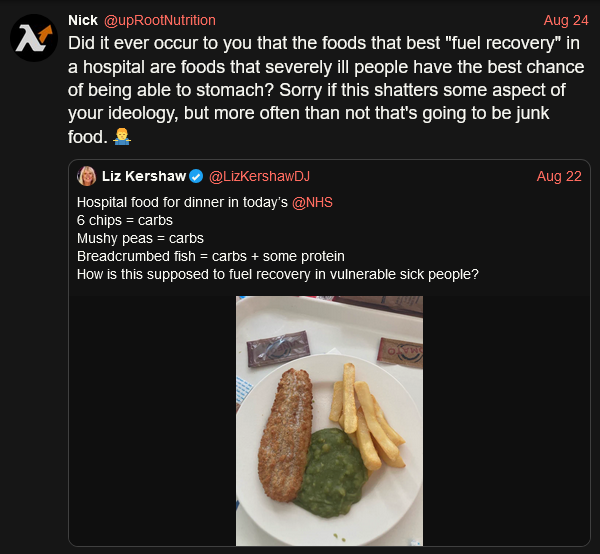
Can we stop pretending that “healthy food” is what’s best in hospitals – whether eaten or in the cafeteria? The hyperpalatable junk food is often precisely the right and healthy food there.
The diet grifters love to mention this, only a child wouldn’t understand why the food is the way it is there.
Source of this data? Call me skeptical, but I suspect the decision on what food to offer patients in a hospital is much more driven by cost than anything else.
Interesting critical and actionable analysis by the GPT5 LLM of the work of Walter Willet and Christopher Gardner, in my reasoned opinion, two of the most credible experts in nutrition.
Ranked food recommendations for health and longevity
Ranking reflects convergent evidence from Willett-style epidemiology (long-term associations with chronic disease outcomes) and Gardner-style trials emphasizing quality and adherence. Each item lists direction of effect and the main rationale; the top tier has the strongest, broadest, and most consistent support.
Extra-virgin olive oil and other unsaturated plant oils (used to replace saturated fat and refined carbs)
Rationale: Improves lipid profile and cardiometabolic risk when replacing saturated fat/refined carbs; central in Mediterranean patterns with strong epidemiological support; high palatability aids adherence. Consensus: High; Probability of benefit if replacing less healthy fats/carbs: ~753–90%.
Rationale: Favorable fats, fiber, micronutrients; linked to lower CVD and mortality in cohorts; helpful in satiety in trials. Consensus: High; Probability: ~730–90%.
Rationale: Fiber, resistant starch, plant protein; improved glycemic control and LDL; cornerstone in epidemiology and compatible with both low-fat and many low-carb variants (in moderated portions). Consensus: High; Probability: ~370–90%.
Vegetables (especially leafy greens, cruciferous) and whole fruits (especially berries)
Rationale: Fiber, polyphenols, micronutrients; consistent inverse associations with CVD and multiple chronic diseases; trials show improvements in weight and glycemic control when displacing refined foods. Consensus: High; Probability: 3~70–90%.
Whole grains (oats, barley, brown rice, rye, whole-wheat, quinoa) adjusted to glycemic tolerance
Rationale: Fiber and phytonutrients; epidemiology links to lower CVD, diabetes risk versus refined grains; glycemic response varies—dose to tolerance in insulin resistance. Consensus: High for replacement of refined grains; Probability:3 ~60–85%.
Fish, especially oily fish (salmon, sardines, mackerel)
Rationale: Marine n-3 fatty acids, high-quality protein; associated with lower CVD risk; fits within quality-first low-carb or Mediterranean variants. Consensus: High; Probability3: ~60–85%.
Rationale: Microbiome and cardiometabolic signals; fermented dairy often associates with lower CVD risk than non-fermented; supports adherence via flavor. Consensus: Moderate–High; Probabilit3y: ~55–80%.
Coffee and tea (unsweetened)
Rationale: Cohort data suggest lower risk of several chronic diseases; polyphenols; benefits contingent on avoiding sugar/cream excess and timing for sleep. Consensus: Moderate–High; Probabili3ty: ~55–80%.
Poultry and eggs (moderate intake; preparation matters)
Rationale: Neutral-to-beneficial when replacing processed red meat and refined carbs; effects depend on overall pattern and cooking method. Consensus: Moderate; Probabil3ity: ~50–75%.
Red meat (unprocessed, modest portions; minimize processed meat)
Rationale: Processed meats consistently associate with higher risk; unprocessed red meat risk appears dose-dependent and sensitive to substitution target (e.g., replacing with legumes/fish/whole grains improves outcomes). Consensus: High on limiting processed meat; nuanced on unprocessed red meat dose; Probability of benefit from reduction when replaced with a3bove: ~60–85%.
Dairy (prefer fermented; low- to moderate-fat per cardiometabolic context)
Rationale: Mixed epidemiology; fermented options often fare better; personalize by LDL response and tolerance. Consensus: Moderate; Probab3ility: ~45–70%.
Ultra-processed foods and refined carbohydrates (limit)
Rationale: Consistently linked to weight gain, higher glycemic load, and worse cardiometabolic outcomes; reducing and replacing with minimally processed foods drives much of the benefit seen in both epidemiology and Gardner’s “quality first” trials. Consensus: High; Probability of benefit from red1uction: ~70–95%.
How to operationalize
Gardner’s RCTs suggest that if you hold “quality” constant (minimally processed, high fiber, adequate protein, healthy fats), macro split (low-fat vs. low-carb) is secondary for weight in the average participant at 12 months; choose the pattern that maximizes your adherence, then populate it with the top-ranked foods above.
When the researchers measured protein levels in the participants’ blood, they found that higher levels of certain proteins were associated with accelerated brain aging. Further, they found that those protein levels decreased in participants who followed the green-Mediterranean diet. The researchers hypothesized that the protective effect of the diet could be a result of the anti-inflammatory molecules contained in green tea and Mankai.
“Studying the circulating proteins in blood allows us to observe, in a real-life setting, how the brain’s aging processes are influenced by lifestyle and dietary changes,” said Anat Meir, postdoctoral research fellow at Harvard Chan School, who co-led the study. “This approach gives us a dynamic window into brain health, helping to reveal biological changes long before symptoms may appear. By mapping these protein signatures, we gain powerful new insight into how interventions, such as diet, may help preserve cognitive function as we age.”
Senior author of the study was Iris Shai, adjunct professor of nutrition at Harvard Chan School. Other Harvard Chan School co-authors included Dong Wang, Frank Hu, and Meir Stampfer.
“Mankai is a proprietary strain of duckweed, the world’s tiniest leaf vegetable. It has no roots; it floats on the water. Duckweed has been eaten for hundreds of years in Southeast Asia. Grandmothers in certain tribes, in certain villages, in Laos, Vietnam, and the north of Thailand used to pick it up from slow-moving water bodies in the winter season and use it in soups and salads as a source of protein.
The word ‘Mankai’ combines ‘manna,’ the heaven-sent food; ‘chai,’ which means ‘alive’ in Hebrew; and ‘khai-nam,’ which is the Thai name for duckweed. At Hinoman, we’ve built an entire ecosystem to enable uniform, sustainable production of this plant year round.”
—Ron Salpeter, CEO, Hinoman
Roger Davis, biologist: ‘If you eat a poor diet, it activates stress throughout your entire body: muscles, liver, fat… everywhere’
The esteemed scientist, one of the world’s leading experts in molecular biology, explains how disruptions at the cellular level influence health
The human body is an extremely complex system that functions well when kept in balance. Diets high in fats or sugar, lack of exercise, toxic substances, or insufficient sleep can disrupt that harmony and lead to all kinds of chronic diseases, such as obesity, cancer, or heart conditions, which rank among the leading causes of illness and death in industrial societies. It has long been known that the body’s inflammatory response to everyday damage — sometimes continuous and low-grade — explains the origin of many of these disorders. Understanding how this response is regulated is one of the most exciting areas for the medicine of the future.
Roger Davis, 67, director of the Department of Molecular Medicine at UMASS Chan Medical School in the U.S., is one of the world’s leading experts in this field. His work in the 1990s led to the cloning of the protein JNK, a switch that activates in our cells when problems are detected, from infections to oxygen deprivation or excess sugar. When the mechanism works properly, it helps cells adapt and survive, but if it becomes overactive or the switch stays on, it contributes to the development of diseases such as arthritis or diabetes.
Davis, one of the most cited scientists in the world, was recently in Madrid to participate in the congress of the Spanish Society of Biochemistry and Molecular Biology (SEBBM), thanks to the collaboration of the BBVA Foundation.
Question. How has the way we understand the effects of stress on cells and our bodies changed since you began your pioneering work?
Answer. It’s been a good number of years since we first cloned JNK — I think some of my current students weren’t even born yet — and the way we think has changed a lot since then. We also know a lot more about the molecular mechanisms and the actual details of how they work. And I think there’s also been a shift in how we think about the purpose of the pathway, why we have it.
Originally, it was defined as a stress pathway, and there were many different types of environmental stimuli that activated it. So, people thought this was a way of responding to stress. Today, we look at it differently, in terms of homeostasis, the balance the body should be in. We now think of stress as the body getting out of balance, and this pathway recognizes the imbalance and corrects it. So it’s more of a physiological balancing act than what we originally thought, where it was simply a bad thing that happened when you were exposed to stress.
So you don’t feel anything from eating healthier. At the same time I’ve had massive changes previously from hydration/sodium reduction that I’ve forgotten about.
Basically the EXPERIENCE is neutral – not tasting much, not feeling much, and it’s about delayed gratification. It’s a change in perspective? It’s pretty interesting not tasting much, no hyperpalatable kick experience in pleasure from eating for a long time, except maybe alleviating hunger.
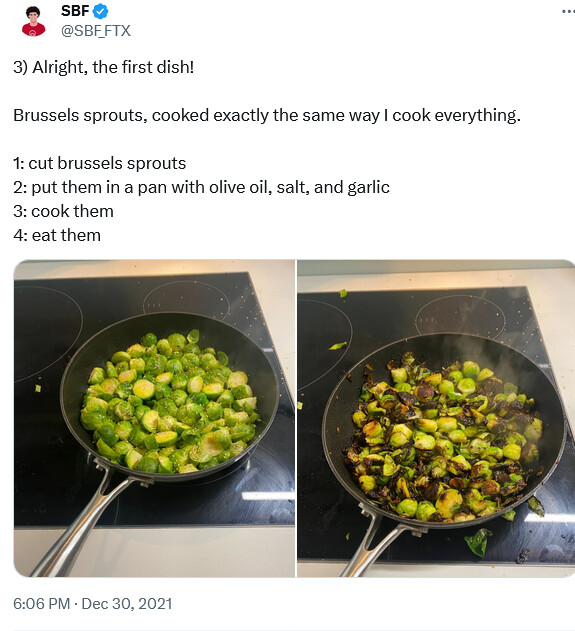
I agree with Aella completely, I do eat “honorary non-vegetables,” corn and peas, and I love baked potatoes. Though I think broccoli, cauliflower, and Brussels sprouts are all cruel jokes and detract from any meal they are served with.
I don’t like cooked broccoli but love it raw in my smoothie. Cauliflower is a different story - it’s great when steamed and served with sour cream and green onions (salt and black pepper to taste).
I guess I’m a freak of nature, because I love brussel sprouts, and especially if well prepared in a dish. I’m less fond of broccoli, unless specially prepared in some Italian dishes. And I kinda hate potatoes, except the very young red ones in a nice dish - small quantities. Don’t like 'em mashed, fried, baked, in flour form - just hate 'em in general (grew up eating them, and hated every minute of it).
The founder making Blueprint foods for delivery used to do this as well.
Since dietary AGE’s doesn’t really have much of an effect according to Olafur except possibly increasing inflammation with you can detect, then baking in oven everything should be easiest and not much of a difference from boiling or steaming.
I’ll have to go with that, whatever is easiest, and arguably more palatable without any health difference.
In the morning I put frozen Brussels in a mason jar and eat them in the afternoon after they have thawed out. I’m lazy yet trying to eat enough vegetables and it’s easy. They also don’t go bad if I buy them frozen.