It seems likely that everything of any potential monetary value is going to be hacked in the next few years…
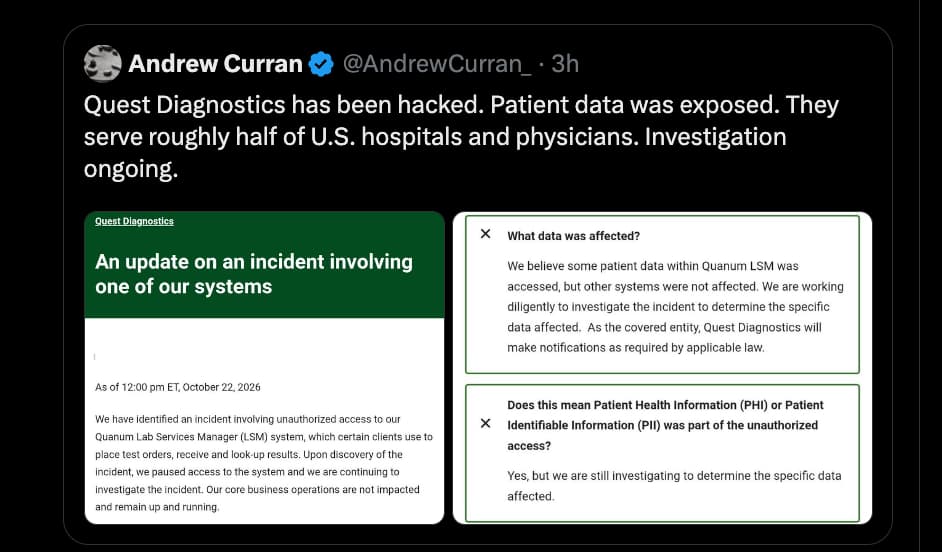
IMHO, leading up to this, why weren’t folks in the US allowed to own their own data in the first place? (See Tim Berners-Lee SOLID project.) Why do we have to opt-out of cookie placement, vs. opting-in? Many of these downstream weaknesses in security may have been addressed much earlier on before we allowed these large corporations to spy on us and build huge databases for advertising and other nefarious purposes. It’s all out there already, just waiting for the LLM’s to scarf up.
Hacking and exposure of patient data can have huge effects on insurance coverage, job certainty to name but a few examples. Is this going to become the norm, and what we can expect to happen (much) more often?
OpenAI CEO Sam Altman: “I don’t even know a dramatic enough word to use… models can find bugs that are outside of the normal threat model of what we think a hacker can do… hardware-level, insane stuff… I no longer think we’re gonna be able to just patch all the bugs.”
·
Relevant
·
hardware bugs were never really patchable, we’ve been paying the Spectre tax since 2018
How would someone actually go about securing their medical data? It’s scattered among doctors and specialists seen over many years, hospital systems, and laboratory companies such as Labcorp and Quest Diagnostics. Tracking it all down would be nearly impossible.
A starting point would be to identify the major healthcare providers that currently hold your records, review their privacy and data-sharing policies, and ask what options they offer for restricting access, limiting data sharing, or deleting information where legally permitted. However, deleting medical records is often not possible because healthcare providers must retain certain records to comply with legal and regulatory requirements. Even when deletion is permitted, it may not extend to copies held by other organizations outside a specific healthcare provider. In addition, eliminating medical records could be detrimental to your future medical care. The more realistic goal is to reduce unnecessary data exposure and secure the records that can be protected, if you can!
Medical records can also contain highly sensitive personal information that, if exposed in a data breach, could help a scammer impersonate you or commit identity theft. Although no single measure can eliminate this risk, one useful precaution is to freeze your credit files with all three major U.S. credit reporting agencies: Experian, Equifax, and TransUnion. A credit freeze generally prevents new creditors from accessing your credit report to approve new credit accounts, although exceptions apply. Freezing your credit is free and does not affect your credit score.
A credit freeze will not prevent every form of identity theft, but it is a straightforward and effective step toward reducing the risk of fraudulent credit accounts being opened in your name. Of the likely things a person can do this is a big one within everyone’s reach. I can’t conceive of actually trying to reduce my medical data exposure. That seems like an impossible task.
Oh, here is another thing to be concerned about if AI gathers your personal data: Phone calls so realistic you’re convinced they’re legitimate. Such calls could be related to swindling you out of money in your bank accounts or retirement accounts. Such techniques already exist, but could be supercharged after an AI data breach. Beware of someone calling about fraudulent activity with one of your financial accounts and asking you to withdraw large sums and convert to Bitcoin for your protection. I would assume no one would fall for this scheme, but it happened to someone I know. And, I’m sure there are other avenues I haven’t thought of yet.