Cardiovascular Health 2026

Its interesting… I can see your point. But I take a more risk adverse approach (to my thinking - since CVD is the number one killer of men in North America).

I’ve suffered from higher cholesterol levels much of my life and have taken statins off and on. Now I’m thinking that I want to make sure that cardiovascular health is not my limiting factor as far as healthspan and lifespan go, so I’m being more aggressive and want to get rid of any plaque I have to lower my future risk. So I’ve lowered LDL-C and APO-B to around 45, with statin, bempadoic acid and ezetimibe.

Here is the data on what percent of people have plaque (from Google Gemini 3 Pro):

Estimating the prevalence of cardiovascular plaque—specifically subclinical atherosclerosis—requires distinguishing between clinically diagnosed Coronary Artery Disease (CAD) and the presence of subclinical plaque (detected via imaging like CAC or CCTA). In asymptomatic populations, the prevalence of plaque is significantly higher than clinical diagnosis rates, showing a steep age-dependent gradient.

1. Subclinical Atherosclerosis Prevalence (Aged 40–64)

In middle-aged populations, imaging studies reveal that a majority of asymptomatic individuals already harbor plaque in at least one vascular territory.

  • Multivascular Prevalence (Aged 40–54): The PESA Study found that 63% of asymptomatic individuals (mean age 45) had subclinical atherosclerosis in at least one area (carotid, coronary, or ilio-femoral) (Fernández-Friera et al., 2015).
  • Coronary-Specific Prevalence (Aged 50–64): The SCAPIS Study utilized Coronary Computed Tomography Angiography (CCTA) and found that 42.1% of the general population had some form of coronary atherosclerosis (Bergström et al., 2021).
Age Group Men (Any Coronary Plaque) Women (Any Coronary Plaque)
50–54 41.2% 18.8%
55–59 56.6% 29.3%
60–64 68.7% 40.1%
(Source: Bergström et al., 2021)

2. Coronary Artery Calcium (CAC) in Older Populations (Aged 75+)

In the elderly, the absence of plaque is the exception rather than the rule. Data from the MESA and ARIC studies indicate that coronary calcification (a proxy for advanced plaque) is nearly universal by the tenth decade of life (Miedema et al., 2022).

  • Age 75–85: Approximately 89% of individuals have a CAC score > 0, meaning detectable calcified plaque is present. Only 11% of this population has a “zero CAC” score (Miedema et al., 2022).
  • Age 90+: Detectable CAC is identified in approximately 95% of individuals across all sex and race subgroups (Miedema et al., 2022).
  • High-Risk Burden: Roughly 62.5% of adults aged 75–85 have a CAC score > 100 Agatston Units, which is the threshold typically used to indicate high atherosclerotic cardiovascular disease (ASCVD) risk (Miedema et al., 2022).

3. Clinical vs. Subclinical Disparity

There is a massive gap between the presence of plaque and the manifestation of symptoms.

  • Young Adults (18–44): Only about 1% report a clinical diagnosis of CAD, yet early autopsy studies (e.g., the PDAY study) have shown fatty streaks and early plaques in the aortas of most teenagers and the coronary arteries of many individuals in their 20s (ResearchProtocols, 2025; StatPearls, 2024).
  • Adults 75+: While ~90% have detectable plaque, only 24.2% report clinical CAD, highlighting a high burden of “silent” atherosclerosis that remains undiagnosed until a major event occurs (ResearchProtocols, 2025).

References

Bergström, G., Persson, M., Adiels, M., Björnson, E., Bonander, C., Ahlström, H., Alfredsson, J., Angerås, O., Berglund, G., Blomberg, A., Brandberg, J., Carlsson, A. C., Cederlund, K., Chen, Y., Coniat, M., Dekkers, R., Duvernoy, O., Ekblom, Ö., Engström, G., … Jernberg, T. (2021). Prevalence of subclinical coronary artery atherosclerosis in the general population. Circulation, 144(12), 916–929. https://doi.org/10.1161/CIRCULATIONAHA.121.055340

Fernández-Friera, L., Peñalvo, J. L., Fernández-Ortiz, A., Ibañez, B., López-Melgar, B., Laclaustra, M., Oliva, B., Mendiguren, J. M., Baguet, J. P., Sánchez-González, J., García, L., García-Huerta, J. J., de Vega, V. M., Zamorano, J. L., Sanz, J., & Fuster, V. (2015). Prevalence, vascular distribution, and multiterritorial extent of subclinical atherosclerosis in a middle-aged cohort: The PESA (Progression of Early Subclinical Atherosclerosis) Study. Circulation, 131(24), 2104–2113. https://doi.org/10.1161/CIRCULATIONAHA.114.014310

Miedema, M. D., Dardari, Z. A., Nasir, K., Blankstein, R., Knickelbine, T., Yeboah, J., Budoff, M. J., McEvoy, J. W., & Blaha, M. J. (2022). Defining demographic-specific coronary artery calcium percentiles in the population aged ≥75: The ARIC Study and MESA. Circulation: Cardiovascular Imaging, 15(10). https://doi.org/10.1161/CIRCIMAGING.122.015145

ResearchProtocols. (2025). Coronary artery disease prevalence in an executive population at a tertiary medical center: Protocol for a retrospective cohort study. JMIR Research Protocols, 14, e72451. JMIR Research Protocols - Coronary Artery Disease Prevalence in an Executive Population at a Tertiary Medical Center: Protocol for a Retrospective Cohort Study

StatPearls. (2024). Risk factors for coronary artery disease. StatPearls Publishing. Risk Factors for Coronary Artery Disease - StatPearls - NCBI Bookshelf
3 Likes

Wow yeah, you were right, I definitely must have some, hopefully not too much lol. and I do get your point in in keeping LDL sub 50 sort of putting the risk of CVD to bed and then deal with other factors. One of those days I’ll have to do a Cleerly to see where I am, and then I can make a more informed decision. for now I’m pretty happy I have been able to lower it in low 70 for 6-7 months from a high of 124. but until couple years ago I’ve always been mid-eighties naturally and then like with everything the whole Hell seems to break loose when one is approaching 60 LOL. Even my glucose was always in mid 80’s and now is 100-110 if i don’t manage it. At least I’m way more informed thanks to you and others on these boards and know what to do to maintained healthy levels.

1 Like

When looking at the gray confidence interval, which represents 95% of the cohort, it is important to note that the level must drop to 60 mg/dl to reach or fall below zero. Even at 60 mg/dl, 2.5% of the cohort remains above the confidence interval and continues to build plaque.

This is why individuals at high risk, such as myself, need to target a level below 50 mg/dl to ensure that plaque progression has likely stopped.

3 Likes

Good observation. I totally missed that and was focused on the mean/line. Now, it makes 100% sense why people in the know say it’s best to keep it under 50.

Elevated LDL-C induces T-cell metabolic dysfunction and increases inflammation and oxidative stress in midlife adults | Journal of Applied Physiology | American Physiological Society

https://journals.physiology.org/doi/full/10.1152/japplphysiol.00226.2025

2 Likes

Definitely need to keep LDL and ApoB below 60. Some of my readings are getting close though! 58 last measurement. However I have switched from Atorvastatin 5 mg EOD to Pitavastatin 2 mg daily. That should push me back down.

1 Like

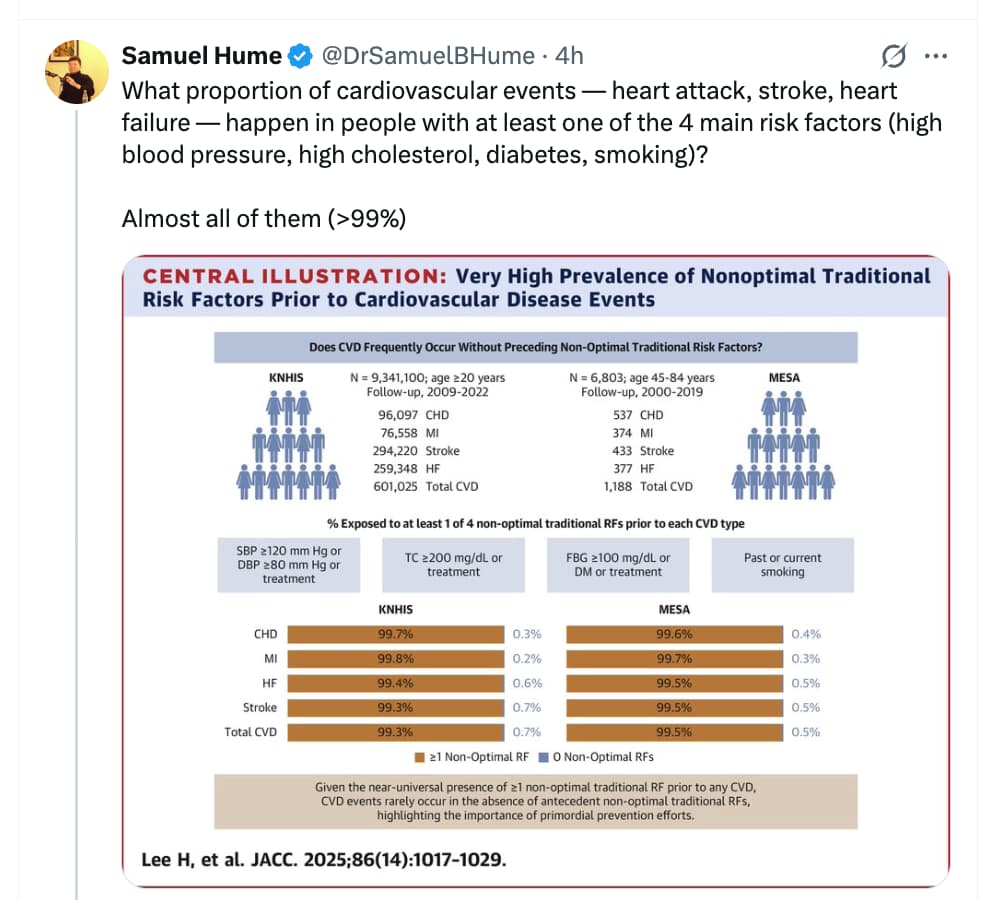
https://x.com/DrSamuelBHume/status/2053927891553968186?s=20

1 Like

If this is true, what am I worrying about? We would only need to stay on track on: diabetes, smoking, BP, cholesterol.

Is it because we are building plaque even on 80-90 LDL, so eventually (super late in life) we would get an obstruction?

I think in part it is an endothelial failure which requires intervention on the pathway of aging (IMO acetylation).

1 Like

Ah - look closely, actually, It’s not diabetes, it’s blood glucose above 100, same for hypertension(above 120). Basically very few people are left out the way it’s classified here, I think.

Full study:

https://www.jacc.org/doi/10.1016/j.jacc.2025.07.014

1 Like

The interesting question, of course, is what proportion of people with optimally controlled of those biomarkers still have plaque.

2 Likes

I figure I’ll join in here with my personal journey and a few questions. Cardio health is a major concern of mine as I have both high Lp(a) and high and rapidly increasing CAC scores. I’d appreciate any feedback.

Personal History – Male, 67yo (2026), 180-lb, 6-ft tall:
~2018 - CAC test with ~30th percentile blockage (missing data)
2022 - CAC test=421 (75th percentile) …yuck
2022 - Stress test: no sign of ischemia. Started on Statin (Rosuvastatin 20mg/day)
2024 – Carotid artery ultrasound: Arteries were clear, no thickening. Ankle-brachial index test: Blood Pressure nearly identical between ankles and heart (minimal arterial blockage)
2025 – Bloodwork (Apr-2025)
• Glucose=102 (high), A1C=6.3% (high, pre-diabetic)
• Calcium=11.4 mg/dL (high)
• Cholesterol=145 mg/dL, HDL=58, Trig=108, LDL-C=67, Chol/HDLC=2.5
• Lp(a) = 122 nmol/L
• ApoB = 67 mg/dL
• CRP=0.22 mg/L
2025 – Started Ezetimibe (10mg/day)
2025 – CAC test=749 (Sep-2025) (78th percentile) … yuck
2025 – Noted to my Doc that my blood calcium always seemed high
• After many tests – Diagnosed with hyperparathyroidism
• Had Parathyroidectomy (Oct-2025) – Calcium levels dropped to normal range (9.3 mg/dL)
2026 – Stress Test (Jan-2026) negative for ischemia, Coronary CT = Moderate coronary atherosclerosis, CAC = 879 (81st percentile) … big yuck. Started Praluent PCSK9 (Jan-2026) at 75 mg/2-wk
2026 – Bloodwork (Feb-2026)
• Glucose = 116 mg/dL (high), A1C = 6.7% (high, pre-diabetic)
• Calcium = 9.3 mg/dL (normal range)
• AST=42 U/L (high)
• Lp(a) = 108 nmol/L (reduced, but still high)
• Cholesterol=85 mg/dL, HDL=64, Trig=76, LDL-C<10, Chol/HDLC=1.3, non-HDL Chol=21
• ApoB <20 mg/dL
• HS CRP=0.4 mg/L
2026 – Stopped taking Ezetimibe (Feb-2026) per cardiologist recommendation

Thoughts/Questions:
• I’m pleased with the reduction in my LDL-C and ApoB due to Praluent, Rosuvastatin and Ezetimibe (subsequently dropped per cardiologist). I’ve had no side effects from this combination.
• HS-CRP is in a good range
• Lp(a) is still a big concern. The Praluent reduced my Lp(a) by about 11%, and when Pelacarsen is available (early 2027) I’m hoping to reduce my Lp(a) significantly
• I will be getting bloodwork done shortly (May-2026) to see if dropping Ezetimibe had a noticeable negative effect and if so, I will restart it
• I’m concerned that despite all my efforts, my glucose/A1C remain in pre-diabetic range
• Should I restart Ezetimibe?
• Should I add Nattokinase to further support heart health? 10,000+ FU range?
• Should I drop Rosuvastatin (20mg) and add Pitavastatin (4mg) to mitigate any statin effect on glucose?
• What other options to reduce glucose/A1C?

Metformin, SGLT-2 inhibitors like jardiance, GLP1 agonists. At 6.7% Hba1c you are already diabetic, so you should qualify for all these meds.

You need bigger guns at 6.7% A1c

I agree with restarting Ezetimibe if ldl creeps back up.

Nattokinas me is nice, but your priority should be lowering that A1c.

1 Like

I guess I should have noted that I’ve been on metformin (500mg, 2x per day) for quite a few years. I also dropped quite a bit of weight (35-lbs) when I first found out that I was pre-diabetic. I stay quite active and do moderate weight training. I’ve been bouncing around on my A1C, ranging from 6.0% up to 6.7% recently. Thanks for the feedback

2 Likes

Continue escalating treatment then. Your options are, in order of efficacy :

  • SGLT-2 inhibitors
  • Glimins like Imeglimin
  • GLP1 agonists

You didn’t mention acarbose. You must be burning mostly carbs. It would be great if you could become a fat burner, but it’s very hard to do for most. At least stay away from wheat and sugar. Start slow with the acarbose.

I agree the flozins are great. Dapa (forxiga) is less trouble than Empag .

Any proof/study on this or just your N=1 experience?

I hadn’t heard the term “flozins” … had to look it up :slight_smile:

I tend to have a low carb diet. I deal with both gout and neuropathy so I do watch what I eat. I try to avoid all wheat products, white rice, potatoes, high-sugar and processed foods. I “try”, but there is always some in my diet. I guess I need to be even more proactive with this given this diabetes issue.

I’d wanted this to resolve itself … but dang … didn’t happen :confused:

I’ll research all the suggestions, and talk to my Doc, to see what might the best path considering my other meds and supplements.

N=1 big time, I noticed it right away, then later did read it in studies and the reason why eludes me now. My recollection is that they just stated it and didn’t explain.

I still have a couple boxes of empag in the drawer. I can’t make it through the night and stop all the time to pee in the day. Not worth it. Dapag I don’t even notice.

1 Like

Full paper:

Very-High-Prevalence-of-Nonoptimally-Controlled-Traditional-Risk-Factors-at-the-Onset-of.pdf (461.3 KB)