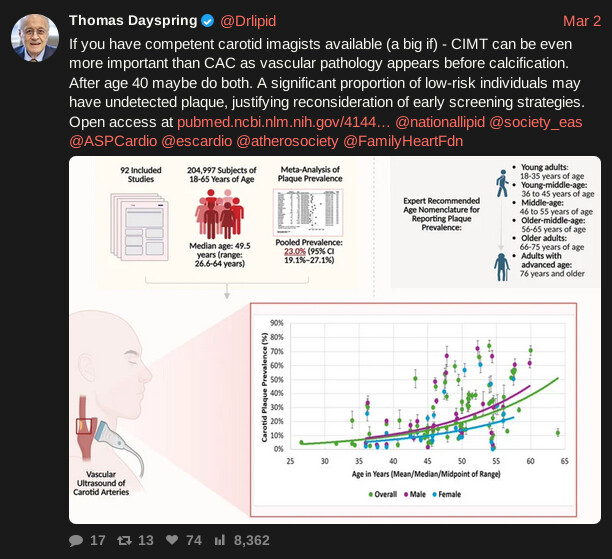
Scanning coronary arteries isn’t enough, plaque can develop in all arteries, and not consistently, some areas can be clear and others clogged, like the arteries near the brain.
$250 test:
… Do you understand that of the 1.6 million Americans who will have a heart attack or stroke that 50% will be a STROKE? Of that number about 85% will be nonfatal. That means you are risking being a brain-damaged, vegetable in a wheelchair. No coronary scan directly assesses stroke risk. A quality CIMT is better for that job. There can be discordance of risk. ASCVD does not present equally in all artery walls. My Cleerly CT Angiogram was fine. My CardioRisk CIMT not so fine.
So, bird dog, when was the last time you did a CardioRisk CIMT (the best quality provider)? I’ll tell you when. Never. When has either of your buddies done one? Never. Or if they have, it’s not been made public. Yet you think you are safe? Don’t bicker with me! Just pay the $250 at CardioRisk’s website (no Rx needed) and go find out …
Risk factors like blood pressure, lipids, insulin resistance should be strived to optimal regardless. A clear test shouldn’t change anything and the former risk factors should still be optimal. A positive test is simply motivation to treat or how aggressive treatment should be, imo.
But simply assuming a coronary artery scan being clear makes one bulletproof from events doesn’t make sense to me, there are more arteries than that and maybe this test will help.
This is good. Worthwhile. It is also worth doing consecutively, like a year apart - first test to get a baseline, then the intervention (LLT or something like lutein + lycopene), and a re-test a year later to see the delta. Of course this assumes same level of technical competence in conducting both tests which may not be realistic.
To be honest, I don’t know much about this – and I guess not many others. But I’m learning, and noting the flaws with certain imaging techniques (like CCTA not imaging around the brain).
I see there’s another thread and DrFraser recommended MRA neck and head with whole body MRI. CIMT (like with CardioRisk) + CAC is fine (CCTA better).
Here’s what SimonOne wrote about MRA neck/intracranial head.
Provides a detailed 3D view of the carotid and vertebral arteries that supply blood to the brain, helping identify plaque buildup, narrowing, and flow-limiting disease that may increase stroke risk. This supports early risk assessment and proactive cardiovascular and brain-health management
Creates a high-resolution 3D map of the arteries inside the brain, including the Circle of Willis, allowing detection of aneurysms, vessel narrowing (stenosis), and other vascular abnormalities that can increase the risk of stroke or hemorrhage—often before symptoms occur
I did this here in London for about £110($150/€130) in January 2025.
It was easy, quick and I got a very good analysis by the technician. My arteries are in pretty good nick. I thought it was well worth doing given the costs of a CAC or MRI scan.
My cardiologist thought a CIMT scan a bad idea when I raised it. I had one done anyway at my expense. However, I don’t know what to do with the results.
Finding atherosclerosis is a late stage finding, as such a negative result shouldn’t change treatment. A positive result is motivating to treat. CIMT scan quality can vary, and doesn’t look at the heart.
For N=1 data over time I think CCTA when it comes to the heart with AI analysis like Heartflow is the best.
My approach on this it to have some certainty, which sadly means exposure to radiation, IV contrast, and a wallet biopsy.
Initial CCTA with either Cleerly or Heartflow ~$1570
Initial MRI whole body plus head/neck at SimonMed includes Neuroquant and MRA of Head/Neck, then yearly whole body MRI (basic) - repeat the more expensive one every 3 years to track Neuroquant, years 2/3 basic one for malignancy ($1599/$999 - often $200 discount available on each)
Yearly low dose lung CT for lung cancer screening ($160 through RadiologyAssist)
This is both vascular disease and malignancy screening (added to routine surveillance for breast, prostate, bowel, skin cancer per standard guidelines).
A CAC is not a test I order, as it only shows the low risk plaque and none of the high risk plaque. A CIMT is a nice test - but is much less useful than an MRA head/neck as the ultrasound sees only the common carotid and not the internal, doesn’t see the vertebrals or other vessels, doesn’t let you know if you have an aneurysm, white matter changes, prior stroke, or brain tumor.
So this is where I’ve ended on imaging for vascular disease and malignancy.
When I had mine done, the technician spent much more time explaining the results than the test itself, and I got a written report emailed with the scans.