Commentary from a Neurophysiologist:
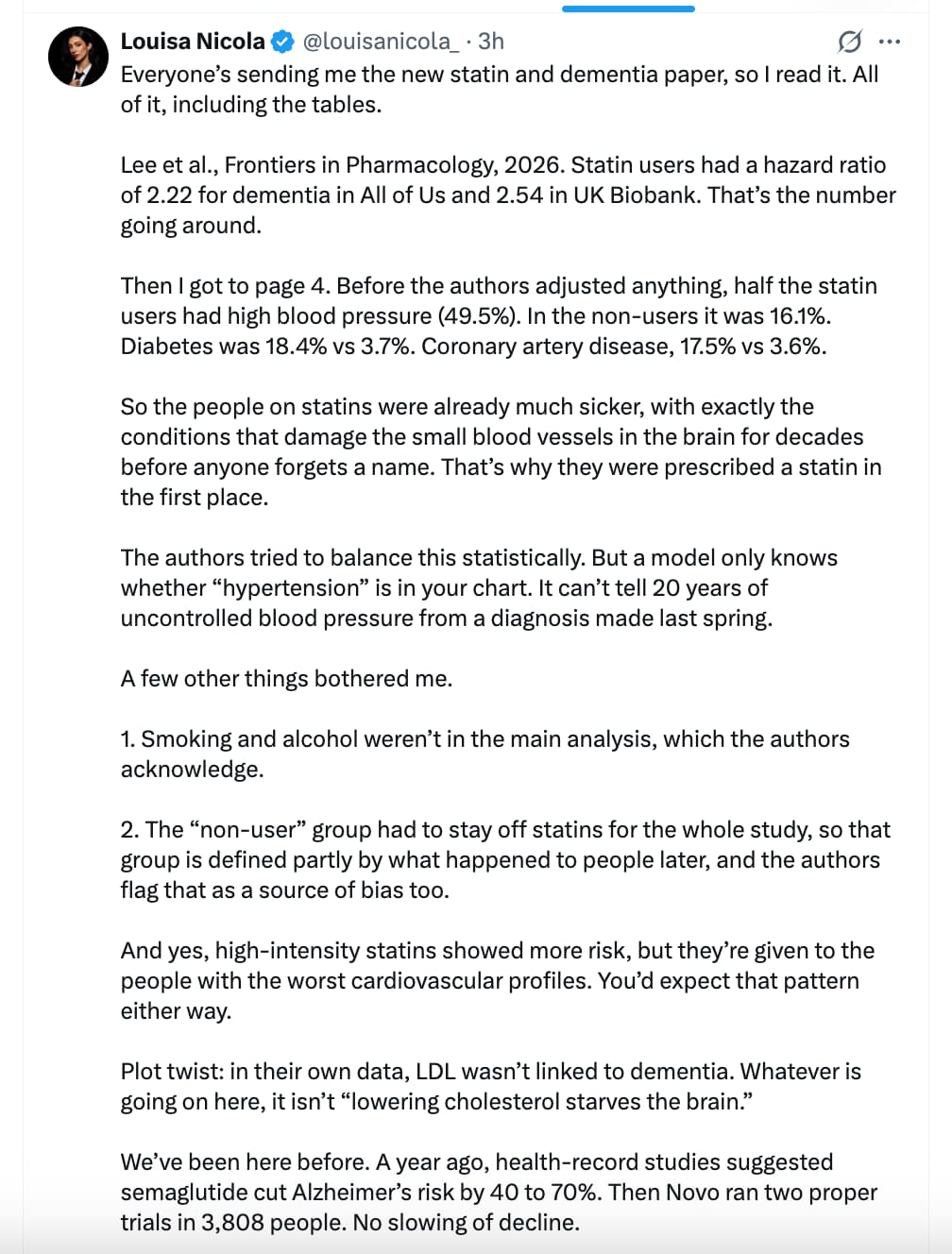

Source: This post on X
Yes, reverse causality, always a concern in such studies. And the adjusting for confounders here was not especially effective. When the authors started trying to point to impact of statins on CoQ10 as responsible for dementia, I lost all faith in the utility of this paper.
I thought about this as well:
“It can’t tell 20 years of uncontrolled blood pressure from a diagnosis made last spring”.
This is damning, even if all factors were adjusted for, people take statins for some reason. They could have had uncontrolled high risk factors for longer more often than the non-statin segment.
Meanwhile the person who received HBP diagnosis last year will be seen as equal to the 20 year case. The researchers check the box that both have HBP – one could have it for much longer than the other.
I don’t see it as damning at all. It is garbage science, data fishing with so many problems and inconsistent with the rest of the literature.
My assessment is that brain penetrating statins are one of the few reasonably evidenced based pharmacologic interventions we have to decrease rate of dementia.
The Mendelian Randomization showed 77% reduction if you have a gene life long, obviously that is also in the brain, of getting dementia. We however don’t know if you suddenly take a statin at age 60 what benefit is there.
Another study showed that in those with ApoE4’s, 5 years of a statin, decreased rate of dementia diagnosis by 40%.
I’ve reviewed and guided this analysis and think it is pretty even handed and certainly on the skeptical side as most medically tuned AI in the mainstream (this went through Doximity) ends up doubting anything that is off label. But it did a good job pointing out all the problems this article, published in a “Frontiers” journal, which, is a journal series that accepts papers that other journals would not.
Statins and Dementia Risk: Interpreting a New Observational Signal
A recent observational study (Lee et al.) reported elevated hazard ratios for dementia among statin users in two large cohorts. These findings should not be interpreted as causal evidence that statins double dementia risk. The paper is a large, carefully analyzed observational study with consistent findings across cohorts, but its exposure definition, comparator construction, outcome ascertainment, and residual confounding leave substantial alternative explanations.
Lee et al. conducted retrospective cohort analyses in:
Additional findings included a modest elevation for high-intensity versus moderate-to-low-intensity statin use among users (HR 1.14; 95% CI 1.07–1.21) and an exploratory COQ7 mediation analysis suggesting a statistically significant indirect association accounting for 8.2% of the total statistical association.
Replication and consistent sensitivity analyses make the finding noteworthy. They do not establish that statins caused the dementia diagnoses.
The study compares different treatment strategies.
Statin users were defined as those with a first recorded statin prescription during the study period. Nonusers had no statin prescription throughout the observation period (with a pseudo-index date). This is not equivalent to a randomized comparison of “start a statin today” versus “do not start a statin today.” The nonuser definition relies on future information (remaining alive, observed, and statin-free). Inverse-probability weighting does not fully correct this time-related selection bias. The analysis approximates initiation and continued observation among users versus persistent nonuse among those who remained under observation—an estimand vulnerable to selection bias.
Censoring at statin discontinuation creates asymmetry.
Users were censored at discontinuation; nonusers had no equivalent event. This is closer to an as-treated than an intention-to-treat analysis. Discontinuation can be informative (related to emerging cognitive symptoms, frailty, changing risk, adverse effects, reduced healthcare engagement, or clinician concerns about prognosis). Competing-risk analysis for death does not correct confounding or informative censoring.
“New users” may include prevalent users.
Exclusion of pre-2006 prescriptions does not guarantee never-use before the observation window. Incomplete historical capture can misclassify prevalent users as initiators.
Before weighting, the All of Us statin group had substantially higher rates of hypertension (49.5% vs 16.1%), diabetes (18.4% vs 3.7%), coronary artery disease (17.5% vs 3.6%), obesity, and older age—expected differences given prescribing patterns. Inverse-probability treatment weighting achieved standardized mean differences <0.1 for measured covariates, but residual confounding remains plausible for:
A 2025 multiverse analysis by Ferguson et al. showed that across 1.27 million observational model specifications, statin HRs for dementia ranged from 0.93 to 1.47; choices about cardiovascular disease adjustment, diabetes adjustment, run-in periods, and exclusion of the first follow-up year materially changed results.
Source: Client Challenge
The primary outcome was the first dementia diagnosis via ICD, SNOMED, and related coding—not biomarker-confirmed Alzheimer disease. Concerns include incomplete or misclassified diagnoses, lumping of Alzheimer disease, vascular dementia, Lewy body disease, frontotemporal dementia, and mixed pathology, differential ascertainment by healthcare utilization intensity, and the fact that a clinical code does not establish Alzheimer pathology. In All of Us, subtype counts were relatively small (Alzheimer disease: 86 nonusers vs 131 users; vascular dementia: 76 vs 133); most cases were “other dementia.” Similar hazard ratios across subtypes are compatible with a broad ascertainment or utilization effect rather than a specific neurodegenerative mechanism.
The within-user high- versus moderate-to-low-intensity comparison (HR 1.14) is more informative than the high-intensity-versus-nonuser comparison (HR 2.70), which is dominated by treated-versus-untreated differences. High-intensity therapy is preferentially prescribed to higher-risk patients. The modest within-user association remains vulnerable to confounding by indication. No statistically significant difference was reported between hydrophilic and lipophilic statins within intensity strata, weakening a simple blood-brain-barrier explanation based on lipophilicity.
UK Biobank replication is valuable, but both cohorts are observational, rely on coded diagnoses and medication records (not confirmed ingestion), are restricted to White participants, use similar definitions, and are susceptible to confounding by indication and healthcare utilization. Incidence rates differed substantially; truncation of All of Us follow-up to the UK Biobank window made rates more similar, confirming that data architecture and follow-up affect outcome rates.
This is hypothesis-generating only and does not establish that statins cause dementia via coenzyme Q10 depletion.
Limitations include:
Reported estimates included statin use associated with lower COQ7 (β −0.10) and lower COQ7 associated with higher dementia odds. These findings justify further research but do not support routine coenzyme Q10 supplementation for dementia prevention or statin discontinuation.
Reddin et al. (2025) meta-analysis of randomized trials (15 trials, 139,169 participants reporting dementia or cognitive impairment): lipid-lowering therapy vs control 1.33% vs 1.36%; overall OR 0.96 (95% CI 0.74–1.26); statin subgroup OR 0.90 (95% CI 0.67–1.21). No large increase in risk. An apparent vascular dementia signal (OR 1.45) was driven almost entirely by one study and was unreliable after exclusion.
Source: https://doi.org/10.1093/ageing/afaf219
Heart Protection Study: 20,536 participants randomized to simvastatin or placebo (~5 years). Cognitive impairment 23.7% vs 24.2%; dementia 31 vs 31. No cognitive harm signal.
Source: Redirecting
PROSPER: 5,804 adults aged 70–82 years randomized to pravastatin or placebo (~42 months). No difference in global cognition, executive function, processing speed, or other domains.
Source: Client Challenge
HOPE-3 cognitive substudy: rosuvastatin 10 mg vs placebo; no significant difference in cognitive decline after ~5.7 years (Digit Symbol Substitution Test difference −0.54; 95% CI −1.88 to 0.80).
Sources: https://doi.org/10.1093/eurjpc/zwab208 ; https://doi.org/10.1161/strokeaha.121.032614
Ott et al. (2015): systematic review and meta-analysis of randomized trials found no adverse cognitive effect in cognitively normal participants (standardized mean difference 0.01; 95% CI −0.01 to 0.03).
Source: Client Challenge
Li et al. (2026): meta-analysis of randomized lipid-lowering trials found no significant increase in neurocognitive events (statins RR 0.94, 95% CI 0.72–1.25; ezetimibe RR 1.11, 95% CI 0.71–1.74; PCSK9 inhibitors RR 1.00, 95% CI 0.87–1.14).
Source: Frontiers | The effects of cholesterol-lowering drugs on neurocognitive function: systematic review and meta analysis
Randomized trials are not ideal for proving long-term dementia prevention (often short follow-up; dementia usually secondary), but they provide the strongest evidence against a large common adverse cognitive effect.
Nordestgaard et al. (2025) (1,091,775 individuals): per 1 mmol/L genetically lower non-HDL cholesterol, HMGCR proxy all-cause dementia OR 0.24 (95% CI 0.18–0.31); NPC1L1 proxy OR 0.18 (95% CI 0.12–0.25); PCSK9 proxy OR 0.97 (95% CI 0.70–1.35). Strong genetic evidence against a large dementia hazard from the statin target; not equivalent to late-life pharmacologic treatment.
Source: https://doi.org/10.1002/alz.70638
Other MR analyses are not uniformly protective (e.g., Williams et al. 2020 no clear Alzheimer effect for HMGCR/NPC1L1, higher risk with PCSK9 proxy; Rosoff et al. 2022 mixed findings on cognitive performance; Fu et al. 2025 and Han et al. 2025 associations requiring further validation). Overall, MR is reassuring against a large harmful effect of the statin target, with some signals of possible protection, but it is not definitive evidence of clinical dementia prevention.
Sources:
https://doi.org/10.1002/ana.25642
https://doi.org/10.1097/md.0000000000044260
Rajan et al. (2024) (4,807 older adults): overall statin initiation and Alzheimer dementia HR 0.81 (95% CI 0.70–0.94); APOE ε4 carriers HR 0.60 (95% CI 0.49–0.74); noncarriers HR 0.96 (95% CI 0.82–1.12); interaction P = .015. Compatible with potentially greater benefit in ε4 carriers, but observational, based on clinical diagnoses, limited by uncertain adherence and lack of baseline cholesterol, and not a basis for prescribing statins solely for Alzheimer prevention.
Source: https://doi.org/10.1212/wnl.0000000000209168
| Evidence source | Main result | What it supports | What it does not prove |
|---|---|---|---|
| Lee et al. (uploaded 2026 cohort) | Statin use associated with HR 2.22–2.54 for dementia | A signal requiring further investigation | That statins cause a twofold dementia risk |
| Nordestgaard et al. 2025 MR | Genetically proxied HMGCR lowering associated with lower all-cause dementia | No strong support for a harmful statin-target effect; possible prevention | That late-life statin treatment prevents dementia |
| Rajan et al. 2024 APOE cohort | Statin initiation associated with HR 0.60 among APOE ε4 carriers | Possible genotype-dependent benefit | A causal 40% reduction after 5 years of treatment |
| Randomized-trial evidence | No significant cognitive harm or dementia reduction | Reassurance about cognitive safety | Definitive long-term dementia prevention |
The Lee et al. study is a hypothesis-generating observational signal with important design limitations (confounding by indication, healthcare-utilization and detection bias, future-information selection in the nonuser definition, informative censoring, misclassification of exposure and dementia, reverse causation from prodromal cognitive decline, lack of biomarker confirmation, and limited generalizability). It does not overturn the evidence hierarchy.
Randomized trials provide reassurance against statin-related dementia. Mendelian randomization is directionally reassuring but not equivalent to medication treatment. The APOE ε4 benefit remains observational. Statin use should be determined by cardiovascular risk and established indications rather than by the expectation of dementia prevention or fear of dementia caused by treatment.
Concise patient-oriented summary:
This new study found an association, but it was not a randomized trial. Its comparison included important differences in health and treatment patterns between users and nonusers, and its methods can still be affected by residual confounding and diagnostic bias. Randomized trials and genetic studies do not show that statins cause dementia, although a dementia-prevention benefit is not definitively proven. The statin decision should therefore remain based primarily on cardiovascular risk, while any temporally related cognitive symptoms can be evaluated individually.
Clinical takeaway: The paper deserves attention but does not change the evidence hierarchy. A patient’s statin should not be stopped solely because of Lee et al.; reassess the cardiovascular indication, document any actual cognitive symptoms objectively, and consider a supervised medication adjustment only if there is a reproducible individual temporal relationship.
I meant it’s damning for the study.
There’s no consideration of uncontrolled risk factor exposure in these observational studies I guess.
So the person who started a statin might’ve had 20 years of uncontrolled HBP and diagnosed officially at 20+1 years.
While the person who never used a statin was diagnosed HBP 1 year before follow up period begun. The researchers adjust for “high blood pressure” and one has had it for 20+1 years, the other 1 year. The segment without statin usage was pre-selected with retrospection as well to have not taken it once over the 17 year follow up (selection bias bonanza).
The person who took the statin over the follow up period might know they are at higher risk, compared to the one diagnosed 1 year before follow up. Either way… mendelian randomization controls for this.
That study is as embarrassing as the one that tried to tell us that melatonin causes heart failure
Every single association study is like this and it draws headlines.
In a sane society these trash papers wouldn’t be allowed to be published in these so called journals.
I think it’s most likely that the reason why statin users developed more cases of dementia is due to the fact they didn’t die of a heart attack or stroke before they developed dementia.
It’s like the study that found smoking prevents dementia too!
That may be a reason for some, but it may not be the only reason.
My own thinking is that cells need cholesterol and the liver distributes it for a reason.
No I don’t think so.
The two segments were different, it’s residual confounding.
MR + RCT + Observational RCT studies already suggest neutral or positive benefit.
For instance this study there was a 76% reduction in dementia risk with lifelong each 39 mg/dl lower non-HDL-c levels via HMGCR.