I just saw that Bryan is on the latest episode of Club Random (Bill Maher’s podcast).
I always learn from Maher, even when I vehemently disagree with him.
He’s into health, so I look forward to seeing if anything interesting comes out of this conversation. It’s hard to know because his podcast, unlike his other show, is rarely informative.
I don’t want to comment on something I don’t know too much about but there is one thing that greatly reduced my trust in Bryan being honest and transparent. That’s the fact that he apparently declined having his epigenetic age independently tested by Steve Horvath, and also by someone else, if I recall. That’s suspicious because if he wanted to gain trust he should have taken the offer. Why else would he decline an offer like that if not to hide something. The benefits of taking that offer are obvious for his image and credibility.
On this issue I agree with you. My two big issues with Bryan Johnson are using botox and hair dye. Neither of those deal with the underlying biochemistry of aging.
On a related note, Matt Kaeberlein also offered to debate him recently at the Vitality Bay conference they both attended. Bryan Johnson not taking up this offer just adds to the list of things that make me question his integrity.
Moreover, during that meeting, BJ’s team wanted to discuss the Rejuvenation Olympics with Horvath, as reported in Vice. To me, it seemed he was interested in talking about his venture. So it wasn’t just a case of declining.
Horvath, whose team discovered the epigenetic clock and who now works at Altos Labs with Levine, offered to re-analyze Johnson’s data to “validate the claims surrounding epigenetic rejuvenation” and look at other biomarkers. "My philosophy: strong claims require strong evidence,” Horvath wrote. But Johnson’s team declined, instead requesting to talk about his new venture, the Rejuvenation Olympics, in which people can upload their epigenetic aging test and compete with one another for the slowest rate of growing old, according to a publicly available algorithm.
He is networking with rich and influential people. I really hope he pushes them to fund research, not just buy supplements/treatments.
Bryan is always talking about how “we are on the cusp of longevity and AI breakthroughs which will extend human lifespan”, so it is very strange to me that he isn’t pushing that specifically. I feel like people need to reach out to him and really hammer that point across. But like I said earlier he is talking to a lot of influential people and we don’t know what is going on behind the scenes. I would love if he was laying the groundwork for something big in terms of funding research.
I was trying to ignore this video because I assumed it would be full of esoteric don’t die stuff (just not my thing) or just an ad for blueprint products (which I happen to already like), but I have to hand it to the guy, I thought it was excellent.
This is nothing any of us need, but I would not hesitate sending it to someone in my life who might need help getting started on their path to better health. I particularly like that he included clips of other famous health influencers in order to appeal to more people.
Executive Summary
The provided transcript outlines the “Don’t Die” philosophy, a systematic approach to longevity and biological alignment spearheaded by Bryan Johnson. The core thesis rejects the “YOLO” (You Only Live Once) framework—characterized by impulsive, short-term gratification that degrades biological systems—in favor of rigorous, data-driven self-preservation. The narrative positions aging and physiological decline not as an inevitability to be accepted, but as a technical challenge to be managed through high-fidelity adherence to specific lifestyle protocols.
The protocol is divided into eight “systems-level” steps. The first emphasizes psychological friction, arguing that growth is predicated on the voluntary pursuit of discomfort. This is followed by a heavy emphasis on sleep hygiene, which Johnson posits as the foundational pillar of all biological repair. Notably, the transcript suggests a four-hour fasting window before sleep to optimize digestion and heart rate variability (HRV), a claim supported by emerging research on Time-Restricted Eating (TRE) and its impact on metabolic health.
Physical optimization is categorized into resistance and endurance training, specifically identifying VO2 max and muscle health as the primary predictors of longevity. The nutritional component adopts a “guilty until proven innocent” stance on food, aggressively filtering for ultra-processed foods (UPFs) which are linked to significant increases in all-cause mortality. The transcript also addresses neurological health, comparing modern digital consumption to “processed junk food” that induces ADHD-like states and undermines cognitive clarity.
Crucially, the transcript identifies a “motivational trap”: the cycle of consuming inspirational content to trigger dopamine without subsequent behavioral change. Johnson advocates for “self-trust” built through the execution of micro-promises rather than “identity overhauls.” While the philosophical goal of immortality by 2039 remains speculative and lacks a verified biological mechanism in current geroscience, the underlying protocols—sleep, exercise, nutrition, and social connection—align with established Level A evidence for extending healthspan. The primary translational gap lies in the transition from these high-resource, high-discipline protocols to a general population that lacks the economic and temporal leverage to implement such a rigid “Don’t Die” system.
II. Insight Bullets
The Motivational Trap: Motivation is identified as a physiological “fake-out” where the brain receives a reward signal for viewing inspiration without performing the actual labor of change.
Systemic Alignment: The protocol shifts focus from “hacks” to “systems-level alignment,” treating the human body as a biological asset requiring constant maintenance.
Pre-Sleep Fasting: Adhering to a minimum 4-hour fasting window before sleep is cited as essential for lowering resting heart rate and entering “repair mode” effectively. Regmi & Heilbronn, 2020.
Circadian Entrainment: Morning sunlight and consistent wake times are non-negotiable for stabilizing the circadian rhythm and improving daytime cognitive function.
Muscle as Longevity Currency: Resistance training is framed not as an aesthetic pursuit but as a critical stimulus for upgrading physiological resilience and preventing sarcopenia. McLeod et al., 2019.
VO2 Max Priority: High cardiorespiratory fitness is emphasized as one of the strongest predictors of long-term survival. Mandsager et al., 2018.
UPF Mortality Risk: Ultra-processed foods (UPFs) are linked to a 14%–32% increase in early death, necessitating an “aggressive” reduction in processed sugars and additives. Lane et al., 2024.
Nutritional Responsibility: The transcript posits that once the addictive nature of the modern food system is understood, dietary choice becomes a matter of biological responsibility rather than personal preference.
Neurological Junk Food: High-frequency digital stimuli (short-form video, infinite feeds) are categorized as “ultra-processed content” that physiologically alters the brain’s attention mechanisms.
Digital Boundaries: The use of app blockers and strict time caps is recommended to protect “mental clarity” from the slot-machine mechanics of smartphones.
Isolation as a Toxant: Chronic loneliness is biologically equated to the damage caused by smoking 15 cigarettes a day, highlighting social connection as a physiological necessity. Holt-Lunstad et al., 2010.
Vulnerability in Connection: Meaningful relationships are described as requiring “effort and presence,” contrasting with the low-effort, low-value interactions common in digital spaces.
Micro-Promises for Self-Trust: Behavioral change is driven by keeping small, boring promises to oneself rather than making large, unsustainable declarations.
Identity Reclaim: Consistent execution of hard tasks is the only verified pathway to reclaiming one’s identity from a reactive, stimulated state.
The 2039 Immortality Claim: The specific target of immortality by 2039 is a speculative projection and is currently source unverified in live search regarding established biological milestones.
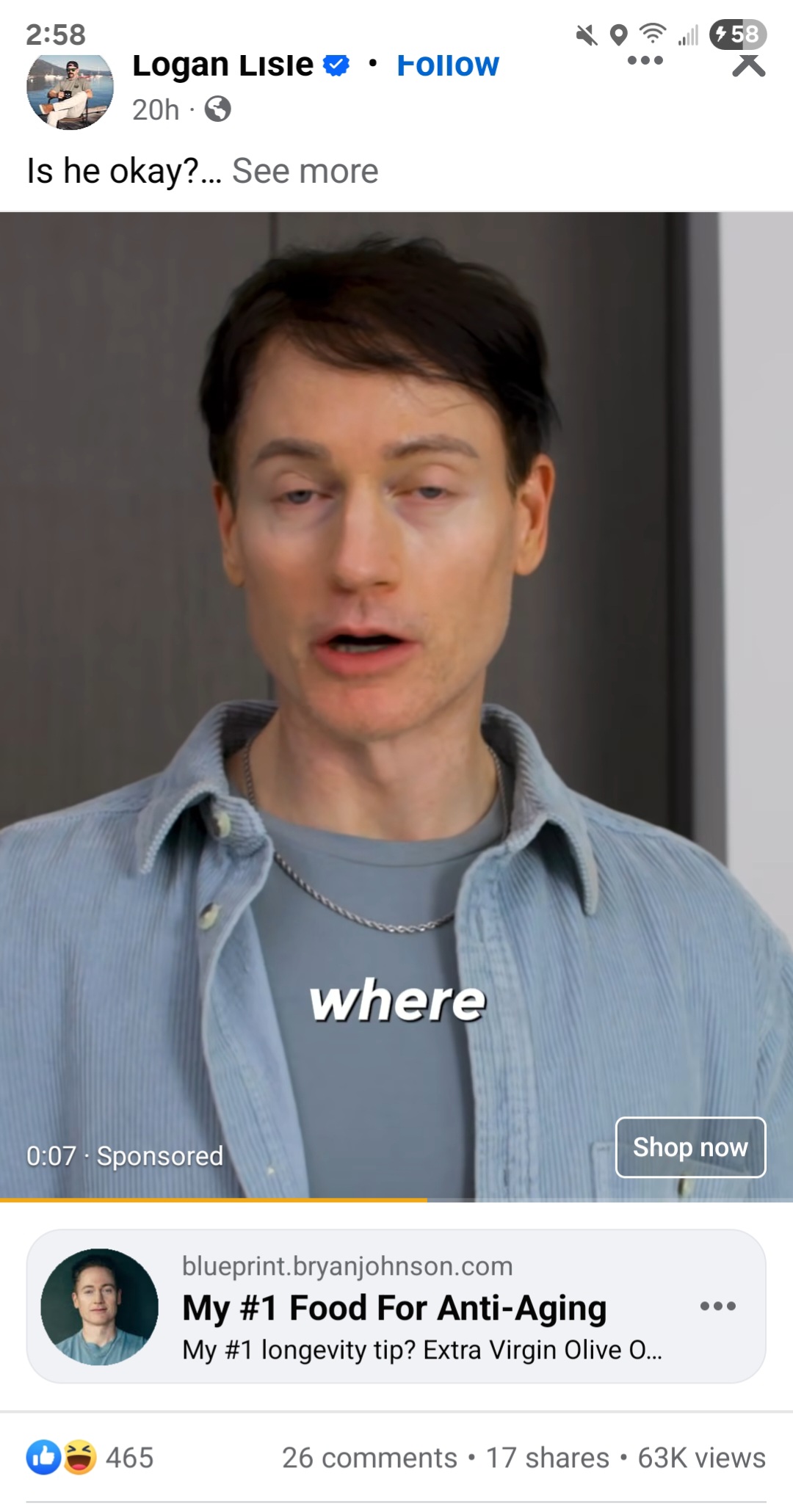
The content is actually good. Just that I find him so douchy so I have to keep reminding myself that it’s not a joke every minute. Also his skin is not looking good. He’s pastier than usual—maybe studio makeup? The face is starting to look more off than I recall. Perhaps the dentures are changing his bite.
I was never much of a young Tom Cruise fan, but I’ve grown to admire him for his longevity as an A list actor which has been the result of intense discipline. It’s fuzzy now, but I remember respecting him as a person after his most recent awards speech (maybe last year).
I choose to ignore his brief jumping on Oprah’s couch phase.

 The benefits of taking that offer are obvious for his image and credibility.