So it’s fancy microneedling?
1 Like
I was saying that I should try using adapalene only on my neck. Even after years of using tretinoin, the skin on my neck still seems sensitive in colder months. I sometimes get redness in the neck creases, so maybe adapalene would be gentler there. On my face, I have no issues at all even around my eyes and I use it daily on my eyelids too.
I’m not game enough to do eyelids but that is an area I want to work on. Dry eyes?
Yea go ahead and do the neck why not. If I ever have any left on my hands I put it on my neck.
I’d steer well clear of oral. So I take it you’ve. Given up on my miracle cleanser? 
No issues around my eyes at all. I did get some redness in the corners during the first couple of months, but now I barely notice that I’m even using tretinoin on my face.
May I ask why you’d steer clear? I’ve been steering clear too even though my Accutane prescription is filled and sitting in my drawer. Still rocking the oily skin life 
Haha, definitely not! It’s been a total game changer. My cleaning lady isn’t a fan, but my skin absolutely is. The grape seed oil + colloidal oat mix has made such a difference.
1 Like
Nice! So glad to hear it. I mean I had customers obsesssed with that product. Mainly stopped making it due to the messy process (felt like your cleaning lady) and sometimes it happened that I didn’t screw the lid of my bottles tight enough and the customers got a soupy mess in the mail  . Those were good times, circa 2017!
I’d steer clear of Accutane because it can cause birth defects. Now if I recall you’re gay with a husband, so not a “birthing person,” but if that’s what it does to women, it can’t be doing much good to men internally. It’s basically a super high dose of vitamin A — and super doses of vitamin A supplementation are inversely correlated with longevity. QED
1 Like
We are talking microdoses here though. I wonder how that would work?
I don’t think it would work at all. You might as well be taking a normal vit A supplement (retinyl palmitate) then. The way Accutane works is, as with everything, the dose making the poison as well as causing the desired effect. You need to take a lot of something orally for enough of its effect to be felt on the skin, the most peripheral part of the organism — its outer edge, if you will. Accutane is highly effective as a short term treatment to bring out of control acne under control. It’s not meant to be used the way some folks are considering to on this thread, but to each his own. I find it particularly useless when you can very safely use topical tretinoin.
GPT5:
1. Structural relationship between Vitamin A and Isotretinoin
- Vitamin A (retinol) is the parent compound. It has a β-ionone ring connected to a polyunsaturated side chain ending in an alcohol group.
- Isotretinoin (13-cis retinoic acid) is a synthetic derivative of Vitamin A. It is a retinoid, meaning it shares the retinoid backbone but differs in geometry: isotretinoin is the 13-cis isomer of all-trans retinoic acid (tretinoin).
- In other words, isotretinoin is not structurally identical to vitamin A, but they are in the same family. Isotretinoin is an oxidized and geometrically modified form of vitamin A.
So: same family, not the same molecule.
2. Microdosed isotretinoin as an anti-aging alternative
-
Topical tretinoin and adapalene are well-studied for skin aging. They act locally to:
- Increase collagen production
- Promote epidermal turnover
- Reduce fine wrinkles and hyperpigmentation
-
Oral isotretinoin, even at low doses, acts systemically. Evidence shows:
- It reduces sebaceous gland activity and oil production.
- It can improve photoaging in some small studies, but the data is limited compared to topical tretinoin.
- Side effects (even at “microdoses”) include dry skin, mucosal dryness, potential liver strain, lipid changes, and teratogenicity.
Pros
- Could improve skin texture and oiliness.
- May help with acne and potentially reduce some photoaging signs indirectly.
Cons
- Much less studied for anti-aging compared to topical retinoids.
- Risks of systemic side effects even at microdoses.
- Lack of long-term safety data when used chronically for purely cosmetic anti-aging.
Bottom line
- No, vitamin A and isotretinoin are not the same compound, but isotretinoin is a retinoid derivative of vitamin A.
- Microdosing isotretinoin is not considered a safe or evidence-based substitute for topical tretinoin or adapalene in anti-aging.
- If your goal is anti-aging skin effects, topical retinoids remain the gold standard. Oral isotretinoin is best reserved for specific medical indications like severe or resistant acne, not as a first-line anti-aging strategy.
Looks like I’ll skip isotretinoin then.
2 Likes
Yep:
“ * Side effects (even at “microdoses”) include dry skin, mucosal dryness, potential liver strain, lipid changes, and teratogenicity.”
Also when I said you might as well microdose Vit A (had retinyl palmitate in mind, actually), I meant it would be equally useless. Vit A is a much less potent version of tretinoin / Accutane, so depending on what you mean by “micro”, if the dose be small enough, it probably becomes equivalent to the systemic effect of plain Vit A, which we know to not be effective for skin purposes
I wasn’t suggesting you would want to supplement with Vit A, merely mentioned that as an illustration of how useless a micro enough dose to moot systemic problems would be. You’d need a ton of oral Vit A to come close to an equivalency with Accutane, and we should all know the dangers of hyper Vit A supplementation.
So you’re saying you put tretinoin on eye bag area under eye with no issue? Did it improve the skin age appearance?
Some people will get dry eyes from retinoids around the eyes. For me, retinoids mostly improved the skin texture, making it smoother and brighter. They can help reduce fine lines too. But deeper wrinkles, nothing topical is going to address that. I don’t think retinoids will help much with dark circles either, if that’s what you mean by “eye bags” haha
3 Likes
I’ve been using 0.1% tret on and around my eyelids with no problems other than occasional dryness and peeling. It works in firming up the eyelid skin, which in my case is the canary in the mine and the first bit of facial skin to want to show some crepeness. But not everyone is so tolerant of tret. To some people it can mess up with their eye glands so I’d tread very cautiously.
1 Like
I have been using it since my mid-thirties, and some 15 years later, my skin around the eyes is looking more or less unchanged.
But be cautious, the skin around the eyes is delicate, and I worked on being able to use it daily over a few months. And my facial skin is generally quite robust.
1 Like
It did make the skin around my eyes a bit inflamed and swollen. I would use a lower strength adapalene next time.
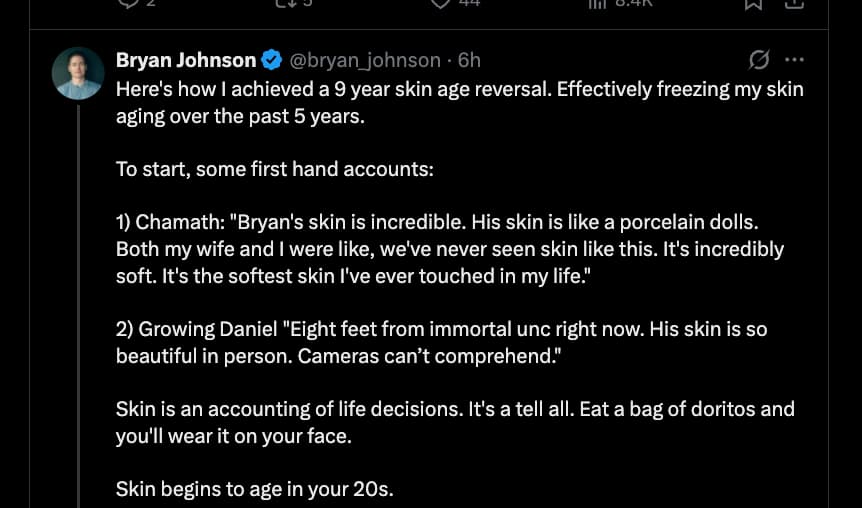
Source: https://x.com/bryan_johnson/status/2006093329717743722?s=20
Copy and paste of the text from his post:
Skin is an accounting of life decisions. It’s a tell all. Eat a bag of doritos and you’ll wear it on your face.
Skin begins to age in your 20s.
-
collagen and elastin decline: starting in our mid 20s, collagen content decreases by about 1% annually, reducing skin firmness and suppleness. Elastin, which provides stretchability and prevents wrinkling, also deteriorates over time.
-
loss of hydration: aging skin loses moisture due to changes in collagen, reduced hyaluronic acid content, and a 65% loss of fat content, leading to dryness, reduced thickness, and diminished suppleness.
-
environmental damage - chronic exposure to environmental factors, especially UV radiation and air pollutants, accelerates skin aging by breaking down collagen and inducing oxidative stress. This damage is largely avoidable through deliberate lifestyle planning.
-
cellular aging: fibroblasts, responsible for collagen and hyaluronic acid production, become less efficient, impairing skin repair and water retention. A drop in active melanocytes also causes the uneven pigmentation typical of elderly skin.
My protocol is comprehensive: nutrition, supplementation, environment, and therapies. Designed to protect the skin from cellular radiation damage, prevent environmental toxic exposures, prevent inflammation and oxidative damage, improve skin hydration, boost blood supply and circulation, enhance detoxification, and optimize the skin microbiome.
Daily Skin Routine
Get the basics right: cleanse, hydrate and keep inflammation and cellular damage at bay.
During the past five years of my project blueprint, I’ve experimented with dozens of serums. The companies making these products overpromise. Few are based upon evidence. Fewer do anything. We reviewed the scientific evidence and found the actives we wanted. But it didn’t exist. So we built it.
A blueprint cleanser, serum and moisturizer, featuring SCF, NMN, and hyaluronic acid as core active ingredients.
SCF is a novel skin anti-inflammatory and anti-aging compound, showing superior effects to niacinamide (the state-of-the-art in most creams). In cultured cells, it demonstrated superior properties to antioxidant vitamins in preventing inflammation linked to UV exposure and chemical or bacterial insults.
In a clinical trial, 1% SCF statistically outperformed 5% niacinamide at reducing skin wrinkles, improving texture, hydration, radiance, luminosity, and brightness, as well as improving the overall healthy appearance of the skin.
NMN (Nicotinamide Mononucleotide) is an NAD+ precursor. Systemic administration of NMN is known to prevent skin aging by improving skin barrier function and enhancing antioxidant and anti-inflammatory defenses against UV damage. Experiments with synthetic skin models also showed that NMN can penetrate the skin, indicating that topical applications can enhance the benefits.
Hyaluronic acid retains moisture, granting the skin extra firmness and an improved texture.
Diet and Supplementation
Oral collagen peptides, flavonols, polyphenols, and antioxidant supplementation help the skin resist photoaging and maintain its elasticity.
-
average collagen users: showed better skin elasticity than 97% of the control group.
-
average flavonoid users: showed better skin resistance to UV than 99% of the control group.
-
average polyphenol users (a mix of flavonols and other polyphenols): Showed better skin elasticity than 97% of the control group.
-
I supplement NR (Nicotinamide Riboside) and hyaluronic acid daily.
I get all of the above from Blueprint: collagen peptides, extra virgin olive oil, cocoa and supplementation as I know its sourcing, quality and it’s third party tested.
My diet, which focuses on plant protein, fiber, and polyphenols, is also geared toward eliminating inflammation, oxidative stress, and glycation. All sources of skin damage.
Photoaging and UV Precautions
- early mornings and later afternoons are better when the UV index is low
- when the UV index is high (10 am - 4 pm), protect your skin
- can protect with clothing, a UV umbrella, hat and/or mineral sunscreen
Skin focused therapies
-
1927 nm laser (1x every 6 months, can do more or less depending on your status and goals) - improves skin tone, texture, dyschromia, sun damage, and fine lines, while also reducing actinic keratoses and pigmentation through accelerated epidermal turnover and renewal.
-
1550-nm laser (1x every 6 months, can do more or less depending on your status and goals) - penetrates deeper into the mid-dermis, where it creates controlled microthermal injury that stimulates fibroblasts to produce new collagen and elastin, leading to improvements in skin firmness, wrinkles, acne scars, and overall structural integrity.
-
Sofwave (1x every 6 months, can do more or less depending on your status and goals): non-invasive ultrasound skin tightening system that delivers controlled energy into the mid-dermis to stimulate collagen and elastin production without damaging the skin’s surface. By activating fibroblasts through precise thermal stimulation, it improves skin firmness, laxity, and fine lines, especially on the face and neck, with minimal downtime.
Systemic therapies
-
red/nir light panels: I do a daily therapy using full body panels with 660nm and 850nm wavelengths. By boosting mitochondrial function, vasodilation, and blood circulation, this therapy offers both localized benefits for skin health (including boosting skin energy and vitality, improving antioxidant defenses, and reversing damage) and aids in muscle recovery from exercise, as well as boosting systemic health, including improving sleep, immunity, and metabolic regulation.
-
Hyperbaric Oxygen Therapy (HBOT): is perhaps the best skin rejuvenation therapy in the world. Data from 60 sessions, 90 minutes each. 20 min oxygen, 5 min off. 5x weekly, 12 weeks.
-
12.8% increase in collagen fiber density
-
144% increase in elastic fiber length
-
reduced fragmentation 90% to 10%
-
40.9% increase in skin blood vessel count
-
84.3% increase in CD31 blood vessel specific marker
-
21% reduction in senescent cells
-
dry sauna: sauna improves skin health by shifting blood flow towards the skin (up to 70%), promoting improved oxygen and nutrient supply, increasing sweating for pore cleansing and detoxification, and improving collagen and elastin production as a heat response.
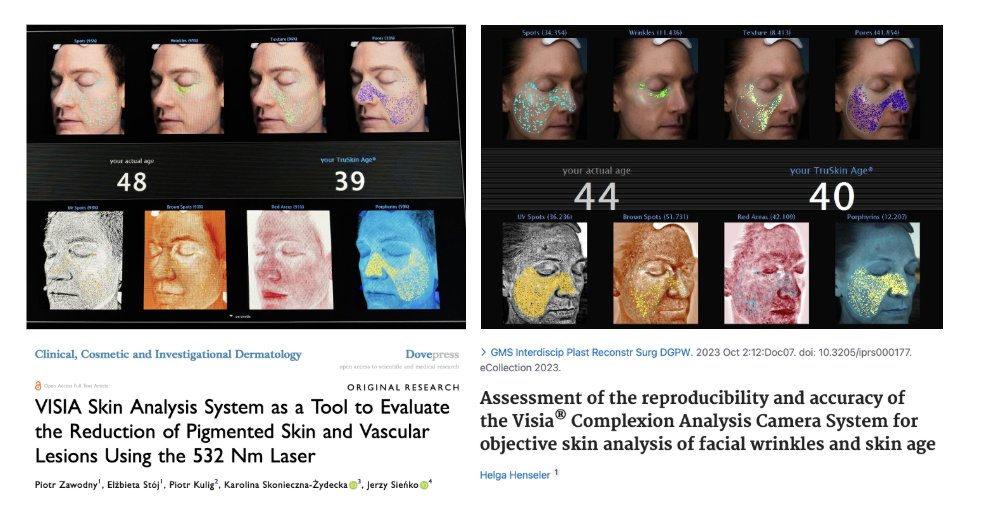
1 Like
I also get a lot of redness on the neck creases (and on the neck in general), seems my skin is very sensitive! Any idea what it could be?
Cold usually causes the creases to turn red for me. The skin in creases moves and is generally thinner than the rest of the skin. I simply make the interval between treatments and it seems to work. Twice or three times a week in winter is enough. In summer my skin appears more robust likely due to less dehydration from the cold and heating which makes it slightly plumper. Perhaps using moisturizer before tretinoin would achieve the same effect I’ll have to try it.
I’m going to choose my sacrifices for 2026 well, technically forever, hopefully.
I started using moisturizer on my skin and minoxidil in hair a few days ago. Body feels worse than ever as I deliberately stopped exercise as an experiment (what I remember) and have eaten junk. I miss the body feeling of 20 years old slightly.

2 Likes