easy answer - enjoy family enjoy sex enjoy biking and then there is the whole living in the future with robots and flying cars and travel to outer space that intrigues me
2 Likes



Simply a nice interview with Johnson and his GF by Rich Roll

1 Like
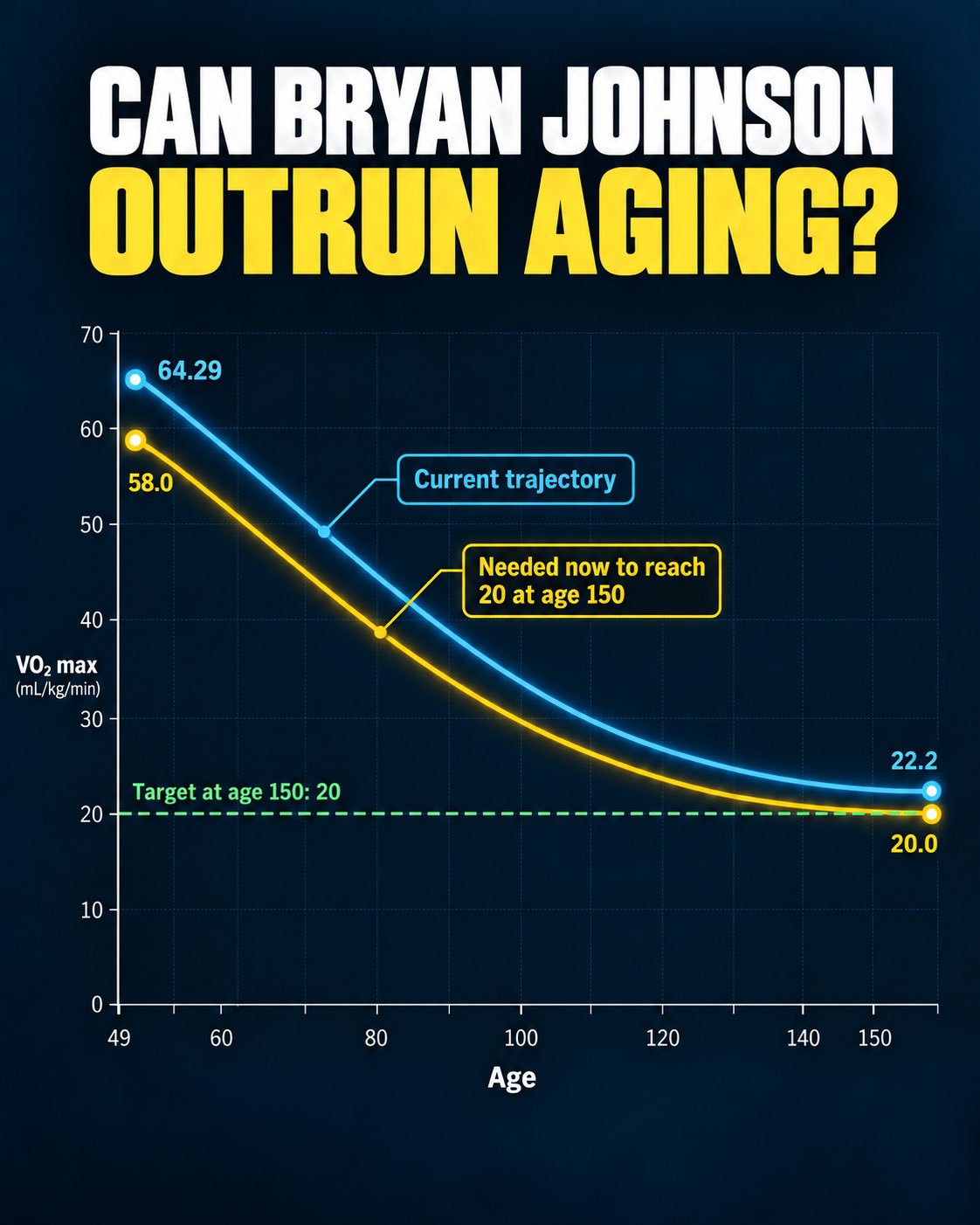
I doubt the use of VO2 max as a causative biomarker.
1 Like
They Built a Movement Around Not Dying. Both Now Have Incurable Diseases.
I. Executive Summary
This conversation between Rich Roll, Bryan Johnson, and Kate Tolo analyzes the intersection of human longevity protocols, high-dimensional physiological tracking, and systemic limitations within contemporary biomedical research. The core thesis asserts that conventional medicine operates on coarse diagnostic heuristics, generalized reference ranges, and population-level reductions that disproportionately fail female biology and complex chronic etiologies. Johnson and Tolo argue that dense, longitudinal N=1 biomarker quantification provides an empirical bridge to illuminate disease onset before clinical irreversibility occurs.
Tolo outlines her personal multi-tiered diagnostic cascade for endometriosis, adenomyosis, and PCOS, contrasting her 42-day multi-modal diagnosis (incorporating endometriosis-specific specialized transvaginal ultrasound, targeted MRI sequences, and investigational salivary/blood microRNA assays) against the standard 6- to 8-year clinical lag time. This serves as the foundation for a 100-day, $2.6-million female baseline tracking project analyzing 1,900 biomarkers across the menstrual cycle to quantify physiological volatility (e.g., intra-cycle lipid and metabolite fluctuations). Concurrently, Johnson discloses a diagnosis of chronic autoimmune gastritis secondary to long-standing autoimmune thyroiditis (Hashimoto’s-associated thyrogastric syndrome). Rather than accepting traditional palliative management, Johnson describes an interventionist pipeline comprising deep immune sequencing, 24 targeted gastric biopsies to develop patient-derived tissue organoids in vitro, and autologous induced pluripotent stem cell (iPSC) reprogramming via Yamaka factors for potential regenerative mucosal autotransplantation.
Beyond therapeutic mechanics, the discussion interrogates the epistemological and psychological substrates driving radical life-extension efforts. Johnson defends the “Don’t Die” framework not as sensory immortality or cultish transhumanism, but as an anti-entropic objective function prioritizing biological survival amid accelerating artificial superintelligence. The narrative evaluates the behavioral architecture required to maintain absolute metabolic fidelity, demonstrating that rigid algorithmic rule sets outperform fluid willpower in mitigating cognitive depletion and nocturnal circadian disruption.
II. Insight Bullets
- Thyrogastric Syndrome Linkage: Bryan Johnson revealed a diagnosis of asymptomatic autoimmune gastritis, which pathophysiologically stems from long-standing Hashimoto’s thyroiditis rather than his experimental longevity protocol; clinically, this co-occurrence is well-characterized in autoimmune polyglandular syndromes as documented by Fallahi et al., 2017.
- Targeted Endoscopic Tissue Mapping: To characterize his mucosal damage, Johnson underwent an upper endoscopy with 24 systematic gastric biopsies cryopreserved for international lab transfer to culture personalized patient-derived gastric organoids.
- Single-Cell Immune Profiling: Johnson sequenced approximately 1,000,000 peripheral immune cells to map specific autoreactive T-cell and B-cell clonotypes mediating mucosal degradation.
- Autologous iPSC Banking: Johnson harvested 150 mL of whole blood to reprogram somatic cells into induced pluripotent stem cells (iPSCs) via Yamanaka factor induction (Oct4, Sox2, Klf4, c−Myc), resetting their epigenetic clock to embryonic state while leaving somatic and mitochondrial DNA mutations intact.
- Regenerative Mucosal Goal: The theoretical therapeutic endgame of Johnson’s stem cell banking is autologous cell-replacement grafting to reconstruct gastric endothelial and mucosal architecture without allogeneic graft rejection.
- Female Biological Data Gap: Preclinical trials and translational medical literature have systematically underrepresented female biology due to cyclical endocrine fluctuations, leaving baseline biomarker volatility poorly characterized across cohorts.
- Quantified Menstrual Baseline Project: Kate Tolo initiated a $2.6-million, 100-day baseline testing protocol tracking 1,900 distinct biomarkers across consecutive menstrual cycles to map normative physiological waveforms.
- Menstrual Lipid Dynamics: Circulating total cholesterol and low-density lipoprotein (LDL-C) fluctuate by up to 19% across the menstrual cycle, declining significantly in the luteal phase relative to the follicular phase, a phenomenon confirmed in comprehensive systematic reviews by Mumford et al., 2011.
- Reference Range Misclassification: Standard clinical blood tests do not record menstrual cycle timing, leading to artifactual false-positive hypercholesterolemia diagnoses during peak follicular phases.
- Metabolomic Waveforms: Pilot academic assays cited by Tolo demonstrate that nearly 50% of approximately 400 serum metabolites systematically oscillate across the menstrual cycle without standard normative ranges established in diagnostic practice.
- Diagnostic Lag in Endometriosis: The average clinical delay from symptom onset to definitive diagnosis of endometriosis spans 6.5 to 8 years across standard healthcare systems due to normalization of dysmenorrhea and reliance on surgical staging.
- Multi-Modal Endometriosis Triangulation: Tolo collapsed her diagnostic timeline to 42 days by deploying an integrated diagnostic panel consisting of specialized endometriosis-protocol transvaginal ultrasound, deep-infiltrating endometriosis MRI protocol, salivary testing, and serum profiling.
- Operator Dependency in Pelvic Ultrasound: Standard pelvic ultrasounds frequently return false negatives for deep infiltrating endometriosis, requiring sonographers specifically certified in sliding-sign assessment and obliteration of the pouch of Douglas.
- Non-Invasive microRNA Panels: Emerging non-invasive assays utilize diagnostic profiles of circulating and salivary microRNAs; meta-analyses demonstrate aggregate sensitivities around 82% (Diagnostic value of MiRNAs in endometriosis, 2024), although broader multicenter validation is ongoing.
- Triple Pelvic Comorbidity: Alongside endometriosis, intensive multi-modal diagnostic screening identified co-occurring adenomyosis (uterine enlargement/myometrial invasion) and polycystic ovary syndrome (PCOS).
- Decentralized At-Home Diagnostic Rollout: Through the Blueprint platform, Johnson and Tolo are building distributed diagnostic protocols to allow women at-home access to specialized biomarker and blood screening for pelvic pathologies.
- Ovulatory Chronobiology Variability: While standard clinical doctrine models ovulation on day 14 of an idealized 28-day cycle, empirical daily tracking reveals broad intra- and inter-individual variance, with mean ovulation frequently occurring around day 17 or later.
- Dense Daily Somatosensory Tracking: Tolo’s daily testing protocol entails waking at 06:30 AM to complete saliva collection, targeted light therapy, heart rate variability (HRV) analysis, 10-minute indirect calorimetry via canopy mask for resting metabolic rate, blood pressure, facial skin microbiome swab, grip strength, and psychomotor reaction testing.
- Point-of-Care Functional Neuroimaging: Tolo utilizes portable time-domain functional near-infrared spectroscopy (fNIRS) neuroimaging hardware developed by Kernel to quantify cortical hemodynamics and brain state across cyclic hormone variations.
- Resting Heart Rate as a Metabolic Audit: Johnson posits that pre-bedtime resting heart rate (RHR) acts as an integrated composite marker reflecting gastrointestinal thermogenesis, autonomic tone, late-day caloric load, and psychological stress.
- Temporal Caloric Restriction Window: The core Blueprint sleep hygiene rule dictates a hard cessation of caloric intake four hours prior to sleep onset to prevent nocturnal gastrointestinal motility and blunt nocturnal core body temperature elevation.
- Nocturnal Autonomic Attenuation: Late-evening food consumption within three hours of bedtime correlates with sleep fragmentation, sympathetic arousal, and attenuated nocturnal heart rate dipping as demonstrated in chronobiological cohort studies (Crispim et al., 2020).
- Light Hygiene Architecture: Blueprint protocols mandate screens off 30 minutes before sleep, elimination of high-energy visible blue/white wavelengths, and shifting environmental exposure strictly to narrow-spectrum amber or red wavelengths post-sunset.
- Caffeine Clearance Threshold: Strict adherence to a 12:00 PM caffeine cutoff ensures adequate metabolic clearance across typical 5- to 7-hour CYP1A2 hepatic half-lives, protecting slow-wave sleep architecture.
- Pre-Bed Cognitive Decoupling: Structuring the final 30–60 minutes of the evening around non-screen analog tasks (e.g., physical reading) functionally emulates sedative-hypnotic sleep latency reduction without pharmaceutical dependency.
- Algorithmic Partitioning of Willpower: Johnson manages compulsive nocturnal eating by assigning structural decision-making authority entirely to a cognitively fresh morning persona, explicitly barring late-evening executive intervention from overriding established rules.
- Sleep Phenotyping via Machine Learning: Tolo highlights validation efforts by Eight Sleep training neural networks on multi-night ballistocardiography, temperature, and respiration data to predict chronological age within an approximate 3.5-year mean absolute error.
- Biological Age Metric Hierarchy: High-dimensional structural imaging—such as cerebral volumetric analysis via magnetic resonance imaging (MRI)—offers superior signal stability for biological age estimation relative to consumer-grade wearable photoplethysmography (PPG).
- Quantified Psychedelic Longevity Modeling: Johnson performed dense biometric tracking during controlled administration of high-dose psilocybin and 27 mg of 5-MeO-DMT, aiming to characterize the neuroplastic and longevity-associated signaling correlates of psychedelic compounds.
- Anti-Entropic Organizational Theory: Johnson and Tolo transitioned away from physical “Don’t Die” regional summits to algorithmic and broadcast social architectures, modeling ideological propagation on durable, anti-entropic cultural structures (e.g., historical organized religions) capable of enduring through the onset of artificial superintelligence.
Produced by Gemini 2.5 Pro
Bryan’s workout routine (by email today):
Here is the good news: 11 min of daily exercise is linked to a 23% lower risk of early death.
A small, daily exercise habit will produce meaningful health benefits.
If you’re in a chapter of life where exercising is hard, I get it.
I remember when I had 3 children below the age of 7, was sleep deprived, and was building a startup. Finding even 10 min of uninterrupted time felt impossible and when that opening arrived, all I wanted to do was sleep.
In this email:
-
- ground rules
- what I do
- sample 7-day routine
- pre- and post-workout nutrition

Gym bro Bryan (making fun of myself in this video)
Ground rules:
No single exercise is best. A mix is best.
Each week, focus on 4 big categories:
-
- Strength training
- Low-intensity cardio (zone 2 heart rate)
- High-intensity cardio (zone 4 or 5)
- Mobility, flexibility, and balance
Some rules to follow:
-
- overall, aim for consistency: It’s more important that you make exercise a habit than go all out once a month. Even 10 minutes a day is a big win. + aim for 2-3 strength training sessions a week: Focus on compound movements, such as squats, deadlifts, and lunges, to work a variety of muscles. If three is too much, even fitting in one makes you a star. + progressive overload is key: Gradually increase the difficulty of strength training over time, increasing the weight you lift or the number of reps you do. Being consistent is also going to get you a long way. + HIIT is the best ROI for your time: 4-6 reps of 30-second all-out efforts with rest in between, 3 times a week, can match the cardiovascular gains of 5 weekly sessions of 40-60 min of steady cardio. Cardiorespiratory fitness is one of the strongest predictors of how long you live. If time is tight, intervals are the best trade you can make. + avoid high-intensity exercise 4 hours before bed: Research shows it can reduce sleep quality and recovery. + just do it: Don’t get caught up in all the nuances and rabbit holes of exercise. Being active, in whatever ways you can, pays big dividends for your health.

What I do
Every day, I do a mixture of strength, cardio, balance, and flexibility.
I aim for:
-
- at least 150 min of zone 2 cardio a week
- at least 75 min of high-intensity cardio a week (~10 min of that is near-max effort)
- mobility, flexibility, and balance training every day
Sample weekly workout routine
You could do some strength training and cardio every day. Or spread it out throughout the week. Do what works for you.
This gives you an idea of what a week of workouts can look like…
Monday: Strength training and moderate cardio
An example workout.
Duration: ~60 min
The workout:
5 min general warm-up: cycling, walking, etc.
5 min dynamic warm-up: arm circles, leg swings, high knees, lateral lunges, etc.
20 min strength training:
-
- squats (weights held at either side or near chest for goblet stance) 3x10-15 + push-ups (standard if possible or on knees/wall) 3x8-12 + single-arm dumbbell rows 3x10-12 + kettlebell swings and/or farmer’s walks 3x30 seconds + planks 3x20-30 seconds
5-10 min stability work: single-leg balance, bird dog, single-leg RDL, single-leg toe touch, plank with shoulder taps, dead bugs
25 min moderate-intensity cardio: brisk walking, jogging, cycling, swimming, elliptical, etc.
Tuesday: High-intensity interval training (HIIT) and moderate cardio
Duration: ~10-15 min
The workout:
8 rounds:
-
- 20 seconds all-out effort
- 20 seconds rest or very low intensity (40 seconds rest if you’re a beginner)
- do this running, cycling, or with bodyweight exercises
- total time ~5 min
- use the remaining time for moderate-intensity cardio
During moderate-intensity cardio, aim to keep your heart rate between 60-70% of your max, a level where you can maintain a conversation but still feel like you’re exerting yourself. ── Wednesday: Strength, flexibility, balance, and mobility training
Duration: 60 min
The workout:
-
- 10 min dynamic stretching: arm circles, wall slides, thread the needle, hip rotations, etc. + 30 min strength training: focus on compound movements targeting areas that are not sore from Monday + 15 min yoga poses: focus on balance and flexibility with cat-cow stretch, cobbler’s pose, tree pose, cobra pose, etc. + 5 min static stretching: cooldown
── Thursday: HIIT - Norwegian 4x4
Duration: ~40 min
The workout:
10 min warm-up: easy jog, cycle, or row, building to a light sweat
4 rounds of:
-
- 4 min hard: push to about 85-95% of your max heart rate (zone 4-5). By the last minute you should be breathing hard and unable to hold a conversation. + 3 min easy: slow to a walk or light spin at zone 2, and let your heart rate settle before the next round.
5 min cooldown: easy pace, then a few static stretches
Do it on anything that raises your heart rate and is kind to your joints: cycling, rowing, incline treadmill walking, or a stair climber.
A few pointers:
-
- the hard 4 min should feel uncomfortable but controlled, not an all-out sprint. Pace it so your fourth interval is as strong as your first. + if four rounds is too much at first, start with two or three and build up. + keep this session at least 4 hours before bed so it doesn’t cut into your sleep.
── Friday: Strength training
Duration: 45-60 min
The workout:
-
- 5 min general warm-up
- 5 min dynamic warm-up
Strength training:
-
- lunges (with dumbbells or bodyweight) 3x10 + overhead press 3x10 + dumbbell chest press 3x10 + side plank hold 20-30 seconds each side + step-ups 3x10 each leg
End with 5-10 min of stability work. ── Saturday: Play with friends
Hiking, biking, swimming, pickleball (be careful), basketball…
Sunday: Active recovery
Duration: 35-50 min
The workout:
-
- 20-30 min gentle yoga or stretching with additional mobility work
- 15-20 min of mindfulness meditation
Nutrition tips
Food is fuel. Use it to power your workouts and recover properly.
Tips:
-
- before: Eat 1-2 hours before exercise. Go for complex carbs and some protein.
- after: Eat complex carbs and protein to refuel and repair muscles. Ideally within 1 hour.
This is what I do:
Pre workout, I have an 8-oz drink with:
I eat Longevity Protein with:
Then I exercise.
Post workout, I eat a meal with veggies, legumes, extra virgin olive oil, berries, nuts, and seeds.
1 Like