Bryan Johnson Longevity Protocol Discussion (2024 / 25 /26)

I found this interesting, how BJ has reduced his supplement count over the past year:

Influencers and other public figures are driving the frenzy. “I do 150 supplements a day, and I have for 20 years,” biohacker Dave Asprey said on a podcast last year. Bryan Johnson, the tech entrepreneur and longevity enthusiast, said in a 2023 YouTube video that he took 111 supplements daily. “A lot of people are pretty confused that I can take this many supplements in a given day,” he said in the video, posted the year before his company Blueprint commercialized multi-nutrient products. (He said in an email that he now takes fewer than 30.) Health Secretary Robert F. Kennedy Jr., who has vowed to “end the war on vitamins,” has said in interviews that he takes “a ton” of them.

From this article on the Wall Street Journal website: Supplement ‘Stacks’ Are a Wellness Status Symbol. Are They Safe?

Just FYI, these 1st generation antihistamines (anticholinergics) are pretty strongly associated with dementias.

797 patients, 7.3 year follow-up

For dementia, adjusted hazard ratios (HRs) went up to 1.54 (95% CI, 1.21-1.96) for the highest use compared to non-use. A similar pattern of results was noted for Alzheimer’s disease.

There was a follow-up study finding the same thing:

https://jamanetwork.com/journals/jamainternalmedicine/fullarticle/2736353

The adjusted OR for dementia increased from 1.06 (95% CI, 1.03-1.09) in the lowest overall anticholinergic exposure category (total exposure of 1-90 TSDDs) to 1.49 (95% CI, 1.44-1.54) in the highest category (>1095 TSDDs),

So yes, they can absolutely help knock you out for a long night in bed, but it’s not something I’d like to rely on.

For sleep, Peter Attia had a phenomenal podcast with a sleep expert and cognitive behavioural therapy practitioner. That seems to be the way to fix pretty much all sleep issues which aren’t physical (apneas etc).

4 Likes

@relaxedmeatball I’m glad you brought this up because it had me look up Astepro.
There was a thread several months ago talking about the study that showed it greatly reduces the chance of getting covid… I’ve been using it a 2-3 times per week.

Do we feel Perplexity is correct when it says ‘negligible’?
I get it’s a good trade off if you have a stuffy nose.

Perplexity said:
Astepro nasal spray is a brand of azelastine (0.1% or 0.15% strength), so it falls into the exact same low-anticholinergic category as generic azelastine—ACB score of 1 (mild/possible), not strong or zero, but negligible for cumulative burden concerns.

Thank you for pointing that out, and I stopped taking it after about a week or so. It started having a very weird effect and started to swell my face, hand and feet. Horrible. Stopped it to never touch it again.

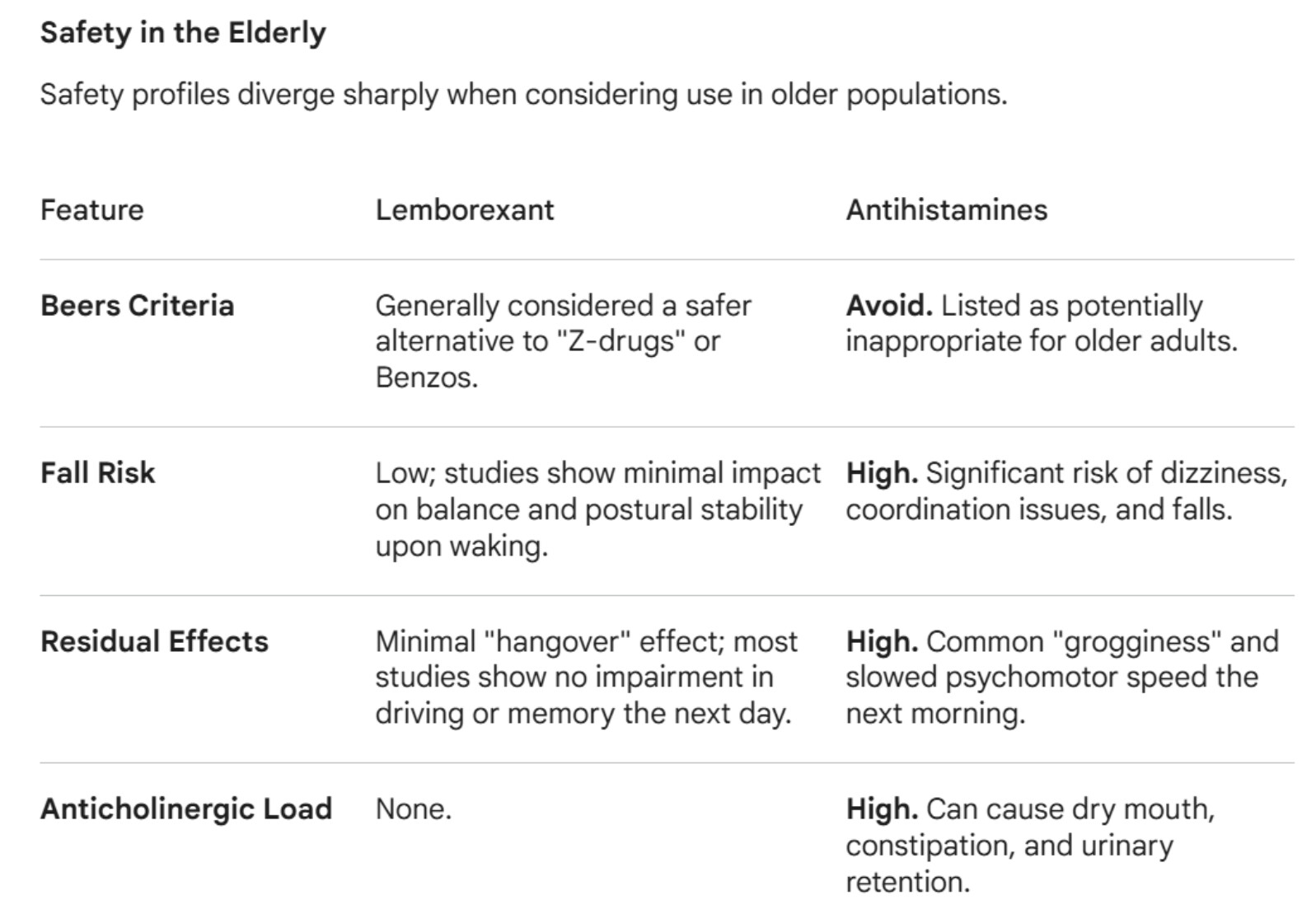
IMO: Forget the antihistamines and CBT. Just get some lemborexant. Lemborexant is no more likely to damage your brain than CBT. It is usually not hard to get a doctor to prescribe it; if not, use our usual India sources. The price is about $180 for 280 Lemborexant 5 mg tablets (10 boxes). So about $231 a year from India.

Gemini said

When comparing lemborexant (a Dual Orexin Receptor Antagonist or DORA) to antihistamines (such as diphenhydramine or doxylamine) for sleep, the differences in mechanism, efficacy, and long-term safety—particularly for older adults—are significant.


Mechanism and Efficacy

  • Lemborexant (e.g., Dayvigo): This medication works by blocking the orexin system, which is the brain’s “wakefulness” switch. Rather than forcing the brain into sedation, it dampens the signals that keep you awake.
    • Sleep Onset: Clinical trials (such as SUNRISE 1 and 2) show it significantly reduces the time it takes to fall asleep.
    • Sleep Maintenance: It is specifically effective at reducing WASO (Wake After Sleep Onset), meaning it helps you stay asleep and get back to sleep faster if you do wake up.

I want to start another ad nauseam battle about CBT. I think it is mostly BS; it is also very time-consuming and expensive compared to drug interventions. Older people almost always have sleep problems. We are not going to send them to CBT. If you are young and have sleep problems, you probably need a doctor’s diagnosis. My main objection is the cost and time involved. I don’t dismiss the fact that CBT may work for some people.

Lemborexant response rate: ~60–70%, works essentially as long as you take it”

CBT-I remission rate: ~36–54% depending on population, with effects that can persist long-term but require active maintenance of behavioral habits. For someone who won’t or can’t sustain the behavioral changes — and the dropout and adherence data suggest that’s a substantial proportion — the remission rates look considerably less impressive in practice than in controlled trials."

“Several meta-analyses have found that when CBT is compared not just to no-treatment controls, but to credible placebo therapies (e.g., supportive listening structured to look like a real treatment), the advantage for CBT narrows considerably — particularly for depression and some anxiety disorders. The specific techniques appear to matter more for some conditions”

CBT explicitly works through belief change — identifying and restructuring maladaptive cognitions. A person who is more absorptive and suggestion-responsive might:

  • More readily internalize the therapist’s reframing of their thoughts
  • More fully commit to the behavioral experiments
  • Experience stronger expectancy effects from the treatment rationale

Responsive people are placebo-prone; they may also extract more from any meaning-rich, expectancy-generating intervention, including psychotherapy.

Psychotherapy history is essentially a graveyard of formerly confident treatments. A partial list of past darlings:

  • Psychoanalysis — dominant for decades, enormously influential culturally, now largely abandoned as a primary treatment in evidence-based settings
  • Primal scream therapy — briefly seized serious attention in the 1970s
  • Recovered memory therapy — caused genuine harm before being largely discredited
  • EMDR — still used, but whether the eye movement component does anything beyond exposure remains contested
  • Rebirthing therapy — resulted in actual deaths
  • Power therapies of the 1990s (Thought Field Therapy, etc.) — came with grandiose claims that evaporated under scrutiny"

The pharmaceutical route offered something psychoanalysis conspicuously lacked: measurable, replicable, relatively rapid results. When the evidence base for analysis was being publicly questioned at exactly the moment that drugs were demonstrably working for schizophrenia and severe depression, the institutional and economic momentum shifted decisively toward biological psychiatry. That shift has never fully reversed.”

Yes, **I believe in DuPont’s “Better Things for Better Living… Through Chemistry.” ** :smile:

1 Like

No — Astepro is not in the same anticholinergic class.
Astepro contains azelastine. It’s a second-generation antihistamine (H1 blocker) used as a nasal spray. It does NOT carry the same anticholinergic burden (per chatbot).

1 Like

Galantamine is an antagonist to anticholinergic medications. Another reason to take it. :slight_smile:

I am not an expert in this at all. The lady on the Attia podcast made it sound pretty simple, reckoned that ~90% of people could be fixed in a couple of months with some behavioural changes. You could be right though about long-term remission and people slipping back to old ways.

I have used a couple of the “tricks” suggested. Like when I’m really busy at work, or stressed, I run things in my mind and can’t sleep. I did find that writing things down, for example, kind of “released” them out of my brain so they’d stop bouncing around in there.

I generally don’t like any sort of “woo-woo” approaches to medicine, but sleep seems so complex, so poorly understood, and we certainly have drugs that can knock you out, or quiet your brain, but I am not really sure they help you “sleep”, if that makes sense.

3 Likes

CBT-I is evidence-based (and worked very well for me with long-term benefits). It doesn’t cost much and is worth a try, (as much as the dozens of unproven low-quality “sleep supplements”, trial and error is the way to go in this community anyway!).

2 Likes

My sleep physician at Mayo Clinic pointed me at this. This is a publicly accessible CBT-I modules/course that one can follow self-paced. (disclaimer: I have no idea how this compares to traditional/practitioner led CBT-I, but I have found it helpful):

https://mccmscontent.mayo.edu/PatientEducation/PatientLearning/index.html#/

p.s. it is one module out of a series that Mayo published here https://mentalhealthandwellbeing.mayo.edu/interactive-skill-building-modules/

3 Likes

In the UK I used that one: https://www.sleepstation.org.uk/

1 Like

Good article/manifesto by Bryan Johnson: https://immortalism.bryanjohnson.com/, “The Immortalism Manifesto”. I think longer-form writing feels like it’s updating my neural weights more than posts, videos, podcasts, or slogans. These are genuinely good ideas and the historical framing was interesting.

What do people think?

Aging Guru Bryan Johnson’s Supplement List for 2026

1 Like

Interesting to note that he’s using Nordihydroguaiaretic acid (NDGA) as a supplement. I thought this was banned as a supplement many years ago due to renal toxicity and hepatotoxicity, and I looked into it for a while, but then thought it wasn’t worth the risk. But obviously Bryan and his medical team think it’s OK at that dose, so perhaps we should look at it more closely…

NDGA was successful in the ITP program: Nordihydroguaiaretic acid and aspirin increase lifespan of genetically heterogeneous male mice - PubMed

NDGA-Cognitive-Vitality-For-Researchers.pdf (331.1 KB)

1 Like

I wonder where Bryan gets his NDGA… it doesn’t seem like there are any supplement makers offering 50mg pills, as Bryan seems to be taking…

Procurement Report: Standardized NDGA Capsules

A real-time market analysis confirms that zero products matching your exact constraints are currently manufactured or available for shipping in the USA. It is not possible to provide a 10-item procurement list.

Constraint Failure Analysis

  • Product Status & Standardization: Dietary supplements standardized specifically for Nordihydroguaiaretic acid (NDGA) content in capsule form do not exist on the legitimate commercial market.
  • Root Cause: NDGA, the primary lignan extracted from the creosote bush (Larrea tridentata or chaparral), is a potent hepatotoxin. Following numerous documented cases of severe acute liver failure and nephrotoxicity, the United States Food and Drug Administration (FDA) issued warnings against the internal consumption of chaparral and NDGA. Consequently, commercial supplement manufacturers ceased the production of standardized NDGA capsules for human consumption.
  • Available Alternatives (Non-Compliant):
    1. Whole Herb Chaparral Capsules: Products such as Arizona Natural Chaparral (500mg leaf) are available, but these utilize raw leaf powder rather than standardized extracts. The exact NDGA yield per capsule is unquantified, making dosage calculations impossible.
    2. Research Chemicals: Pure NDGA is available from chemical supply vendors exclusively as a laboratory reagent in powder form, strictly labeled “Not for Human Consumption.” These are not encapsulated.

If they’re using NDGA, I truly wonder how credible they can be due to the risks with NDGA. Rapamycin is dangerous but NDGA is not?

1 Like

It might be a laboratory-produced research reagent, which is easy to obtain. If it’s a custom formulation not for public sale, it’s not illegal. Does he have any conclusions regarding the effectiveness of Nordihydroguaiaretic acid?

thank you for contacting Arizona Natural.

NDGA content in chaparral leaf can vary between 6% to 10% by dry weight, which roughly translates to about 30–50 mg per 500 mg capsule, but actual content can vary by harvest.

We take great care to source our Chaparral from the best regions to help ensure potency and bioavailability.

You can view the product on our site here: Chaparral (Larrea tridentata) – Arizona Natural

1 Like

Did Bryan actually publish his list somewhere? I am only asking because, for example, if he’s only taking NR 6 days a week, that means he’s advertising he’s not taking his own product (the daily contains NR)… that just seems odd to me

it’s entirely possible I missed something here!

He should pay ME $1,000,000 to fix his face. It’s giving me the jeepers and what he’s doing skin wise is clearly wrong.

1 Like