HELLLLLLLLLL NO!
You would take this, rapa, and LDN out of my cold dead hands!! Everything else is up for grabs!
HELLLLLLLLLL NO!
You would take this, rapa, and LDN out of my cold dead hands!! Everything else is up for grabs!
I don’t rely on SuppCo for recommendations. I usually check with consumerlab.com for their supplement recommendations.
I also am put off by Dr. Hyman. I think he’s a bit of a snake oil salesman. However, I find the app useful and doubt he had much to do with its design or programming.
You’ve got to try one more and guaranteed you’d put it on top of that list, 1.25mg (or 1/4th) of Selegiline. Try it and you’ll see. I had same reaction as you when I tried LDN but Selegiline is exactly like LDN but multiplied by a factor of 10 LOL. I still take LDN and still like it, but Selegiline is by far my favorite now.
I know there’s some chatter about it being a MAO-b inhibitor and how you should be careful not to eat certain foods, but from all the research I’ve done in small doses that I’m taking it (1.25mg) one needs NOT to worry about those things.
“Low-dose Selegiline, also known as Deprenyl, has been shown to prolong lifespan in animal studies. Dr. Joseph Knoll’s pioneering research demonstrated that Deprenyl treatment increased the average lifespan by 34% in rats.”
Selegiline, a selective MAO-B inhibitor, has a unique neurological focus that sets it apart from other life-extension drugs like rapamycin, metformin, and NAD+ boosters. While these compounds target various aspects of aging, Selegiline specifically promotes neuronal health and resilience, making it an attractive option for those looking to support brain health.
Selegiline’s anti-aging effects may be enhanced when combined with metabolic or antioxidant compounds. Its MAO-B inhibition promotes neuronal protection and plasticity, offering potential synergies with compounds like metformin, rapamycin, or NAD+ boosters. This makes Selegiline a promising option for reversing age-related cognitive decline and promoting healthy brain aging.
I hope not. It seems that LDN is favored by many, but it had no effect on my sleep at any dose that I have tried. What it did do for me was ruin the taste of many things.
"The difference in how people respond to Low-Dose Naltrexone (LDN) is often due to its highly individualized nature, where “one size does not fit all”.
“While some find it transformative for sleep, others see no change because of biological variations and dosing complexities.”
LDN affecting the taste of things is unusual, but it is known to affect appetite. That is something I don’t need. I am surprised more people aren’t trying it for weight loss.
In any case, I will order and give 5 mg selegiline a try for: “This makes selegiline a promising option for reversing age-related cognitive decline and promoting healthy brain aging benefits.” Still another drug to try in my ever-increasing longevity stack.
In the case of selegine, I will base its benefits on a purely subjective measure. If I don’t feel any cognitive effects or it has any unwanted side effects, I will quit taking it.
**: A New Addition to Your GLP-1 Journey: Low-Dose Naltrexone for Weight Loss
LDN had zero effect on my sleep also. I was referring to an overall calming effect that one gets from LDN and Selegiline does same but wayyyyy better. I don’t know if you’ve tried Selegiline yet, or if you even have a sleeping issue but for me it seems to be the one and only one to fix my sleeping problems, which is to say to help me stay asleep for a good eight hours. I still woke up in the middle of night (last couple nights), but had no problem getting back to sleep., I know it is the Selegiline making the difference because everything else is the same and the only new thing I added was Selegiline.
The way I feel on Selegiline it is kind of hard to describe but it is something like the calmness before a storm, but the storm never comes LOL. I know I’ll have a great night of sleep again tonight because I feel exactly (good) as I was felling yesterday this time of day and last night had an amazing night of sleep. I would have literally paid $50K (even more but I’m not rich lol) to find a cure for my sleeping issue and it seems I found it via a 15-cent pill LOL. I still want to give it about 10 days before I celebrate, and I put this matter to rest for good.
BTW, I must thank you because it was about a year or so ago that you’d suggested it to me (thus the reason I had bought it) and I don’t even know if you’d tried it yet but remember you suggesting it as a good candidate to try (among few other things) and even though I bought it then I never tried it. I’m always reluctant to try drugs that have neurological effects until I find nothing else that helps.
[The significance of selegiline/(-)-deprenyl after 50 years in research and therapy (1965-2015) -
Have you noticed any significant cognitive effects other than its calming benefits?
You seem to have an atypical reaction to selegaline. Because it is more often reported to produce insomnia than improve sleep.
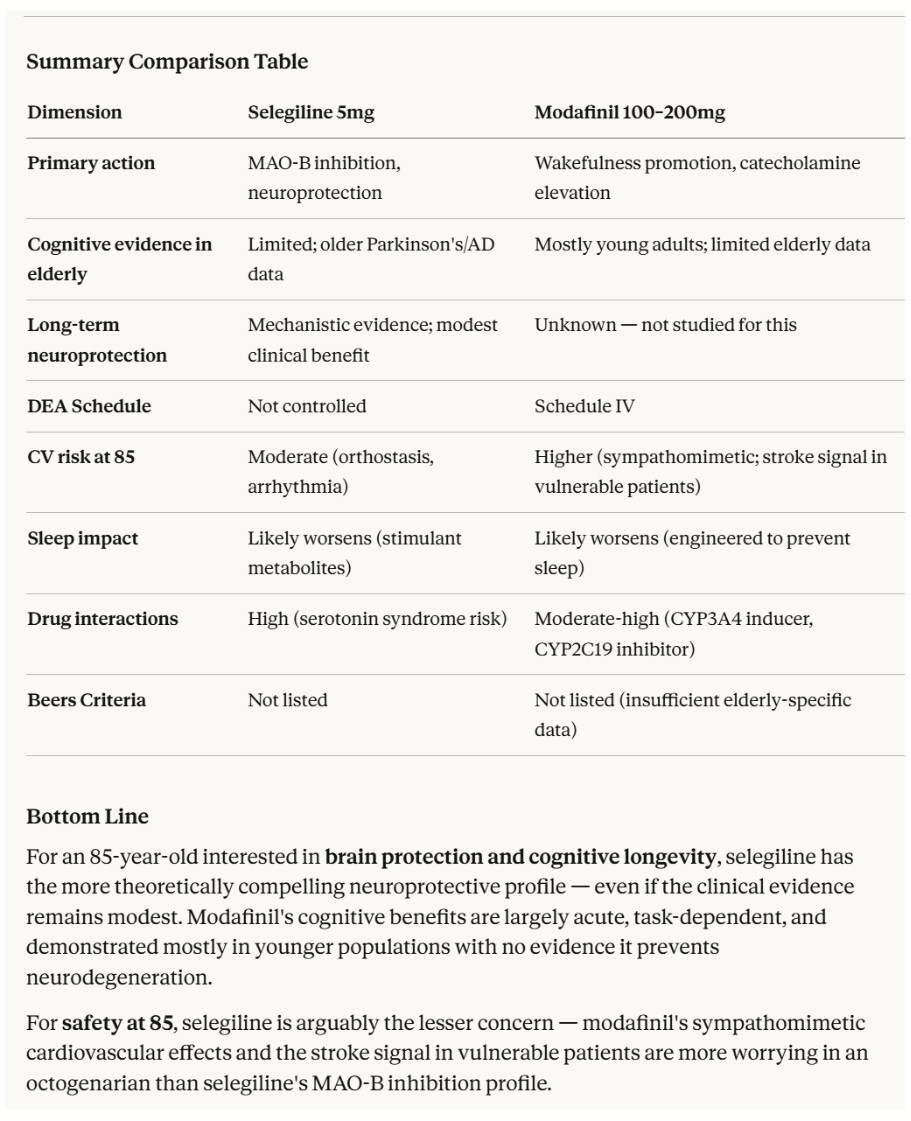
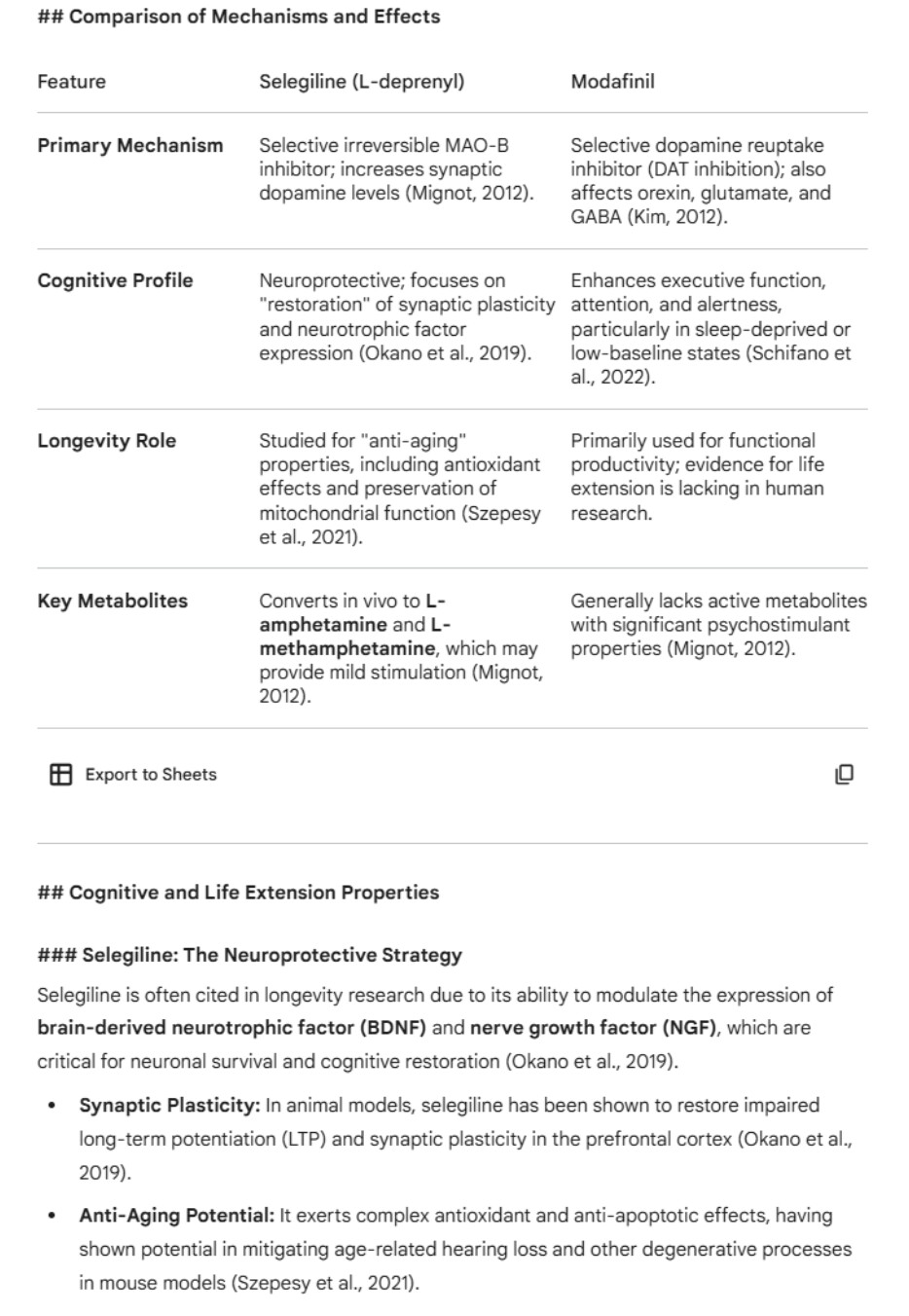
Two comparison tables from AIs, Gemini and Claude?
Claude:
Gemini:
Very good point and to be honest I took it to fight the midafternoon sluggishness I was having (mostly lack of sleep, I think) while I was waiting for my order of modafinil to be shipped/delivered and wasn’t expecting to get help with my sleep (I had also read the opposite to be true for some people) but as luck would have it, first day I took it I had my first 8:5h of uninterrupted sleep (in a long time) then same the next and the next. So, to me the help with sleep seems like a side effect LOL but a good one.
The other positive I notice is that it has helped me with inflammation quite a bit also, plus I used to have tense muscles mainly upper shoulder in my back and neck, and they are totally relaxed now.
Hard to explain other than I absolutely love the feeling. It is almost same as marijuana (indica type the one that sedates you) but without the nasty side effects, i.e. grogginess after the fact, the headache etc…
I tend to think that for some people it may not have any significant effect but from what I remember from a while back I think it would be a great addition for @Beth and @CronosTempi and some other people that are highly alert at night, sort of the types that are ADD or almost so.
But definitely worth trying.
You are exactly the type of person that motivated me to start this topic matter. Taking 3 diabetic meds when you don’t have diabetes, and nobody is monitoring this. There is no significant evidence that Metformin is of any benefit to a non diabetic. And yes, it is a mitochondrial poison.
It’s hard for me to find evidence for any of the prescription medications you take. I’m not sure whether to call LDN a prescription medication because of the dose. Hopefully you don’t get any serious side effects.
Thanks for the response and so far, so good, no side effects that I can tell and I’m monitoring blood markers carefully twice per year. My FG moved from high normal 98-104 to 81-84 as result of three diabetes meds I take. I’d prefer it in low to mid 70’s.
Interesting you say that because everything I’ve read about it says the opposite that metformin is good for mitochondrial function, maybe a little bit of poison here and there doesn’t hurt LOL
“The gold standard for the treatment of type 2 diabetes is metformin, which has a beneficial impact on the mitochondrial metabolism”
Metformin, primarily used for managing type 2 diabetes, shows promise as a life extension drug due to its ability to activate cellular pathways that may inhibit aging and promote longevity.
Metformin works by activating AMP-activated protein kinase (AMPK), an enzyme that plays a crucial role in cellular energy homeostasis. This activation has several beneficial effects, including:
Improved Insulin Sensitivity : By enhancing the body’s response to insulin, metformin helps regulate blood sugar levels, which is particularly important for individuals with diabetes.
2 Sources
4 Sources
Conclusion
While metformin shows significant potential as a life extension drug, further research is needed to fully understand its effects on human longevity. The ongoing studies, particularly the TAME trial, will provide more definitive answers regarding its role in promoting healthy aging
Karl - just a minor quibble but your post was about supplements and now you are complaining about meds.
What potential thing do you think that taking metformin by a non-diabetic would do?
Metformin is an okay weight loss drug and cheap as dirt. It has also been used millions of times with almost no serious side effects. Sure lactic acidosis but we stopped being overly cautious about even that over the years. And, yes, I know there are guidelines regarding surgery that I have also seen completely ignored.
There are all sorts of studies about Metformin in various situations including diabetes prevention, PCOS, metabolic syndrome and diastolic dysfunction. Also prevention of muscle atrophy during recovery and reducing fibrosis.
I don’t have diabetes but have no qualms about popping a Metformin, rybelsus and some Jardiance right now (I don’t do that). None of them interact significantly and even hypoglycemia is unlikely if added to sequentially and while keeping an eye on things. None of them really drive sugars that low.
Real patient stories - I’ve given mine, why not give yours? People do stupid things all the time but that doesn’t make using things off label necessarily a dangerous thing.
And if you have strong objections to off label use, what it is about a Rapamycin forum that interests you?
I’ve been around long enough to know that we make mistakes in medicine and interpreting data is fraught with challenges. I also feel that inferences can be made and risk benefit can be balanced. Our system focuses on reducing risk perhaps a bit too much. All of us have biases based on specialty and I’m sure that an ER doc has a certain bias formed from spending time taking care of acute problems.
Interesting how the American College of Cardiology just validated what everyone here already knew. And people here and online have been essentially working under the newer guidelines for 5 years getting all sorts of benefits because of it. Just consider the damage done in those 5 years by being too conservative about guidelines. Yes - 5 years is arbitrary but I’m thinking of my own statin use over the objections of my PCP. Now consider the MIs that you took care of over those 5 years. And balance the reduction in that with your Metformin or statin overdoses. And you aren’t taking care of the excess dementia patients created over those 5 years.
Do you think that borderline high glucose levels are just fine for your vessels and your brain just because you haven’t reached a particular cutoff?
I am lumping these together as they are all essentially medications, and they are being taken without physician oversight by people with varying amounts of knowledge.
My primary point on Metformin is that there is no evidence to support longevity benefits in non diabetics.
What is your personal statin use?
I take lipitor 10. I had an LDL of 140 which with no other risk factors didn’t get you a statin. Going very near vegan didn’t move the needle.
I also take Zetia 10.
My LDL is 66.
As you know, proving longevity is pretty hard when you don’t look. Heck it is pretty hard when you do look. I don’t take Metformin personally although I have. My Aic was 5.9%. Now 5.3 on Jardiance.
There is no proof that Jardiance will help in a prediabetic. I find the risk benefit works. Maybe I am wrong and gambling may not always be a thing we want to do to patients but educated extrapolated guesses can be pretty good.
I am in complete agreement with the precautions you express regarding supplements. As a data guy, I expected to see a more urgent call to exercise caution when prescription drugs are recommended. Let’s look at the contrast:
Based on reasonably good (although I expect less than complete) public data, zero deaths are reported due to supplements in a typical year. Often, when a death does occur, the FDA seizes upon the tragedy and attempts to put a ban in place. Sometimes they are successful.
In contrast, the most recent analysis by the American Society of Pharmacovigilance (ASP) estimates that 250,000 to 300,000 deaths annually are attributable to adverse drug events, including overdoses, drug interactions, allergic reactions, and medication errors. This figure positions ADEs as the 3rd leading cause of death in the U.S., surpassing deaths from stroke and respiratory disease.
To be clear, an important footnote should accompany these hundreds of thousands of annual deaths; some of these deaths occurred in very frail patients and might not have occurred in a more robust person. This footnote, however, does not put much of a dent in the overwhelming contrast between supplements and prescriptions drugs. I think you should have mentioned that.
So then you are taking a statin for good reason. You’re not someone with an LDL of 80 who starts a statin on their own to get LDL to 40 without evidence that it will help and at risk of causing diabetes.
@RobTuck Agree with your assessment that supplements in general are much safer than medications. I’m not sure I’m as confident that we get reliable feedback on bad outcomes of supplements.
There is certainly a fair amount people that go from supplement use to off label and non prescription use of prescription medications without fully understanding what they are taking.
Eh? There’s a bunch of studies showing a variety of benefits like increasing insulin sensitivity and lowering odds of progressing to full blown T2DM for SGLT2i agents. But regarding empagliflozin specifically we should have some answers at the end of this year:
Use of Empagliflozin to Treat Prediabetes
You would need to have the indication specify prediabetes for empagliflozin to get more studies financed, but even so, in clinical use physicians on their own do prescribe empa for prediabetes.
Depends on what level of evidence you need, but empagliflozin in prediabetes seems a reasonable bet.
To get really specific, my A1C normalized during a statin holiday and weight loss. I’m not obese (the trial looks like it is in obese patients) and my insulin is 3.3. So for me with a history of prediabetes, there is not likely any proof.
And what is out there to date would not be considered proof. Evidence perhaps but not proof. Semantics perhaps but I suspect most doctors wouldn’t prescribe even with a clear pre diabetic picture and no insurance would pay for it. My doc wouldn’t.
As far as using a statin to go from LDL 80 to 40 - I suspect if there was a trial it would show a reduction in CV disease. It might be a small effect and take years and a large population to demonstrate it but I would bet money it would show it. And if A1C was watched and used as a stóp point, there would be insignificant harm done.
We will not see a trial because the trial would be expensive and no one makes enough $ to pay for it. A shame for sure. It would be really nice to know if driving LDL low would help with dementia. I think we can infer from high risk patients that CV gets better down to at least LDL 55. But dementia is a big unknown.
A study for reducing LDL from 80 to 40 has not been done exactly but close. The median LDL-C in Repatha’s trial was 92. 6,600 had LDL-C between 70-80 (had to have LDL-C of 70 or higher). Everyone was on a statin or some other lipid lowering drug. The trial was so successful it ended early due to ethical concerns. The risk reduction in these trials is always low because they only last a few years. But if you extend it over a lifetime then a 1.5% reduction in risk can easily be 25% or higher.
A statin got my LDL-C to 80. But Repatha lowered it to 27.
Thanks for that reference. The question was specifically about statins and the potential harm of diabetes which repatha does not have. And presumably this study was in high-risk patients. But it is a good example of how we can make educated inferences and be correct most of the time.
Aspirin is of course instructive on balancing harm. Overall is felt to be net negative on low risk people. But it also isn’t providing a benefit 20 years down the line. By mechanism, it works just the week you take it whereas cholesterol lowering benefits for life. Colon polyps is another story and I’m not sure if this was ever accounted for in the study. In other words, while aspirin bleeds overwhelms the cardiac benefit, does it overwhelm polyps + cardiac benefit?
Similar to statins where both CVD and dementia are benefits. Studies just look at CVD. And dementia results are much more confusing.